
December 18th Market Commentary

December 18, 2017

The Markets

Here we come a tax-reforming…

The reconciliation of Congressional tax reform bills proceeded apace last week, and Congress is expected to vote on the measure early this week. If tax reform passes, Dubravko Lakos-Bujas, head of U.S. equity strategy with JPMorgan, thinks we may see value stocks swing back into favor. Barron’s reported:

“The spread between value and growth has reached a point historically associated with a reversal; the Russell 1000 value index is up 9 percent this year, against a gain of 27 percent in the comparable growth index. Tax reform is a catalyst for a rotation into value stocks, as value companies generate almost 80 percent of their revenue in the U.S. and are subject to an effective tax rate of 30.3 percent, the strategist observes.”

Tax reform isn’t the only driver that may support value stocks. Value also tends to outperform when interest rates are rising. If the Federal Reserve has anything to say about, rates should begin to move higher.

The Federal Open Market Committee (FOMC) increased its benchmark interest rate by one-quarter of a percentage point last week. It was the third increase during 2017.

Normally, a Fed rate hike would be expected to push Treasury rates higher; however, that didn’t happen last week. Rates on U.S. government bonds fell on Wednesday after the Fed took action, reported CNBC. It’s notable that, after three rate hikes during 2017, the yield on 10-year Treasury bonds finished last week at 2.4 percent, which was lower than at the start of the year.

Following the FOMC meeting last week, Chair Janet Yellen told CNBC, “My colleagues and I are in line with the general expectation among most economists that the type of tax changes that are likely to be enacted would tend to provide some modest lift to GDP growth in the coming years.”
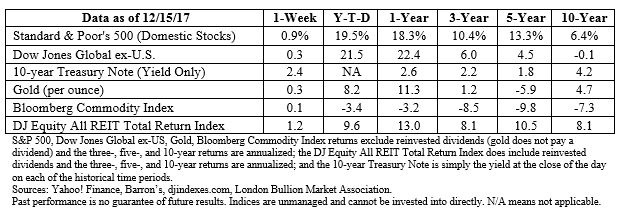
 

HERE’S ANOTHER REASON TO LIKE EMERGING MARKETS. The MSCI Emerging Markets Index was up more than 30 percent year-to-date late last week, outperforming national indices in most developed nations. (Remember, past performance is no indication of future results.) There may be more to like about emerging markets than 2017 performance, though, wrote Ben Inker in the latest GMO Quarterly letter:

“…if there is one group of equities that deals with inflation on a pretty much continuous basis, it is emerging equities…To be clear, our fondness for emerging equities today is driven overwhelmingly by their cheaper valuations…But if worse did come to worst and inflation flared up, owning a good chunk of the only equities that remember what inflation is like seems like a decent idea.”

Do you remember inflation?

In the 1970s, it was a household name. People wore WIN (Whip Inflation Now) buttons, earrings, sweaters, and other paraphernalia after President Ford declared inflation “public enemy number one.” The Great Inflation, as it was called, lasted from 1965 to 1982 with inflation rising above 14 percent in 1980.

While another Great Inflation isn’t expected, it’s likely inflation eventually will move higher. For most of the last decade, inflation in the United States has remained low. As economic activity picked up, late in 2016 and early in 2017, the pace of inflation increased and moved slightly above the Federal Reserve’s target level of 2 percent. Then, it dropped once again, reported Inker.

Goldman Sachs recently suggested “a sizable and relatively long-lasting drag from the earlier weakness in import and commodity prices…” is the reason for low inflation, and the company anticipates inflation will increase during 2018.

If inflation begins to move higher, the Federal Reserve is likely to continue to push interest rates higher. Higher interest rates translate into higher bond yields and that could affect investors by making investments with lower risk more attractive.

We hope you will enjoy a very happy holiday!

Weekly Focus – Think About It

“Inflation is when you pay fifteen dollars for the ten-dollar haircut you used to get for five dollars when you had hair.”
--Sam Ewing, American baseball player

* These views are those of Carson Group Coaching, and not the presenting Representative or the Representative’s Broker/Dealer, and should not be construed as investment advice.
* This newsletter was prepared by Carson Group Coaching. Carson Group Coaching is not affiliated with the named broker/dealer.
* Government bonds and Treasury Bills are guaranteed by the U.S. government as to the timely payment of principal and interest and, if held to maturity, offer a fixed rate of return and fixed principal value. However, the value of fund shares is not guaranteed and will fluctuate.
* Corporate bonds are considered higher risk than government bonds but normally offer a higher yield and are subject to market, interest rate and credit risk as well as additional risks based on the quality of issuer coupon rate, price, yield, maturity, and redemption features.
* The Standard & Poor's 500 (S&P 500) is an unmanaged group of securities considered to be representative of the stock market in general. You cannot invest directly in this index.
* All indexes referenced are unmanaged. Unmanaged index returns do not reflect fees, expenses, or sales charges. Index performance is not indicative of the performance of any investment.
* The Dow Jones Global ex-U.S. Index covers approximately 95% of the market capitalization of the 45 developed and emerging countries included in the Index.
* The 10-year Treasury Note represents debt owed by the United States Treasury to the public. Since the U.S. Government is seen as a risk-free borrower, investors use the 10-year Treasury Note as a benchmark for the long-term bond market.
* Gold represents the afternoon gold price as reported by the London Bullion Market Association. The gold price is set twice daily by the London Gold Fixing Company at 10:30 and 15:00 and is expressed in U.S. dollars per fine troy ounce.
* The Bloomberg Commodity Index is designed to be a highly liquid and diversified benchmark for the commodity futures market. The Index is composed of futures contracts on 19 physical commodities and was launched on July 14, 1998.
* The DJ Equity All REIT Total Return Index measures the total return performance of the equity subcategory of the Real Estate Investment Trust (REIT) industry as calculated by Dow Jones.
* Yahoo! Finance is the source for any reference to the performance of an index between two specific periods.
* Opinions expressed are subject to change without notice and are not intended as investment advice or to predict future performance.
* Economic forecasts set forth may not develop as predicted and there can be no guarantee that strategies promoted will be successful.
* Past performance does not guarantee future results. Investing involves risk, including loss of principal.
* You cannot invest directly in an index.
* Stock investing involves risk including loss of principal.
* Consult your financial professional before making any investment decision.

Sources:
https://bankingjournal.aba.com/2017/12/house-senate-leaders-release-text-of-final-tax-reform-bill/
https://www.barrons.com/articles/outlook-2018-the-bull-markets-next-act-1512796307 (or go to https://s3-us-west-2.amazonaws.com/peakcontent/+Peak+Commentary/12-18-17_Barrons-Outlook_2018-The_Bull_Markets_Next_Act-Footnote_2.pdf)
https://am.jpmorgan.com/us/en/asset-management/gim/adv/insights/will-value-catch-up-with-growth
https://www.cnbc.com/2017/12/13/bonds-and-fixed-income-data-fed-meeting-decision-tax-plan-on-the-agenda-for-investors.html
https://finance.yahoo.com/quote/%5ETNX/history?p=%5ETNX
https://www.cnbc.com/2017/12/13/tax-reform-helping-boost-economic-growth-outlook-yellen-says.html
https://www.msci.com/end-of-day-data-search (or go to https://s3-us-west-2.amazonaws.com/peakcontent/+Peak+Commentary/12-18-17_MSCI-Emerging_Markets_as_of_12-15-17-Footnote_7.pdf)
https://www.gmo.com/docs/default-source/public-commentary/gmo-quarterly-letter.pdf?sfvrsn=48
https://www.fordlibrarymuseum.gov/museum/ArtifactCollectionSamples/WIN.html
https://www.federalreservehistory.org/essays/great_inflation
https://www.blackrock.com/ch/individual/en/literature/whitepaper/bii-navigating-markets-in-2017-broadening-reflation-en-whitepaper.pdf
http://www.goldmansachs.com/our-thinking/pages/macroeconomic-insights-folder/2018-global-economic-outlook-as-good-as-it-gets/report.pdf
https://www.brainyquote.com/quotes/sam_ewing_103896?src=t_inflation
December 11th Market Commentary

December 11, 2017

The Markets 

“It's the hap- happiest season of all.”

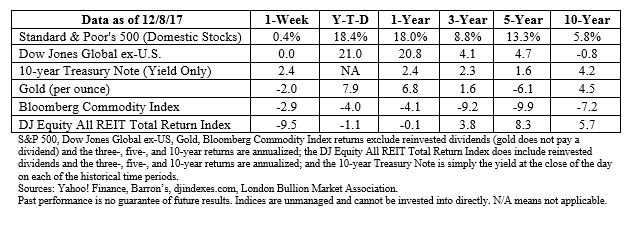
While holidays don’t make everyone happy, investors should be feeling festive. The Standard & Poor’s 500 Index is up more than 18 percent year-to-date. The Dow Jones Global ex U.S. Index is up about 21 percent year-to-date (refer to the table), and Treasury bond yields are lower than they were at the start of the year.

In addition, the CBOE Volatility Index (VIX), a measure of how unpredictable investors expect the S&P 500 Index to be over the short-term, finished the week below 10. A low VIX reading means investors expect calm markets through the end of the year.

Some are wary of the optimism that pervades markets, though. Barron’s wrote:

“In fact, everything’s going well right now – really well…The Citigroup U.S. Economic Surprise Index – a metric designed to measure the extent to which economic data have been beating or missing expectations – is near its highest level since January 2014, a sign of just how smoothly everything’s been going. The problem is that once the data have been surprising by this much, for this long, it gets hard for good news to provide much more of a boost…”

There was a disappointing piece of economic news last week concerning wages. Unemployment has fallen to a 17-year low (4.1 percent), and unemployment in the manufacturing sector is at 2.6 percent, an all-time low. It appears demand for labor is high and supply is low. That should translate into higher wages, but it hasn’t yet. Average hourly earnings are up 2.5 percent year-on-year. That’s an improvement on October, but not much of one.

A lot of folks are scratching their heads wondering when inflation is going to move higher. The Fed has been expecting it to happen for a while. Maybe 2018 will be the year. 


ARE YOU CONCERNED ABOUT HUMAN OBSOLESCENCE? Researchers from the University of Oxford and Yale University asked experts at several artificial intelligence (AI) conferences how long it would be before machines became better than humans at various tasks. The answers weren’t encouraging.

Overall, researchers think there is a 50 percent chance that AI will outperform humans at all tasks within 45 years. They also said it’s possible many jobs humans do now will be automated within 120 years. Asian survey participants expect the change to happen more quickly than North American participants do.

Wondering if this might affect you? Here are a few of the time frames as determined by averaging survey participants’ answers. Machines may be better at: 

• Translating languages by 2024 
• Writing high-school essays by 2026 (Would this be cheating?)
• Driving trucks by 2027 
• Working in retail by 2031 
• Writing bestselling books by 2049 
• Working as surgeons by 2053 

While the idea of human employment prospects becoming more limited is disturbing, there is still time to capitalize on shorter-term opportunities. For example, eSports is a booming industry. FactSet reported, “Last year’s League of Legends World Championship sold out the Los Angeles Staples Center in less than an hour…an additional 43 million tuned in online – for context, the 2016 NBA Finals Game 7 broke records with 30 million viewers…” The League of Legends champions took home about $1.5 million in 2017. 

If you can’t picture yourself encouraging your loved ones to spend hours playing video games, perhaps an online or bricks and mortar eSports store is an option. According to reports from Statista, the eSports market is growing 40 percent year-over-year globally and is expected to generate about $1.5 billion by 2020. 

Weekly Focus – Think About It
“Gamers always believe that an epic win is possible and that it's always worth trying, and trying now. Gamers don't sit around.”
--Jane McGonigal, American game designer and author

* These views are those of Carson Group Coaching, and not the presenting Representative or the Representative’s Broker/Dealer, and should not be construed as investment advice.
* This newsletter was prepared by Carson Group Coaching. Carson Group Coaching is not affiliated with the named broker/dealer.
* Government bonds and Treasury Bills are guaranteed by the U.S. government as to the timely payment of principal and interest and, if held to maturity, offer a fixed rate of return and fixed principal value.  However, the value of fund shares is not guaranteed and will fluctuate.
* Corporate bonds are considered higher risk than government bonds but normally offer a higher yield and are subject to market, interest rate and credit risk as well as additional risks based on the quality of issuer coupon rate, price, yield, maturity, and redemption features.
* The Standard & Poor's 500 (S&P 500) is an unmanaged group of securities considered to be representative of the stock market in general. You cannot invest directly in this index.
* All indexes referenced are unmanaged. Unmanaged index returns do not reflect fees, expenses, or sales charges. Index performance is not indicative of the performance of any investment.
* The Dow Jones Global ex-U.S. Index covers approximately 95% of the market capitalization of the 45 developed and emerging countries included in the Index.
* The 10-year Treasury Note represents debt owed by the United States Treasury to the public. Since the U.S. Government is seen as a risk-free borrower, investors use the 10-year Treasury Note as a benchmark for the long-term bond market.
* Gold represents the afternoon gold price as reported by the London Bullion Market Association. The gold price is set twice daily by the London Gold Fixing Company at 10:30 and 15:00 and is expressed in U.S. dollars per fine troy ounce.
* The Bloomberg Commodity Index is designed to be a highly liquid and diversified benchmark for the commodity futures market. The Index is composed of futures contracts on 19 physical commodities and was launched on July 14, 1998.
* The DJ Equity All REIT Total Return Index measures the total return performance of the equity subcategory of the Real Estate Investment Trust (REIT) industry as calculated by Dow Jones.
* Yahoo! Finance is the source for any reference to the performance of an index between two specific periods.
* Opinions expressed are subject to change without notice and are not intended as investment advice or to predict future performance.
* Economic forecasts set forth may not develop as predicted and there can be no guarantee that strategies promoted will be successful.
* Past performance does not guarantee future results. Investing involves risk, including loss of principal.
* You cannot invest directly in an index.* Stock investing involves risk including loss of principal.
* Consult your financial professional before making any investment decision.

Sources:
http://www.metrolyrics.com/its-the-most-wonderful-time-of-the-year-lyrics-andy-williams.html
https://finance.yahoo.com/quote/^TNX?p=^TNX
https://finance.yahoo.com/quote/^VIX?p=^VIX
http://www.cboe.com/products/vix-index-volatility/vix-options-and-futures/vix-index
https://www.barrons.com/articles/what-could-go-wrong-1512793294 (or go to https://s3-us-west-2.amazonaws.com/peakcontent/+Peak+Commentary/12-11-17_Barrons-What_Could_Go_Wrong-Footnote_4.pdf)
https://www.washingtonpost.com/business/economy/2017/12/08/274e325e-dc4d-11e7-b859-fb0995360725_story.html?utm_term=.3e715acdfa52
http://fortune.com/2017/11/27/william-dudley-federal-reserve-inflation/
https://www.technologyreview.com/s/607970/experts-predict-when-artificial-intelligence-will-exceed-human-performance/
https://insight.factset.com/gaming-the-system-a-market-view-of-esports
http://www.lolesports.com/en_US/articles/update-fan-contribution-worlds-2017-prize-pool
https://www.statista.com/statistics/490522/global-esports-market-revenue/
https://www.brainyquote.com/quotes/jane_mcgonigal_560557?src=t_gamers

Weekly Market Commentary

December 4, 2017

The Markets 

What will it take to shake investors’ confidence?

From the perspective of unsettling events, last week was jam-packed. North Korea claimed to have the capability to strike the United States with a nuclear missile, tax reform continued to travel a controversial path through the House and Senate, and former national security adviser Michael Flynn pled guilty to lying to the FBI about conversations with Russia's ambassador.

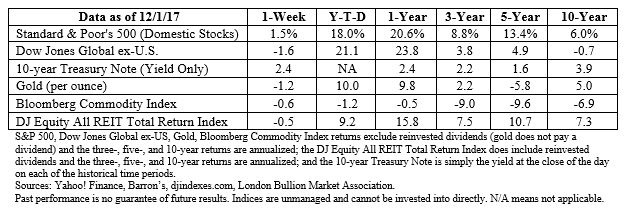
U.S. stock markets weren’t immune to these events and some lost value. However, the Dow Jones Industrial Average and the Standard & Poor’s 500 Index didn’t stay down for long. Both indices finished the week higher.

Barron’s reported black-box trading may have been the reason “…the Dow shed 400 points from peak to trough in a matter of minutes. The drop happened so quickly that some opined that humans couldn’t have been responsible for the tumble. ‘No way real traders were moving that fast,’ says Andrew Brenner, head of international fixed income securities at NatAlliance Securities. ‘Clearly, it was algorithms taking over.’”

Investor sentiment remained largely undented. The AAII Sentiment Survey showed slightly more investors were bullish near week’s end than had been the previous week. Bearishness was also up, gaining 2.6 percent. Fewer investors were neutral about markets. Despite an increase in bullish sentiment, the level was below the historic average for bullishness for the 39th time in 2017. (The AAII survey runs from Thursday to Thursday, so it did not reflect any changes in sentiment that may have occurred after reports of Michael Flynn’s indictment and cooperation with special investigators.)

The CNN/Money Fear & Greed Index is an investor sentiment gauge that relies on seven market indicators – stock price momentum, strength, and breadth, put and call options, junk bond demand, market volatility, and safe haven demand – to measure whether fear or greed is driving the market. Last week, the needle was in the Greed range, as it has been for some time.


RETIREMENT REQUIREMENTS. For a number of years, policymakers have been focused on finding ways to help Americans become better financially prepared for retirement. Studies have found having access to payroll-deduction retirement savings plans at work makes it 15 times more likely Americans will save for the future. Consequently, policymakers have focused their attention on smaller companies. About 36 percent of Americans work for companies with fewer than 100 employees, and many of these businesses do not offer retirement plans.

Last July, Oregon launched OregonSaves, the state’s auto-IRA program. Companies that don’t have workplace retirement plans are required to facilitate the program by:

• Providing information to set up Roth IRA accounts for employees
• Making payroll deductions to the Roth accounts 
• Delivering updated employee information California, Connecticut, Illinois, Maryland, and Massachusetts are working on similar programs.

Some business owners have embraced the auto-IRA opportunity, while others object to having the government involved. A Pew Charitable Trusts survey of 1,600 small and mid-sized business owners found 51 percent would prefer to sponsor their own retirement plans rather than participate in a state-run plan.

Many employers who participated in focus groups were not aware low-cost retirement plan options are available in the marketplace. Pew researchers noted:

“Most [small and medium-sized employers] did not have a full understanding of how 401(k) plans work, and few were familiar with plans or incentives designed for small businesses, such as the Simplified Employee Pension (SEP) Plan, the Savings Incentive Match Plan for Employees (SIMPLE), or the small employer tax credit for retirement plan startup costs.”

If you’re interested in learning more about retirement plan options for small businesses, sole proprietorships, or freelancers, contact your financial professional.

Weekly Focus – Think About It 

“Humanity is a lot like me. It’s an aging movie star, grappling with all the newness around it, wondering whether it got it right in the first place and still trying to find a way to keep on shining regardless.”
--Shah Rukh Khan, Indian film actor

* These views are those of Carson Group Coaching, and not the presenting Representative or the Representative’s Broker/Dealer, and should not be construed as investment advice.
* This newsletter was prepared by Carson Group Coaching. Carson Group Coaching is not affiliated with the named broker/dealer.
* Government bonds and Treasury Bills are guaranteed by the U.S. government as to the timely payment of principal and interest and, if held to maturity, offer a fixed rate of return and fixed principal value.  However, the value of fund shares is not guaranteed and will fluctuate.
* Corporate bonds are considered higher risk than government bonds but normally offer a higher yield and are subject to market, interest rate and credit risk as well as additional risks based on the quality of issuer coupon rate, price, yield, maturity, and redemption features.
* The Standard & Poor's 500 (S&P 500) is an unmanaged group of securities considered to be representative of the stock market in general. You cannot invest directly in this index.
* All indexes referenced are unmanaged. Unmanaged index returns do not reflect fees, expenses, or sales charges. Index performance is not indicative of the performance of any investment.
* The Dow Jones Global ex-U.S. Index covers approximately 95% of the market capitalization of the 45 developed and emerging countries included in the Index.
* The 10-year Treasury Note represents debt owed by the United States Treasury to the public. Since the U.S. Government is seen as a risk-free borrower, investors use the 10-year Treasury Note as a benchmark for the long-term bond market.
* Gold represents the afternoon gold price as reported by the London Bullion Market Association. The gold price is set twice daily by the London Gold Fixing Company at 10:30 and 15:00 and is expressed in U.S. dollars per fine troy ounce.
* The Bloomberg Commodity Index is designed to be a highly liquid and diversified benchmark for the commodity futures market. The Index is composed of futures contracts on 19 physical commodities and was launched on July 14, 1998.
* The DJ Equity All REIT Total Return Index measures the total return performance of the equity subcategory of the Real Estate Investment Trust (REIT) industry as calculated by Dow Jones.
* Yahoo! Finance is the source for any reference to the performance of an index between two specific periods.
* Opinions expressed are subject to change without notice and are not intended as investment advice or to predict future performance.* Economic forecasts set forth may not develop as predicted and there can be no guarantee that strategies promoted will be successful.
* Past performance does not guarantee future results. Investing involves risk, including loss of principal.
* You cannot invest directly in an index.* Stock investing involves risk including loss of principal.

Sources:
http://www.cnn.com/2017/11/28/politics/north-korea-missile-launch/index.html
https://www.forbes.com/sites/kellyphillipserb/2017/12/02/senate-republicans-get-a-big-win-on-tax-reform/#119cd9ba2545 
http://www.cnn.com/2017/12/01/politics/michael-flynn-charged/index.html
https://www.barrons.com/articles/washington-whipsaws-the-market-1512186612 (or go to https://s3-us-west-2.amazonaws.com/peakcontent/+Peak+Commentary/12-04-17_Barrons-Washington_Whipsaws_the_Market-Footnote_4.pdf)
http://www.aaii.com/sentimentsurveyhttp://money.cnn.com/data/fear-and-greed/
https://www.aarp.org/ppi/info-2017/Access-to-Workplace-Retirement-Plans-by-Race-and-Ethnicity.html
https://www.bls.gov/web/cewbd/table_f.txt
http://www.pewtrusts.org/~/media/assets/2016/01/retirement_savings_report_jan16.pdf?la=en (Page 9)
https://employer.oregonsaves.com/home.html
https://www.segalco.com/media/3139/medicaid-savings-infographic.pdf
http://www.pewtrusts.org/en/research-and-analysis/issue-briefs/2017/01/small-business-views-on-retirement-savings-plans
http://www.pewtrusts.org/en/research-and-analysis/issue-briefs/2016/09/business-owners-perspectives-on-workplace-retirement-plans-and-state-proposals-to-boost-savings
https://blog.ted.com/the-quest-for-love-and-compassion-shah-rukh-khan-speaks-at-ted2017/