
February 20th Market Commentary

February 19, 2018

The Markets

As New York Fashion Week ended, inflation strutted its stuff. 

Ever since the Federal Reserve began raising the Fed funds rate in 2015, analysts have been anticipating higher inflation. The fact that price increases remained relatively small was a perplexing mystery. Then, last week, inflation increased faster than expected.

The Bureau of Labor Statistics reported the Consumer Price Index (CPI), one measure of inflation, rose 0.5 percent in January. As you might expect, the cost of some items rose faster than others. For example, energy costs rose by 3.0 percent, while the cost of food was up 0.2 percent. In total, during the last 12 months, the all-items index rose 2.1 percent. When food and energy are excluded, the increase was 1.8 percent.

Barron’s reported, “Leaving aside the month-to-month squiggles, the real story is that inflation is closing in on the Fed’s 2 percent target…And even if January’s rise in the CPI was overstated, a real cyclical uptrend is under way…Deflation in the prices of consumer goods we like to buy is ending; the rate of increase in the cost of things we have to buy either is rising, as for food and energy, or remains high, as for services or rent.”

Higher prices are one side of the inflation coin; the other side is higher interest rates. Inflation is one of the data points the Federal Reserve considers when determining how well the economy is performing. Rising inflation signals a robust economy. That may encourage the Fed to raise rates more aggressively during 2018 to prevent the economy from overheating. The possibility of more concerted Fed tightening helped bump U.S. treasury rates higher last week.

Higher interest rates could become a boon for income-oriented investors. For years, persistently low rates have caused some investors to accept higher risk than they might have otherwise. As interest rates move higher, there may be opportunities to reduce portfolio risk and still generate attractive levels of income.

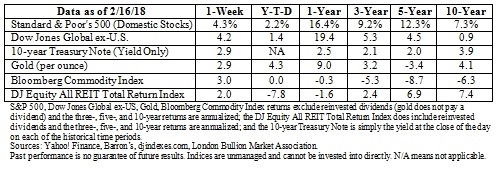
Despite inflation-inspired volatility mid-week, stock markets around the world moved higher. In the United States, major indices once again moved into positive territory for 2018.
  

RIDICULOUS? SILLY? STRANGE? SOME IDEAS MAY SEEM THAT WAY. Albert Einstein is famous for having said, “If at first the idea is not absurd, then there is no hope for it.” In recent weeks, Fast Company has reported on some “world-changing ideas,” including:

• Teaching happiness in school. The mandate of a school being built in India will be teaching children how to be happy. One of the co-founders said, “It’s our view that happiness – or emotional intelligence, or balance, or confidence, or self-esteem, or any other word for feeling good about ourselves and our place in the world – is the foundation on which great lives and great achievements are built.”

• Cancelling student debt. “Collectively, [Americans] owe nearly $1.4 trillion on outstanding student loan debt. Research shows that this level of debt hurts the U.S. economy in a variety of ways, holding back everything from small business formation to new home buying, and even marriage and reproduction,” according to a February report from the Levy Economics Institute at Bard College.

The research estimates if the U.S. government purchased and cancelled student loan debt the U.S. economy would increase real gross domestic product – the value of all goods and services produced – by $861 billion to $1,083 billion over 10 years. Also, the step could lead to the creation of more than a million new jobs every year.

• Revitalizing Haiti with blockchain. The details are still being hammered out, but the Blockchain Cotton Project hopes to use distributed digital ledgers (blockchain) to manage supply chains, making it easier and less expensive to source organic cotton. One member of the project said, “We’re still figuring out how the farmers do the live reporting. But we hope it will replace the normal organic or fair trade certification through a radical transparency approach.”
What do you think? Do they pass the absurdity test? Or are these ideas too tame? 

Weekly Focus – Think About It 

“The function of education is to teach one to think intensively and to think critically. Intelligence plus character – that is the goal of true education.”
--Martin Luther King, Jr., American Baptist minister and activist

* These views are those of Carson Group Coaching, and not the presenting Representative or the Representative’s Broker/Dealer and should not be construed as investment advice.
* This newsletter was prepared by Carson Group Coaching. Carson Group Coaching is not affiliated with the named broker/dealer.
* Government bonds and Treasury Bills are guaranteed by the U.S. government as to the timely payment of principal and interest and, if held to maturity, offer a fixed rate of return and fixed principal value.  However, the value of fund shares is not guaranteed and will fluctuate.
* Corporate bonds are considered higher risk than government bonds but normally offer a higher yield and are subject to market, interest rate and credit risk as well as additional risks based on the quality of issuer coupon rate, price, yield, maturity, and redemption features.
* The Standard & Poor's 500 (S&P 500) is an unmanaged group of securities considered to be representative of the stock market in general. You cannot invest directly in this index.
* All indexes referenced are unmanaged. Unmanaged index returns do not reflect fees, expenses, or sales charges. Index performance is not indicative of the performance of any investment.
* The Dow Jones Global ex-U.S. Index covers approximately 95% of the market capitalization of the 45 developed and emerging countries included in the Index.
* The 10-year Treasury Note represents debt owed by the United States Treasury to the public. Since the U.S. Government is seen as a risk-free borrower, investors use the 10-year Treasury Note as a benchmark for the long-term bond market.
* Gold represents the afternoon gold price as reported by the London Bullion Market Association. The gold price is set twice daily by the London Gold Fixing Company at 10:30 and 15:00 and is expressed in U.S. dollars per fine troy ounce.
* The Bloomberg Commodity Index is designed to be a highly liquid and diversified benchmark for the commodity futures market. The Index is composed of futures contracts on 19 physical commodities and was launched on July 14, 1998.
* The DJ Equity All REIT Total Return Index measures the total return performance of the equity subcategory of the Real Estate Investment Trust (REIT) industry as calculated by Dow Jones.
* Yahoo! Finance is the source for any reference to the performance of an index between two specific periods.
* Opinions expressed are subject to change without notice and are not intended as investment advice or to predict future performance.
* Economic forecasts set forth may not develop as predicted and there can be no guarantee that strategies promoted will be successful.
* Past performance does not guarantee future results. Investing involves risk, including loss of principal.
* You cannot invest directly in an index.
* Stock investing involves risk including loss of principal.
* Consult your financial professional before making any investment decision.

Sources:
https://www.cnbc.com/2018/02/14/us-consumer-price-index-jan-2018.html
http://fortune.com/2017/12/28/us-inflation-economists-2017/
https://www.bls.gov/news.release/cpi.nr0.htm
https://www.barrons.com/articles/the-ghost-of-inflation-reappears-1518837372 (or go to https://s3-us-west-2.amazonaws.com/peakcontent/+Peak+Commentary/02-20-18_Barrons-The_Ghost_of_Inflation_Reappears-Footnote_4.pdf)
https://finance.yahoo.com/quote/%5ETNX/history?p=%5ETNX
https://www.globalbankingandfinance.com/tighter-monetary-policy-will-put-brake-on-corporate-profits/
http://www.barrons.com/mdc/public/page/9_3063-economicCalendar.html (Click on U.S. & Intl Recaps, “Equities regain composure,” scroll down to “Global Stock Market Recap” chart) (or go to https://s3-us-west-2.amazonaws.com/peakcontent/+Peak+Commentary/02-20-18_Barrons-Global_Stock_Market_Recap-Footnote_7.pdf)
https://wordplay.blogs.nytimes.com/2013/12/10/whats-taken-home/
https://www.fastcompany.com/section/world-changing-ideas
https://www.fastcompany.com/40528502/this-school-focuses-on-teaching-students-happiness-not-math
http://www.levyinstitute.org/pubs/rpr_2_6.pdf (Pages 6 and 50)
https://www.fastcompany.com/40525347/timberland-is-helping-rebuild-haitis-cotton-industry
https://www.brainyquote.com/quotes/martin_luther_king_jr_402936
February 12th Market Commentary

February 12, 2018

The Markets

Back to reality...

After months of eerie calm, stock market volatility has returned. The CBOE Volatility Index (VIX) – a measure of how turbulent investors expect stock markets to be during the next 30 days – appeared to fall asleep in November 2016. For more than a year, a level of serenity that is rarely associated with stock markets prevailed and U.S. share prices moved steadily higher.

It appears that time is behind us. Barron’s wrote:

“With February’s swift stock market correction, volatility has arrived and will probably stay awhile. The downturn last week ended a streak of 404 trading days without a 5 percent drop in stock prices from the previous high – the longest such streak in market history.

The last correction came in February 2016, when stocks dropped 15 percent. Investors then fretted that Chinese economic growth might be slowing, which turned out to be a false alarm. Long term, the latest nose dive might yet become just a bull speed bump, but there’s already been plenty of pain.”

So, is this a speed bump or is it the beginning of a bear market? A bear market, generally, is a decline of 20 percent or more, and it is normally accompanied by a recession, which is a significant decline in economic activity.

In general, financial firms and publications do not anticipate a recession in 2018, but forecasting recessions can be challenging.

No matter what happens, the key is keeping your head. At times like these, emotion grabs investors by the throat, and it can be difficult to recall markets and economies tend to move in cycles. Historically, bull markets lead to bear markets, which lead to bull markets. Likewise, economic expansions are followed by contractions (recessions), which are followed by expansions.

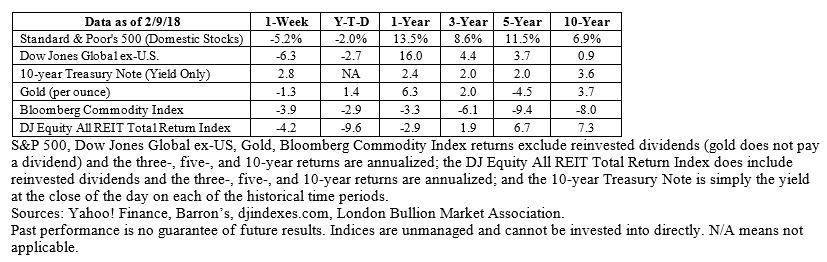
U.S. stock markets rallied on Friday, but the Standard & Poor’s 500 Index, Dow Jones Industrial Index, and NASDAQ all finished the week more than 5 percent lower.


MARKET DOWNTURNS ARE NOT A DESTINATION. Markets and economies are cyclical. For instance, from 1945 through 2009 (the start of the current expansion), the United States experienced 11 economic cycles. The average recession lasted for about 11 months and the average expansion persisted for about 58 months, reported the National Bureau for Economic Research.

After the recent market decline, many people are concerned the bull market may have run its course, and a bear market may be ahead. Since bear markets usually mark the beginning of recessions, let’s take a look at what some leading financial companies and publications have to say about their expectations for 2018:

“The U.S. expansion is on course to become the longest on record, stirring concerns it is about to run out of steam. But is it? The recently enacted tax overhaul and higher federal spending could add 0.8 percentage point to U.S. GDP growth in 2018, we estimate. This could tip the balance toward accelerating growth. Such a boost could shorten the cycle’s expiration date to two or three years.”
--BlackRock Investment Institute, February 7, 2018

“Most analysts think that while profits are growing and the economy is healthy, the stock market will be supported. But there is scope for a lot more choppiness as investors await the Federal Reserve’s rate decisions and look for data to indicate whether inflationary pressures are rising.”
--The Economist, February 8, 2018

“Perhaps the over-arching risk is complacency. While the current conjuncture might appear to be a sweet spot for the global economy, prudent policymakers must look beyond the near term…The next recession may be closer than we think, and the ammunition with which to combat it is much more limited than a decade ago, notably because public debts are so much higher.”
--IMF Blog, January 22, 2018

“While we expect volatility will be higher this year than in 2017, with company fundamentals looking solid and synchronized global economic growth set to continue, it seems reasonable to expect that stocks will move higher over the coming year.”
--J.P. Morgan Asset Management, February 5, 2018

“An overheating global economy could mean a more rapid shift by central banks to rein in stimulus, often a precursor to recession. Yet, we still believe a recession is not on the near-term horizon.”
--Schwab market commentary, February 9, 2018

Forecasting is a difficult task. Time will tell.

Weekly Focus – Think About It

“Stock market goes up or down, and you can't adjust your portfolio based on the whims of the market, so you have to have a strategy in a position and stay true to that strategy and not pay attention to noise that could surround any particular investment.”
--John Paulson, Investment manager

* These views are those of Carson Group Coaching, and not the presenting Representative or the Representative’s Broker/Dealer, and should not be construed as investment advice.
* This newsletter was prepared by Carson Group Coaching. Carson Group Coaching is not affiliated with the named broker/dealer.
* Government bonds and Treasury Bills are guaranteed by the U.S. government as to the timely payment of principal and interest and, if held to maturity, offer a fixed rate of return and fixed principal value. However, the value of fund shares is not guaranteed and will fluctuate.
* Corporate bonds are considered higher risk than government bonds but normally offer a higher yield and are subject to market, interest rate and credit risk as well as additional risks based on the quality of issuer coupon rate, price, yield, maturity, and redemption features.
* The Standard & Poor's 500 (S&P 500) is an unmanaged group of securities considered to be representative of the stock market in general. You cannot invest directly in this index.
* All indexes referenced are unmanaged. Unmanaged index returns do not reflect fees, expenses, or sales charges. Index performance is not indicative of the performance of any investment.
* The Dow Jones Global ex-U.S. Index covers approximately 95% of the market capitalization of the 45 developed and emerging countries included in the Index.
* The 10-year Treasury Note represents debt owed by the United States Treasury to the public. Since the U.S. Government is seen as a risk-free borrower, investors use the 10-year Treasury Note as a benchmark for the long-term bond market.
* Gold represents the afternoon gold price as reported by the London Bullion Market Association. The gold price is set twice daily by the London Gold Fixing Company at 10:30 and 15:00 and is expressed in U.S. dollars per fine troy ounce.
* The Bloomberg Commodity Index is designed to be a highly liquid and diversified benchmark for the commodity futures market. The Index is composed of futures contracts on 19 physical commodities and was launched on July 14, 1998.
* The DJ Equity All REIT Total Return Index measures the total return performance of the equity subcategory of the Real Estate Investment Trust (REIT) industry as calculated by Dow Jones.
* Yahoo! Finance is the source for any reference to the performance of an index between two specific periods.
* Opinions expressed are subject to change without notice and are not intended as investment advice or to predict future performance.
* Economic forecasts set forth may not develop as predicted and there can be no guarantee that strategies promoted will be successful.
* Past performance does not guarantee future results. Investing involves risk, including loss of principal.
* You cannot invest directly in an index.
* Stock investing involves risk including loss of principal.
* Consult your financial professional before making any investment decision.

Sources:
http://www.cboe.com/products/vix-index-volatility/vix-options-and-futures/vix-index/vix-faqs#1
https://www.barrons.com/articles/seat-belts-fastened-volatility-ahead-1518237935 (or go to https://s3-us-west-2.amazonaws.com/peakcontent/+Peak+Commentary/02-12-18_Barrons-Seat_Belts_Fastened-Volatility_Ahead-Footnote_2.pdf)
http://www.cboe.com/products/vix-index-volatility/vix-options-and-futures/vix-index/vix-historical-data (Click on “VIX data for 2004 to present (Updated Daily)”)
https://www.investopedia.com/terms/b/bullmarket.asp
http://country.eiu.com/article.aspx?articleid=1812501365&Country=United%20States&topic=Economy&subtopic=Forecast&subsubtopic=Economic+growth&u=1&pid=1173309701&oid=1173309701&uid=1http://country.eiu.com/article.aspx?articleid=1812501365&Country=United%20States&topic=Economy&subtopic=Forecast&subsubtopic=Economic+growth&u=1&pid=1173309701&oid=1173309701&uid=1
http://www.nber.org/cycles/cyclesmain.html
http://www.barrons.com/mdc/public/page/9_3063-economicCalendar.html (Click on U.S. & Intl Recaps, “A sea of red ink," then scroll down to the “Global Stock Market Recap” chart) (or go to https://s3-us-west-2.amazonaws.com/peakcontent/+Peak+Commentary/02-12-18_Barrons-Global_Stock_Market_Recap-Footnote_7.pdf)
https://www.blackrock.com/investing/insights/blackrock-investment-institute/market-selloff-february-2018
https://www.economist.com/blogs/economist-explains/2018/02/economist-explains-6 (or go to https://s3-us-west-2.amazonaws.com/peakcontent/+Peak+Commentary/02-12-18_TheEconomist-Why_Share_Prices_are_See-Sawing-Footnote_9.pdf)
https://blogs.imf.org/2018/01/22/the-current-economic-sweet-spot-is-not-the-new-normal/
https://am.jpmorgan.com/blob-gim/1383452890099/83456/weekly_market_recap.pdf?segment=AMERICAS_US_ADV&locale=en_US
https://www.schwab.com/resource-center/insights/content/market-perspective
https://www.brainyquote.com/quotes/john_paulson_863898

February 5th Market Commentary

February 5, 2018

The Markets

It was not a good week for stocks.

Last week, stock markets around the world lost value. In the United States, the Standard & Poor’s 500 Index (S&P 500), Dow Jones Industrial Index (Dow), and NASDAQ all finished lower.

Some pundits have been drawing comparisons between the performance of the Dow last Friday and Black Monday, the memorable day in 1987 when the index shed 508 points in a single day.

They may be barking up the wrong tree. 

Yes, the Dow lost more than 600 points on Friday. That was about 2.5 percent of its value. On Black Monday a lesser drop equated to a 22 percent loss for the Dow. In addition, Black Monday was widely attributed to program trading gone awry. The culprit behind last Friday’s fall is likely to be bonds, according to Barron’s.

Last week, the U.S. Treasury announced it would begin selling more short-term government bonds to fund the rising budget deficit. That sparked concerns about the impact of a bigger bond supply on interest rates. When bond supply exceeds demand, interest rates typically go up to attract investors. The United States already has ample bond supply since the Federal Reserve curtailed its bond buying program. Financial Times reported:

“Equity investing involves a delicate balance of three things: earnings, interest rates and valuation. Over the past decade, low long-term bond yields have played a crucial role in helping elevate equity valuations… ‘You have to consistently show economic and earnings growth to justify these valuations at higher rates,’ says Nicholas Colas, cofounder at DataTrek. ‘People forget how closely tied economic and profit growth is to rising rates – it is a horse race and profit growth has to win – even if just by a little.’”

News about employment and wage gains added fuel to the fire of investor worries. In January, the United States experienced its strongest wage growth since 2009. While that’s good news for workers, it may cause the Fed to raise rates more aggressively in an effort to keep inflation manageable.


WHAT DOES SUCCESS MEAN TO YOU? For some, having a big following on social media translates as success. NASA, which has more followers than any other government organization worldwide (28 million), may be considered successful. Of course, NASA doesn’t hold a candle to Katy Perry, who has close to 106 million followers.

It will surprise few to learn the U.S. Treasury, which manages the money resources of the United States, doesn’t have many followers (770,000); however, it has more than the Federal Reserve (446,000).

It’s almost enough to make you wonder whether Americans care about money. They do, but on a more personal level. A corporate survey, Making It in America, queried Americans about what it means to reach “…a level of success, comfort, and security that you find wholly satisfying.” As you might expect, there were a variety of answers.

One gauge of success is income, according to about two-thirds of the respondents. The group’s average income was $57,426 a year. They would know they’d ‘made it’ when they earned about $147,000 a year. According to CNBC, annual income of $150,000 would put many people in the middle class, depending on where they lived and the size of their households. It’s notable few people aspire to join the ranks of the wealthiest Americans. More than three-fourths said they would not want to earn more than one million dollars a year.

Of course, money is not the only measure of success. A Pew Research study found just 11 percent of those surveyed thought wealth was an essential part of the American dream. Far more important were:

• Freedom of choice in how to live (77 percent)
• Having a good family life (70 percent)
• Retiring comfortably (60 percent)
• Contributing to their communities (48 percent)
• Owning a home (43 percent)
• Having a successful career (43 percent)

One participant said, “Even though I truly believe that having money is freedom, money is really just a tool to make experiences in life possible.”

Weekly Focus – Think About It 

“You can’t reach for anything new if your hands are still full of yesterday’s junk.” 
--Louise Smith, NASCAR driver

* These views are those of Carson Group Coaching, and not the presenting Representative or the Representative’s Broker/Dealer, and should not be construed as investment advice.
* This newsletter was prepared by Carson Group Coaching. Carson Group Coaching is not affiliated with the named broker/dealer.
* Government bonds and Treasury Bills are guaranteed by the U.S. government as to the timely payment of principal and interest and, if held to maturity, offer a fixed rate of return and fixed principal value.  However, the value of fund shares is not guaranteed and will fluctuate.
* Corporate bonds are considered higher risk than government bonds but normally offer a higher yield and are subject to market, interest rate and credit risk as well as additional risks based on the quality of issuer coupon rate, price, yield, maturity, and redemption features.
* The Standard & Poor's 500 (S&P 500) is an unmanaged group of securities considered to be representative of the stock market in general. You cannot invest directly in this index.
* All indexes referenced are unmanaged. Unmanaged index returns do not reflect fees, expenses, or sales charges. Index performance is not indicative of the performance of any investment.
* The Dow Jones Global ex-U.S. Index covers approximately 95% of the market capitalization of the 45 developed and emerging countries included in the Index.
* The 10-year Treasury Note represents debt owed by the United States Treasury to the public. Since the U.S. Government is seen as a risk-free borrower, investors use the 10-year Treasury Note as a benchmark for the long-term bond market.
* Gold represents the afternoon gold price as reported by the London Bullion Market Association. The gold price is set twice daily by the London Gold Fixing Company at 10:30 and 15:00 and is expressed in U.S. dollars per fine troy ounce.
* The Bloomberg Commodity Index is designed to be a highly liquid and diversified benchmark for the commodity futures market. The Index is composed of futures contracts on 19 physical commodities and was launched on July 14, 1998.
* The DJ Equity All REIT Total Return Index measures the total return performance of the equity subcategory of the Real Estate Investment Trust (REIT) industry as calculated by Dow Jones.
* Yahoo! Finance is the source for any reference to the performance of an index between two specific periods.
* Opinions expressed are subject to change without notice and are not intended as investment advice or to predict future performance.
* Economic forecasts set forth may not develop as predicted and there can be no guarantee that strategies promoted will be successful.
* Past performance does not guarantee future results. Investing involves risk, including loss of principal.
* You cannot invest directly in an index.
* Stock investing involves risk including loss of principal.
* Consult your financial professional before making any investment decision.

Sources:
http://www.barrons.com/mdc/public/page/9_3063-economicCalendar.html (or go to https://s3-us-west-2.amazonaws.com/peakcontent/+Peak+Commentary/02-05-18_Barrons-Global_Stock_Market_Recap-Footnote_1.pdf
https://www.marketwatch.com/story/all-30-dow-stocks-fall-as-the-point-decline-exceeds-that-of-black-mondays-2018-02-02
https://www.investopedia.com/ask/answers/042115/what-caused-black-monday-stock-market-crash-1987.asp
https://www.barrons.com/articles/risk-roars-back-1517626616 (or go to https://s3-us-west-2.amazonaws.com/peakcontent/+Peak+Commentary/02-05-18_Barrons-Risk_Roars_Back-Footnote_4.pdf
https://www.ft.com/content/08f29ca6-07f3-11e8-9650-9c0ad2d7c5b5 (or go to https://s3-us-west-2.amazonaws.com/peakcontent/+Peak+Commentary/02-05-18_FinancialTimes-Stock_Bulls_Fret_that_Bad_News_Comes_in_Threes-Footnote_5.pdf
https://www.cnbc.com/2018/02/02/best-wage-growth-since-2009-spurs-talk-of-more-fed-rate-hikes.html
https://twittercounter.com/pages/100/government-organization
https://www.statista.com/statistics/273172/twitter-accounts-with-the-most-followers-worldwide/
https://www.treasury.gov/about/history/Pages/edu_history_brochure_index.aspx
https://twitter.com/ustreasury?lang=en
https://twitter.com/federalreserve
https://www.thermosoft.com/en-US/blog/making-it-in-america
https://www.cnbc.com/2018/01/18/heres-how-much-money-americans-think-you-need-to-have-made-it.html
https://www.cnbc.com/2017/12/01/american-dream-isnt-about-getting-rich.html
http://www.possibilityoftoday.com/2012/01/03/how-you-can-stop-letting-yesterdays-junk-get-in-the-way-of-todays-success/