
July 23rd Market Commentary

July 23, 2018

The Markets

Last week, there was some good news and some notable news.

Here’s the good news: Corporate earnings have been strong. As of July 20, 17 percent of the companies in the Standard & Poor’s 500 Index had reported second quarter results. More than 85 percent of those companies reported positive earnings surprises, according to FactSet, which means they earned more than expected.

“It appears the lower tax rate is more than offsetting the impact of rising costs, resulting in a record-level net profit margin for the index for the second quarter,” explained FactSet.

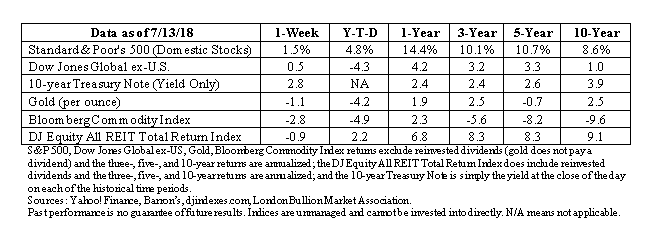
Here’s the notable news: U.S. stock markets largely ignored a slew of domestic and global issues to finish up a basis point or two last week. (Performance was flat when you round to one place, as we do in the table.) Barron’s reported:

“President Donald Trump took on the Federal Reserve, telling an interviewer that he’s ‘not happy’ about rising interest rates, the kind of meddling we haven’t seen in a while. We also had the usual trade war concerns, as the president and his advisors talked about the need to take on what they consider China’s unfair trade practices. China’s yuan, meanwhile, tumbled in a way that was a little too reminiscent of August 2015, when its slide caused global markets to shudder. Those concerns, however, were offset by strong corporate earnings.”

The U.S. bond market has been less sanguine than the U.S. stock market. Debate has focused on the flattening yield curve. The yield curve reflects the difference in yield on U.S. Treasuries from short- to long-term. Normally, investors expect to earn higher yields when they lend their money for longer periods of time (e.g. invest in longer-term bonds).

At the end of last week, two-year U.S. Treasuries yielded 2.6 percent and 30-year Treasuries yielded 3.0 percent. Some say when short-term rates rise above long-term rates, inverting the yield curve, recession is ahead.


FORWARD LOOKING CAREER: AIR BROKER. By 2050, about 70 percent of the world’s population is expected to live in cities, reports UNICEF.

The United States is ahead of the curve. Since the 1990s, 75 percent or more of Americans have lived in metropolitan areas. The same was true in Spain, the United Kingdom, Australia, and Canada. In 2000, citizens of Mexico, Korea, and Brazil were largely urban dwelling. By 2050, China and India are expected to have almost two billion people living in cities – and neither will have crossed the 75 percent level.

If the thought of densely packed cities inspires a bit of claustrophobia, you’re not alone. Anyone who has ever watched ‘Green Acres’ knows city living isn’t for everyone. However, cities are innovation engines, reports Fast Company. “The more people there are in an area, and the more densely they’re networked, the more startups get created and the more patents get filed.”

Consider the entrepreneurial example set by a New York City (NYC) deli owner who was trying to figure out how to stay in business on the Lower East Side of Manhattan. The answer was selling air, reports The Indicator From Planet Money:

“So when you buy a plot of land in New York, it comes with what are called ‘air rights.’ That essentially says how much you are allowed to build on that plot of land. Let’s say you buy a plot of land and it comes with 10 stories worth of air rights, you could build a 10-story building on it.”

The deli owned five stories worth of air rights, or 27,960.66 square feet of air. How much was all that air worth? Reportedly, a developer in New York paid about $17 million for it.

Guess who negotiates air deals in NYC.

That’s right: Air brokers.

Weekly Focus – Think About It

“Growth is inevitable and desirable, but destruction of community character is not. The question is not whether your part of the world is going to change. The question is how.”
--Edward T. McMahon, Author

* These views are those of Carson Group Coaching, and not the presenting Representative or the Representative’s Broker/Dealer, and should not be construed as investment advice.
* This newsletter was prepared by Carson Group Coaching. Carson Group Coaching is not affiliated with the named broker/dealer.
* Government bonds and Treasury Bills are guaranteed by the U.S. government as to the timely payment of principal and interest and, if held to maturity, offer a fixed rate of return and fixed principal value. However, the value of fund shares is not guaranteed and will fluctuate.
* Corporate bonds are considered higher risk than government bonds but normally offer a higher yield and are subject to market, interest rate and credit risk as well as additional risks based on the quality of issuer coupon rate, price, yield, maturity, and redemption features.
* The Standard & Poor's 500 (S&P 500) is an unmanaged group of securities considered to be representative of the stock market in general. You cannot invest directly in this index.
* All indexes referenced are unmanaged. Unmanaged index returns do not reflect fees, expenses, or sales charges. Index performance is not indicative of the performance of any investment.
* The Dow Jones Global ex-U.S. Index covers approximately 95% of the market capitalization of the 45 developed and emerging countries included in the Index.
* The 10-year Treasury Note represents debt owed by the United States Treasury to the public. Since the U.S. Government is seen as a risk-free borrower, investors use the 10-year Treasury Note as a benchmark for the long-term bond market.
* Gold represents the afternoon gold price as reported by the London Bullion Market Association. The gold price is set twice daily by the London Gold Fixing Company at 10:30 and 15:00 and is expressed in U.S. dollars per fine troy ounce.
* The Bloomberg Commodity Index is designed to be a highly liquid and diversified benchmark for the commodity futures market. The Index is composed of futures contracts on 19 physical commodities and was launched on July 14, 1998.
* The DJ Equity All REIT Total Return Index measures the total return performance of the equity subcategory of the Real Estate Investment Trust (REIT) industry as calculated by Dow Jones.
* Yahoo! Finance is the source for any reference to the performance of an index between two specific periods.
* Opinions expressed are subject to change without notice and are not intended as investment advice or to predict future performance.
* Economic forecasts set forth may not develop as predicted and there can be no guarantee that strategies promoted will be successful.
* Past performance does not guarantee future results. Investing involves risk, including loss of principal.
* You cannot invest directly in an index.
* Stock investing involves risk including loss of principal.
* Consult your financial professional before making any investment decision.
Sources:
https://insight.factset.com/hubfs/Resources%20Section/Research%20Desk/Earnings%20Insight/EarningsInsight_072018.pdf
https://www.investopedia.com/terms/e/earningssurprise.asp
https://www.barrons.com/articles/stocks-at-a-standstill-as-earnings-offset-tariffs-1532131202 (or go to https://s3-us-west-2.amazonaws.com/peakcontent/+Peak+Commentary/7-23-18_Barron's-Stocks_at_a_Standstill_as_Earnings_Offset_Tariffs-Footnote_3.pdf)
https://www.marketwatch.com/story/5-key-ways-wall-street-and-economists-think-about-the-yield-curve-2018-07-12
https://money.cnn.com/retirement/guide/investing_bonds.moneymag/index9.htm
https://www.treasury.gov/resource-center/data-chart-center/interest-rates/Pages/TextView.aspx?data=yield
https://www.unicef.org/sowc2012/urbanmap/# (Place cursor over the country to find country/population percentages.)
https://www.imdb.com/title/tt0058808/
https://www.fastcompany.com/1669244/by-2050-70-of-the-worlds-population-will-be-urban-is-that-a-good-thing
https://www.npr.org/sections/money/2018/07/20/630949390/the-market-for-air (Audio starts at 2:56)
http://www.myurbanist.com/archives/8160
 

July 17th Market Commentary

July 17, 2018

The Markets

Investors are becoming more discriminating.

Trade tensions escalated as the U.S. administration expanded tariffs on Chinese goods last week. You wouldn’t have known by watching the performance of benchmark indices, though. Just four of the 25 national stock market indices tracked by Barron’s – Australia, Italy, Spain, and Mexico – moved lower.

However, if you look a little deeper into the performance of various market sectors, you discover an important fact: The market tide wasn’t lifting all stocks.

It has been said a rising tide lifts all boats. When translated into stock-market speak, the saying becomes, ‘A rising market tide lifts all stocks.’ In other words, when the market moves higher, stocks tend to move higher, too. That wasn’t the case last week.

Barron’s reported investors have become more selective:

“We went from a market where everything moved largely together to one where sector fundamentals began to matter more than where the S&P 500 was going...At the sector level, it’s apparent that no one has been ignoring tariffs. While the S&P 500 has gained 1.7 percent over the past month of trading, industrials and materials have dropped 2.5 percent, while financials have slumped 2.9 percent, hit by a double whammy of trade fears and a flattening yield curve. Utilities and consumer staples have outperformed, gaining 8.1 percent and 3.5 percent, respectively.”

Utilities and Consumer Staples are considered to be non-cyclical or defensive sectors of the market because they are not highly correlated with the business cycle.

Defensive companies tend to perform consistently whether a country’s economy is expanding or in recession. For example, a household’s need for power, soap, and food doesn’t disappear during a recession. As a result, the revenues, earnings, and cash flows of defensive companies remain relatively stable in various economic conditions.

In addition, the share prices of these companies tend to be less susceptible to changing economic conditions. Defensive stocks tend to outperform the broader market during periods of recession and underperform it during periods of expansion.

WHAT ARE THE BIGGEST RISKS FOR RETIREMENT INVESTORS? If market risk, inflation risk, and interest rate risk were on the tip of your tongue, you need to update your list.

Recently, T. Rowe Price surveyed employers that make defined contribution plans, like 401(k) plans, available to their employees. The company asked plan sponsors to rank the risks they were most concerned about for the people who saved in the plan. The top concerns were:

42 percent = Longevity Risk. No one knows exactly how long they will live, which makes it difficult for plan participants (and anyone else planning for retirement) to be certain future retirees won’t outlive their savings. Longevity risk was among the top three risks listed by 95 percent of plan sponsors.

25 percent = Participant Behavioral Risk. “Left on their own, participants tend to take on either too much or too little risk by: failing to properly allocate and diversify their savings; overinvesting in company stock (or stable value/money market funds); neglecting to rebalance in response to market or life changes; and attempting to time the market,” explained T. Rowe Price.

14 percent = Downside Risk. This is the likelihood an investment will fall in price. For instance, stocks have higher return potential than Treasury bonds, and higher potential for loss. When planning for retirement, it’s important to balance the need for growth against the need to preserve assets.

If you would like to learn more about these risks and strategies that may help overcome them, give us a call.

Weekly Focus – Think About It

“Strategy without tactics is the slowest route to victory. Tactics without strategy is the noise before defeat.”
--Sun Tzu, Chinese general and military strategist

* These views are those of Carson Group Coaching, and not the presenting Representative or the Representative’s Broker/Dealer, and should not be construed as investment advice.
* This newsletter was prepared by Carson Group Coaching. Carson Group Coaching is not affiliated with the named broker/dealer.
* Government bonds and Treasury Bills are guaranteed by the U.S. government as to the timely payment of principal and interest and, if held to maturity, offer a fixed rate of return and fixed principal value. However, the value of fund shares is not guaranteed and will fluctuate.
* Corporate bonds are considered higher risk than government bonds but normally offer a higher yield and are subject to market, interest rate and credit risk as well as additional risks based on the quality of issuer coupon rate, price, yield, maturity, and redemption features.
* The Standard & Poor's 500 (S&P 500) is an unmanaged group of securities considered to be representative of the stock market in general. You cannot invest directly in this index.
* All indexes referenced are unmanaged. Unmanaged index returns do not reflect fees, expenses, or sales charges. Index performance is not indicative of the performance of any investment.
* The Dow Jones Global ex-U.S. Index covers approximately 95% of the market capitalization of the 45 developed and emerging countries included in the Index.
* The 10-year Treasury Note represents debt owed by the United States Treasury to the public. Since the U.S. Government is seen as a risk-free borrower, investors use the 10-year Treasury Note as a benchmark for the long-term bond market.
* Gold represents the afternoon gold price as reported by the London Bullion Market Association. The gold price is set twice daily by the London Gold Fixing Company at 10:30 and 15:00 and is expressed in U.S. dollars per fine troy ounce.
* The Bloomberg Commodity Index is designed to be a highly liquid and diversified benchmark for the commodity futures market. The Index is composed of futures contracts on 19 physical commodities and was launched on July 14, 1998.
* The DJ Equity All REIT Total Return Index measures the total return performance of the equity subcategory of the Real Estate Investment Trust (REIT) industry as calculated by Dow Jones.
* Yahoo! Finance is the source for any reference to the performance of an index between two specific periods.
* Opinions expressed are subject to change without notice and are not intended as investment advice or to predict future performance.
* Economic forecasts set forth may not develop as predicted and there can be no guarantee that strategies promoted will be successful.
* Past performance does not guarantee future results. Investing involves risk, including loss of principal.
* You cannot invest directly in an index.
* Stock investing involves risk including loss of principal.
* Consult your financial professional before making any investment decision.

Sources:
https://money.cnn.com/2018/07/11/news/economy/china-us-tariffs-list/index.html
http://www.barrons.com/mdc/public/page/9_3063-economicCalendar.html (Click on U.S. & Intl Recaps, then "Trade jitters cont'd") (or go to https://s3-us-west-2.amazonaws.com/peakcontent/+Peak+Commentary/07-16-18_Barrons-Global_Stock_Market_Recap-Footnote_2.pdf)
https://www.barrons.com/articles/nasdaq-hits-record-high-defying-tariffs-1531526401 (or go to https://s3-us-west-2.amazonaws.com/peakcontent/+Peak+Commentary/07-16-18_Barrons-NASDAQ_Hits_Record_High_Defying_Tariffs-Footnote_3.pdf)
https://www.investors.com/how-to-invest/investors-corner/follow-the-best-stocks-in-the-market/
https://www.investopedia.com/terms/d/defensivestock.asp
https://www4.troweprice.com/gis/content/dam/ide/articles/pdfs/2018/Q2/advancing-the-way-we-think-about-perceptions-of-risk.pdf
https://www.naic.org/cipr_topics/topic_longevity_risk.htm
https://www2.troweprice.com/rms/rps/Marketing/Assets/pdf/Portfolio%20Perf%20Analysis%20Paper%20022908%2005169-963.pdf
http://www.investinganswers.com/financial-dictionary/investing/downside-risk-2510
https://www.khorus.com/blog/14-inspirational-quotes-strategy-execution


July 9th Market Commentary

July 9, 2018

The Markets

What a rollercoaster of a quarter!

When it comes to the American Association of Individual Investors (AAII) Sentiment Survey, respondents tend to be more bullish than bearish about U.S. stock markets. The survey’s historical averages are:

• 38.5 percent bullish
• 31.0 percent neutral
• 30.5 percent bearish

As the second quarter of 2018 began, investors were feeling less optimistic than usual. (About 36.6 percent were bearish and 31.9 percent bullish.) Their outlook was informed by a variety of factors, according to an early April article in The New York Times, which said:

“First there was the risk that the economy might be growing too fast, which could prompt central banks to hike interest rates sooner than expected. Then there was the risk of a trade war ignited by the White House imposing tariffs on certain products, an action that quickly prompted countries like China to erect trade barriers of their own. Next came the threat of a government crackdown on technology companies, after revelations of their misuse of customer data.”

As the quarter progressed, investor optimism increased on signs of economic strength. In early June, CNBC reported the economy appeared to be “operating close to full employment, with an unemployment rate at 3.8 percent, inflation still hovering at or below 2 percent, and business and consumer confidence strong.”

Robust corporate earnings helped spur optimism, too. FactSet Insight wrote, “The S&P 500 reported earnings growth of 25 percent for the first quarter – the highest growth since Q3 2010.” In mid-June, the AAII survey showed 44.8 percent of respondents were feeling bullish, 21.7 percent were bearish, and 33.5 percent were neutral.

As talk of tariffs and trade wars resumed, investor optimism plummeted. By the end of June, just 27.9 percent of respondents were bullish and more than 39 percent reported they were feeling bearish. AAII explained:

“Many – but not all – individual investors anticipate continued volatility and/or think that the current political backdrop could have a further impact on the stock market. Trade policy is influencing some individual investors’ sentiment as well. While many approve of the Federal Reserve’s plan to continue gradually raising interest rates, some AAII members are concerned about the impact that rising rates will have. Also influencing sentiment are valuations, tax cuts, earnings growth, and economic growth.”

Despite a downturn in bullishness, major U.S. stock indices moved higher last week.


THERE’S A CARBON DIOXIDE (CO2) SHORTAGE. REALLY, IT’S TRUE. Many people agree the world has too much CO2. It’s the reason representatives from countries around the world signed the Paris Climate Agreement. They committed to “adopt green energy sources, cut down on climate change emissions, and limit the rise of global temperatures,” reported National Public Radio.

The effort has been less successful than many had hoped, according to the International Energy Association (IEA). After several years without increases, energy-related emission rose by 1.4 percent in 2017. That’s the rough equivalent of putting 170 million more cars on the road, reported Scientific American.

Emissions rose primarily in Asia, although the European Union (EU) saw increases, too. The biggest decline was in the United States. There’s a certain irony there, since President Trump announced he would withdraw from the agreement in June 2017, reported The Washington Post.

Despite realizing a 1.5 percent increase in emissions, the EU is experiencing a shortage of food-grade CO2. The Economist reported:

“Food-grade CO2 is a vital ingredient: it puts the fizz in carbonated drinks and beer, knocks out animals before slaughter and, as one of the gases inside packaging, delays meat and salad from going off. A shortage of the stuff has therefore created havoc in food makers’ supply chains.”

The EU’s food-grade CO2 is a harvested by-product of processes for making ammonia and other chemicals, reported The Economist. Three of Britain’s five ammonia plants have been closed because farmers are using less fertilizer, and CO2 does not deliver enough revenue to keep the plants running.

Let’s hope the shortage of CO2 doesn’t affect the supply of beverages available to World Cup fans.

Weekly Focus – Think About It

“My garden is an honest place. Every tree and every vine are incapable of concealment, and tell after two or three months exactly what sort of treatment they have had. The sower may mistake and sow his peas crookedly; the peas make no mistake, but come up and show his line.”
--Ralph Waldo Emerson

* These views are those of Carson Group Coaching, and not the presenting Representative or the Representative’s Broker/Dealer, and should not be construed as investment advice.
* This newsletter was prepared by Carson Group Coaching. Carson Group Coaching is not affiliated with the named broker/dealer.
* Government bonds and Treasury Bills are guaranteed by the U.S. government as to the timely payment of principal and interest and, if held to maturity, offer a fixed rate of return and fixed principal value. However, the value of fund shares is not guaranteed and will fluctuate.
* Corporate bonds are considered higher risk than government bonds but normally offer a higher yield and are subject to market, interest rate and credit risk as well as additional risks based on the quality of issuer coupon rate, price, yield, maturity, and redemption features.
* The Standard & Poor's 500 (S&P 500) is an unmanaged group of securities considered to be representative of the stock market in general. You cannot invest directly in this index.
* All indexes referenced are unmanaged. Unmanaged index returns do not reflect fees, expenses, or sales charges. Index performance is not indicative of the performance of any investment.
* The Dow Jones Global ex-U.S. Index covers approximately 95% of the market capitalization of the 45 developed and emerging countries included in the Index.
* The 10-year Treasury Note represents debt owed by the United States Treasury to the public. Since the U.S. Government is seen as a risk-free borrower, investors use the 10-year Treasury Note as a benchmark for the long-term bond market.
* Gold represents the afternoon gold price as reported by the London Bullion Market Association. The gold price is set twice daily by the London Gold Fixing Company at 10:30 and 15:00 and is expressed in U.S. dollars per fine troy ounce.
* The Bloomberg Commodity Index is designed to be a highly liquid and diversified benchmark for the commodity futures market. The Index is composed of futures contracts on 19 physical commodities and was launched on July 14, 1998.
* The DJ Equity All REIT Total Return Index measures the total return performance of the equity subcategory of the Real Estate Investment Trust (REIT) industry as calculated by Dow Jones.
* Yahoo! Finance is the source for any reference to the performance of an index between two specific periods.
* Opinions expressed are subject to change without notice and are not intended as investment advice or to predict future performance.
* Economic forecasts set forth may not develop as predicted and there can be no guarantee that strategies promoted will be successful.
* Past performance does not guarantee future results. Investing involves risk, including loss of principal.
* You cannot invest directly in an index.
* Stock investing involves risk including loss of principal.
* Consult your financial professional before making any investment decision.

Sources:
http://www.aaii.com/sentimentsurvey (or go to https://s3-us-west-2.amazonaws.com/peakcontent/+Peak+Commentary/07-09-18_AAII_Sentiment_Survey-Results_for_Week_Ending_7-4-2018-Footnote_1.pdf)
http://www.aaii.com/sentimentsurvey/sent_results (or go to https://s3-us-west-2.amazonaws.com/peakcontent/+Peak+Commentary/07-09-18_AAII_Sentiment_Survey-Past_Results-Footnote_2.pdf)
https://www.nytimes.com/2018/04/02/business/stock-markets-technology-trade.html
https://www.cnbc.com/2018/06/08/gdp-for-second-quarter-on-track-to-double-2018-full-year-pace-of-2017.html
https://insight.factset.com/earnings-insight-q118-by-the-numbers-infographic
https://www.npr.org/sections/thetwo-way/2017/06/01/531048986/so-what-exactly-is-in-the-paris-climate-accord
https://www.iea.org/geco/emissions/
https://www.scientificamerican.com/article/global-co2-emissions-rise-after-paris-climate-agreement-signed/
https://www.washingtonpost.com/news/energy-environment/wp/2018/06/01/trump-withdrew-from-the-paris-climate-plan-a-year-ago-heres-what-has-changed/?noredirect=on&utm_term=.c673c6f445ec
https://www.economist.com/business/2018/07/05/shortages-of-carbon-dioxide-in-europe-may-get-worse (or go to https://s3-us-west-2.amazonaws.com/peakcontent/+Peak+Commentary/07-09-18_TheEconomist-Shortages_of_Carbon_Dioxide_in_Europe_May_Get_Worse-Footnote_10.pdf)
https://books.google.com/books?id=YvyUAwAAQBAJ&printsec=frontcover&dq=The+heart+of+emerson%27s+journals&hl=en&sa=X&ved=0ahUKEwinmq3P2IrcAhXJx4MKHcu1DcoQ6AEIKTAA#v=onepage&q=The%20heart%20of%20emerson's%20journals&f=false (or go to https://s3-us-west-2.amazonaws.com/peakcontent/+Peak+Commentary/07-09-18_Book_Excerpt-The_Heart_of_Emersons_Journals-Footnote_11.pdf)