
October 15th Market Commentary

October 15, 2018

The Markets

Like an unexpected gust of wind that blows the hat off your head or flips your umbrella inside out, last week’s stock market performance startled investors.

Looking back, it’s easy to identify some of the factors that may have contributed to investors’ unease and shaken confidence in the markets. Ben Levisohn of Barron’s offered a brief rundown that included:

The yield on 10-year Treasuries rising to a seven-year high. As interest rates move higher, bonds become more attractive to investors who prefer to take less risk. They move money from stocks into bonds and that can push stock prices lower.
• Federal Reserve Chairman Jerome Powell suggesting the Fed funds target rate could move higher. Investors worry the Federal Reserve is too hawkish and will raise rates too high, too quickly, causing economic growth to stumble.
• A speech by Vice President Mike Pence indicating tensions with China may persist. Companies that export to China or manufacture goods in China are at risk if relations between China and the United States don’t improve. Poor relations could affect profits, share values, and economic growth.
• Earnings reports showing tariffs negatively affecting some companies’ profit margins. FactSet reported, “the term ‘tariff’ has been mentioned during the earnings calls of 12 S&P 500 companies to date, with six of these 12 companies citing a negative impact linked to tariffs.”
• The International Monetary Fund (IMF) lowering its economic growth projections. Concern about the impact of trade tensions on companies around the world led the IMF to lower some of its economic growth estimates for 2018, especially in Asia and emerging markets.

Some analysts believe a desire to take profits also helped fuel the downturn, according to Barron’s Randall W. Forsyth.

Whatever combination of events was responsible, the result was markets losing value on Wednesday and Thursday of last week before regaining some lost ground on Friday. Forsyth wrote, “What turned the U.S. markets around Friday – when the Dow and the S&P 500 managed to pop more than 1 percent and the NASDAQ Composite bounced over 2 percent – wasn’t much clearer than what set off the slide. Market Semiotics’ Woody Dorsey says that his proprietary sentiment polling found a bullish reading of absolute zero on Thursday, a contrarian indication that “panic” would be short-lived.”

While sharp drops in share values are never comfortable, it’s important to consider the bigger picture. A contributor to Bloomberg Opinion wrote, “This decline follows a market that has tripled since 2009, had zero volatility in 2017…This was the 20th time since the bear market ended in 2009 that the Standard & Poor’s 500 Index had a one-day loss of 3 percent. The NASDAQ-100 Index had its eighth 4 percent down day (although it was the biggest one-day fall since August 2011).”

In other words, selloffs are normal and we have experienced them before.

So, what should you take away from last week?

1. First, it was a reminder that stocks are volatile investments. They have the potential to deliver higher returns than other asset classes because they require investors to take higher levels of risk.

2. Second, stock market volatility is one reason we allocate assets and build well-diversified portfolios. Holding different asset classes and diverse investments within a portfolio can help reduce the sting of unwelcome surprises like a sharp drop in the value of stocks.

3. Worries about what the future may hold are likely to ruffle investors and we may see additional bouts of market volatility. The current bull market has been running for a long time. Some analysts anticipate recession and a bear market are ahead. As Barron’s reported, neither appears to be here yet:

Other leading indicators, including jobless claims and credit spreads, also held up. ‘I don’t see this all leading to recession,’ says Ed Yardeni, president of Yardeni Research. ‘And, without a recession, I don’t think we get a bear market.’”

No matter how intellectually rational these points seem, downturns tend to leave everyone feeling jittery and uncertain. So, take a moment. Think about your portfolio and how it was built to help you achieve your financial goals. Now, ask yourself:

• Have my goals changed?

• Has my risk tolerance changed?

If the answer to either of these questions is, ‘Yes,’ call us. We’ll sit down, review your goals and risk tolerance, and make sure your portfolio is structured appropriately.

We’re hoping for calmer markets ahead, but we may be in for a bumpy ride.


ON A LIGHTER NOTE…It’s important to recognize when daily challenges affect our ability to cope and take steps to lower stress when they do. The Mayo Clinic recommends laughter, “Whether you're guffawing at a sitcom on TV or quietly giggling at a newspaper cartoon, laughing does you good. Laughter is a great form of stress relief, and that's no joke.”

In the hope of offsetting some of last week’s stress, here is humor from F In Exams: The Very Best Totally Wrong Test Answers by Richard Benson:

Question: What is a vibration?
Answer: There are good vibrations and bad vibrations. Good vibrations were discovered in the 1960s.

Question: What happens when your body starts to age?
Answer: When you get old your organs work less effectively and you can become intercontinental.

Question: What is a fibula?
Answer: A little lie.

Question: Give three ways to reduce heat loss in your home.
Answer: 1) Thermal underwear; 2) Move to Hawaii; 3) Close the door.

Question: You are at a friend’s party. Six cupcakes are distributed among nine plates, and there is no more than one cake per plate. What is the probability of receiving a plate with a cake on it?
Answer: None, if my sister is invited too.

Question: Explain the dispersal of various farming types in the Midwest.
Answer: The cows and pigs are distributed in different fields so they don’t eat each other.

Question: Name six animals that live specifically in the Arctic.
Answer: Two polar bears Three Four seals

Sometimes, laughter is truly the best medicine.

Weekly Focus – Think About It

“In the business world, the rearview mirror is always clearer than the windshield.”
--Warren Buffett, American businessman, speaker, and philanthropist


* These views are those of Carson Group Coaching, and not the presenting Representative or the Representative’s Broker/Dealer, and should not be construed as investment advice.
* This newsletter was prepared by Carson Group Coaching. Carson Group Coaching is not affiliated with the named broker/dealer.
* There is no guarantee that a diversified portfolio will enhance overall returns or outperform a non-diversified portfolio. Diversification does not protect against market risk. Asset allocation does not ensure a profit or protect against a loss.
* Government bonds and Treasury Bills are guaranteed by the U.S. government as to the timely payment of principal and interest and, if held to maturity, offer a fixed rate of return and fixed principal value. However, the value of fund shares is not guaranteed and will fluctuate.* Government bonds and Treasury Bills are guaranteed by the U.S. government as to the timely payment of principal and interest and, if held to maturity, offer a fixed rate of return and fixed principal value. However, the value of fund shares is not guaranteed and will fluctuate.
* Corporate bonds are considered higher risk than government bonds but normally offer a higher yield and are subject to market, interest rate and credit risk as well as additional risks based on the quality of issuer coupon rate, price, yield, maturity, and redemption features.
* The Standard & Poor's 500 (S&P 500) is an unmanaged group of securities considered to be representative of the stock market in general. You cannot invest directly in this index.
* All indexes referenced are unmanaged. Unmanaged index returns do not reflect fees, expenses, or sales charges. Index performance is not indicative of the performance of any investment.
* The Dow Jones Global ex-U.S. Index covers approximately 95% of the market capitalization of the 45 developed and emerging countries included in the Index.
* The 10-year Treasury Note represents debt owed by the United States Treasury to the public. Since the U.S. Government is seen as a risk-free borrower, investors use the 10-year Treasury Note as a benchmark for the long-term bond market.
* Gold represents the afternoon gold price as reported by the London Bullion Market Association. The gold price is set twice daily by the London Gold Fixing Company at 10:30 and 15:00 and is expressed in U.S. dollars per fine troy ounce.
* The Bloomberg Commodity Index is designed to be a highly liquid and diversified benchmark for the commodity futures market. The Index is composed of futures contracts on 19 physical commodities and was launched on July 14, 1998.
* The DJ Equity All REIT Total Return Index measures the total return performance of the equity subcategory of the Real Estate Investment Trust (REIT) industry as calculated by Dow Jones.
* Yahoo! Finance is the source for any reference to the performance of an index between two specific periods.
* Opinions expressed are subject to change without notice and are not intended as investment advice or to predict future performance.
* Economic forecasts set forth may not develop as predicted and there can be no guarantee that strategies promoted will be successful.
* Past performance does not guarantee future results. Investing involves risk, including loss of principal.
* You cannot invest directly in an index.
* Stock investing involves risk including loss of principal.
* Consult your financial professional before making any investment decision.

Sources:
https://www.barrons.com/articles/heres-why-more-scares-are-ahead-for-the-stock-market-1539390914?mod=hp_LEAD_1 (or go to https://s3-us-west-2.amazonaws.com/peakcontent/+Peak+Commentary/10-15-18_Barrons-Heres_Why_More_Scares_are_Ahead_for_the_Stock_Market-Footnote_1.pdf)
https://www.wsj.com/articles/surging-yields-raise-threat-of-tipping-point-for-stocks-1538913600 (or go to https://s3-us-west-2.amazonaws.com/peakcontent/+Peak+Commentary/10-15-18_WSJ-Surging_Yields_Raise_Threat_of_Tipping_Point_for_Stocks-Footnote_2.pdf)
https://www.bloomberg.com/view/articles/2018-08-21/central-banks-are-too-hawkish
https://www.reuters.com/article/us-usa-trade-china/factbox-impact-of-u-s-china-trade-tariffs-on-u-s-companies-idUSKBN1KK23E
https://insight.factset.com/more-sp-500-companies-see-negative-impact-from-fx-than-tariffs-in-q3
https://www.imf.org/en/Publications/WEO/Issues/2018/07/02/world-economic-outlook-update-july-2018
https://www.barrons.com/articles/why-the-stock-market-went-loco-1539361320?mod=hp_LEAD_3 (or go to https://s3-us-west-2.amazonaws.com/peakcontent/+Peak+Commentary/10-15-18_Barrons-Why_the_Stock_Market_Went_Loco-Footnote_7.pdf)
https://www.bloomberg.com/view/articles/2018-10-11/the-stock-market-meltdown-that-everyone-saw-coming
https://www.mayoclinic.org/healthy-lifestyle/stress-management/in-depth/stress-relief/art-20044456
https://books.google.com/books/about/F_in_Exams.html?id=hei-i5QP_7UC (or go to https://s3-us-west-2.amazonaws.com/peakcontent/+Peak+Commentary/10-15-18_Book-F_in_Exams-Footnote_10.pdf)
https://www.brainyquote.com/quotes/warren_buffett_385064

 

October 8th Market Commentary

October 8, 2018

The Markets

The stock market tends to be a leading economic indicator.

Last week offered some insight to economics and stock market behavior. The U.S. unemployment rate reached its lowest level since 1969 and wages moved higher, yet major U.S. stock indices lost value.

Why didn’t stock markets move higher?

The answer is stock prices tend to be leading indicators. They reflect investors’ expectations for the future. Last week, investors may have been thinking like this:

When unemployment is low, companies cannot always hire enough workers…
To hire more workers, companies raise wages…
Higher wages give workers more spendable income…
More spendable income produces higher demand for goods and services…
Higher demand for goods and services leads to higher prices…
Higher prices (inflation) cause the Federal Reserve to increase the Fed funds rate…
An increase in the Fed funds rate pushes interest rates higher…
Higher interest rates make borrowing more expensive…
Higher borrowing costs may slow business spending…
Slower business spending may cause profits to fall…
Falling profits may cause investors to sell shares…
When investors sell shares, stock prices may drop.

In general, “…while it usually takes at least 12 months for any increase or decrease in interest rates to be felt in a widespread economic way, the market's response to a change (or news of a potential change) is often more immediate,” explained Mary Hall on Investopedia.com.

At the end of last week, 10-year Treasuries yielded 3.2 percent. Daniel Kruger of The Wall Street Journal reported, “U.S. government bond yields rose to their highest level in years Friday as investors reconsidered the strength of the U.S. economy while selling off stocks that could be hurt by higher borrowing costs.”

One way to manage stock market volatility is to have a well-allocated and diversified portfolio.


WHAT DO YOU THINK? Athletes who grew up playing pick-up games of baseball, kickball, basketball, street hockey, and other sports with neighborhood kids may have had some advantages they didn’t recognize.

A Brazilian research study, cited by Freakonomics Radio’s show Here’s Why You’re Not An Elite Athlete (Ep. 351), found children who played sports in unstructured environments showed more tactical creativity and tactical intelligence than children who played in structured environments.

In addition, playing multiple sports may be more beneficial than specializing in a single sport, at least when it comes to soccer.

A study by Manuel Hornig, Friedhelm Aust, and Arne Güllich reviewed the training of soccer players in Germany. Practice and play in the development of German top-level professional football players, which was published in the European Journal Of Sports Science, reported athletes who went on to play for the German national team played more pick-up sports as children, and played more types of sports in adolescence, than players who did not make the German team.

“The trick is not just to get lots of children playing, but also to let them develop creatively. In many countries they do so by teaching themselves…Such opportunities are disappearing in rich countries,” reported The Economist.

Maybe we should rethink our tactics.

Weekly Focus – Think About It

“One man practicing sportsmanship is far better than 50 preaching it.”
--Knute Rockne, University of Notre Dame football coach


* These views are those of Carson Group Coaching, and not the presenting Representative or the Representative’s Broker/Dealer, and should not be construed as investment advice.
* This newsletter was prepared by Carson Group Coaching. Carson Group Coaching is not affiliated with the named broker/dealer.
* Government bonds and Treasury Bills are guaranteed by the U.S. government as to the timely payment of principal and interest and, if held to maturity, offer a fixed rate of return and fixed principal value. However, the value of fund shares is not guaranteed and will fluctuate.
* There is no guarantee that a diversified portfolio will enhance overall returns or outperform a non-diversified portfolio. Diversification does not protect against market risk. No investment strategy or risk management technique can guarantee return or eliminate risk in all market environments.
* Corporate bonds are considered higher risk than government bonds but normally offer a higher yield and are subject to market, interest rate and credit risk as well as additional risks based on the quality of issuer coupon rate, price, yield, maturity, and redemption features.
* The Standard & Poor's 500 (S&P 500) is an unmanaged group of securities considered to be representative of the stock market in general. You cannot invest directly in this index.
* All indexes referenced are unmanaged. Unmanaged index returns do not reflect fees, expenses, or sales charges. Index performance is not indicative of the performance of any investment.
* The Dow Jones Global ex-U.S. Index covers approximately 95% of the market capitalization of the 45 developed and emerging countries included in the Index.
* The 10-year Treasury Note represents debt owed by the United States Treasury to the public. Since the U.S. Government is seen as a risk-free borrower, investors use the 10-year Treasury Note as a benchmark for the long-term bond market.
* Gold represents the afternoon gold price as reported by the London Bullion Market Association. The gold price is set twice daily by the London Gold Fixing Company at 10:30 and 15:00 and is expressed in U.S. dollars per fine troy ounce.
* The Bloomberg Commodity Index is designed to be a highly liquid and diversified benchmark for the commodity futures market. The Index is composed of futures contracts on 19 physical commodities and was launched on July 14, 1998.
* The DJ Equity All REIT Total Return Index measures the total return performance of the equity subcategory of the Real Estate Investment Trust (REIT) industry as calculated by Dow Jones.
* Yahoo! Finance is the source for any reference to the performance of an index between two specific periods.
* Opinions expressed are subject to change without notice and are not intended as investment advice or to predict future performance.
* Economic forecasts set forth may not develop as predicted and there can be no guarantee that strategies promoted will be successful.
* Past performance does not guarantee future results. Investing involves risk, including loss of principal.
* You cannot invest directly in an index.
* Stock investing involves risk including loss of principal.
* Consult your financial professional before making any investment decision.

Sources:
https://www.conference-board.org/data/bcicountry.cfm?cid=1
https://www.barrons.com/articles/dow-tumbles-180-points-jobs-report-inflation-gauge-1538774927?mod=hp_DAY_3 (or go to https://s3-us-west-2.amazonaws.com/peakcontent/+Peak+Commentary/10-08-18_Barrons-Dow_Tumbles_180_Points_Because_the_Jobs_Report_is_Really_an_Inflation_Gauge-Footnote_2.pdf)
https://www.investopedia.com/investing/how-interest-rates-affect-stock-market/
https://finance.yahoo.com/quote/^TNX?p=^TNX
https://www.wsj.com/articles/bond-yields-reach-new-highs-on-growth-outlook-1538774696 (or go to https://s3-us-west-2.amazonaws.com/peakcontent/+Peak+Commentary/10-08-18_WSJ-Bond_Yields_Reach_New_Highs_on_Growth_Outlook-Footnote_5.pdf)
https://www.researchgate.net/publication/45492811_The_effect_of_deliberate_play_on_tactical_performance_in_basketball
http://freakonomics.com/podcast/sports-ep-3/
https://www.tandfonline.com/doi/abs/10.1080/17461391.2014.982204
https://www.economist.com/international/2018/06/09/what-makes-a-country-good-at-football (or go to https://s3-us-west-2.amazonaws.com/peakcontent/+Peak+Commentary/10-08-18_TheEconomist-What_Makes_a_Country_Good_at_Football-Footnote_9.pdf)
http://www.keepinspiring.me/100-most-inspirational-sports-quotes-of-all-time/ (Number 89)


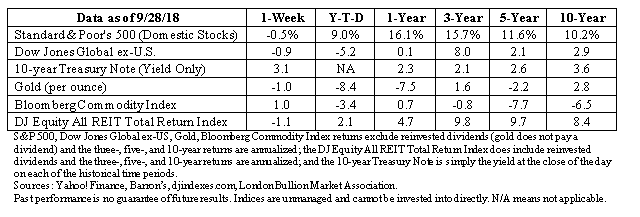
October 1st Market Commentary

October 1, 2018

The Markets

It wasn’t headline news…

But, if newsprint was still popular, last week’s key economic news would have appeared below the fold.

The Federal Reserve raised rates for the third time in 2018, as expected. In addition, the Federal Open Market Committee projects economic growth will continue for three more years, although its median numbers show growth slowing from 3.1 percent in 2018 to 1.8 percent in 2021. (Remember, forecasts, no matter how venerable the source, are best guesses and not bedrock.)

Investors weren’t enthusiastic about the Fed’s actions or its expectations, and the onset of United States-China tariffs didn’t lift their spirits. Ben Levisohn of Barron’s explained:

“The Dow Jones Industrial Average dropped 285.19 points, or 1.1 percent, to 26,458.31 on the week, while the S&P 500 fell 0.5 percent to 2913.98. Neither could be considered life threatening, and the S&P 500 still rose for a sixth consecutive month. So, while we need something to blame, we needn’t get too worried. Last Monday kicked off with the implementation of tariffs by the United States and China and continued with a Federal Reserve rate hike. Neither was a surprise, though the Fed might have caught a few napping when it removed the word ‘accommodative’ from its statement.”

What does it mean when the Federal Reserve removes the word ‘accommodative?’

The Fed pursues ‘accommodative’ or ‘easy’ monetary policy when it is encouraging economic growth. Accommodative policy may include lowering interest rates or, in unusual circumstances, quantitative easing.

By removing the word, the Fed may be signaling that policy will be ‘tightening’ in an effort to prevent the economy from overheating, reported Sam Fleming of Financial Times. There is debate about whether rates are at a neutral level; one that won’t cause the economy to run too hot or too cold.

Let’s hope for a Goldilocks economy.


WHEN DO YOU BEHAVE THE MOST LIKE YOURSELF? Don’t worry. This isn’t about soul-searching and trying to find answers to existential questions like, ‘Who am I?’ or ‘What is my purpose?’ or ‘How should I live my life?’

Nope. This is about a science experiment!

Ian Krajbich of Ohio State University and Fadong Chen of Zhejiang University in China wanted to better understand how people made social decisions, according to a paper they published in Nature Communications. They began with the premise that “Social decisions typically involve conflicts between selfishness and pro-sociality.”

Then, they asked 200 students in the United States and Germany to play “mini-dictator games in which subjects make binary decisions about how to allocate money between themselves and another participant.”

Science Daily explained, “In some cases, participants had to decide within two seconds how they would share their money as opposed to other cases, when they were forced to wait at least 10 seconds before deciding. And, in additional scenarios, they were free to choose at their own pace, which was usually more than two seconds but less than 10.”

The upshot was people who were pro-social became more pro-social, and people with more selfish instincts became more selfish, under severe time constraints. Given more time, “pro-social subjects became marginally less pro-social under time delay…while selfish subjects became less selfish under time delay…though these effects are less pronounced.”

Maybe you behave most like you when you’re pressed for time.

Weekly Focus – Think About It

“Selfishness is not living as one wishes to live, it is asking others to live as one wishes to live.”
--Oscar Wilde, Irish poet and playwright


* These views are those of Carson Group Coaching, and not the presenting Representative or the Representative’s Broker/Dealer, and should not be construed as investment advice.
* This newsletter was prepared by Carson Group Coaching. Carson Group Coaching is not affiliated with the named broker/dealer.
* Government bonds and Treasury Bills are guaranteed by the U.S. government as to the timely payment of principal and interest and, if held to maturity, offer a fixed rate of return and fixed principal value. However, the value of fund shares is not guaranteed and will fluctuate.
* Corporate bonds are considered higher risk than government bonds but normally offer a higher yield and are subject to market, interest rate and credit risk as well as additional risks based on the quality of issuer coupon rate, price, yield, maturity, and redemption features.
* The Standard & Poor's 500 (S&P 500) is an unmanaged group of securities considered to be representative of the stock market in general. You cannot invest directly in this index.
* All indexes referenced are unmanaged. Unmanaged index returns do not reflect fees, expenses, or sales charges. Index performance is not indicative of the performance of any investment.
* The Dow Jones Global ex-U.S. Index covers approximately 95% of the market capitalization of the 45 developed and emerging countries included in the Index.
* The 10-year Treasury Note represents debt owed by the United States Treasury to the public. Since the U.S. Government is seen as a risk-free borrower, investors use the 10-year Treasury Note as a benchmark for the long-term bond market.
* Gold represents the afternoon gold price as reported by the London Bullion Market Association. The gold price is set twice daily by the London Gold Fixing Company at 10:30 and 15:00 and is expressed in U.S. dollars per fine troy ounce.
* The Bloomberg Commodity Index is designed to be a highly liquid and diversified benchmark for the commodity futures market. The Index is composed of futures contracts on 19 physical commodities and was launched on July 14, 1998.
* The DJ Equity All REIT Total Return Index measures the total return performance of the equity subcategory of the Real Estate Investment Trust (REIT) industry as calculated by Dow Jones.
* Yahoo! Finance is the source for any reference to the performance of an index between two specific periods.
* Opinions expressed are subject to change without notice and are not intended as investment advice or to predict future performance.
* Economic forecasts set forth may not develop as predicted and there can be no guarantee that strategies promoted will be successful.
* Past performance does not guarantee future results. Investing involves risk, including loss of principal.
* You cannot invest directly in an index.
* Stock investing involves risk including loss of principal.
* Consult your financial professional before making any investment decision.

Sources:
https://accounts.ft.com/login?location=https%3A%2F%2Fwww.ft.com%2Fcontent%2F635daa64-c1ac-11e8-95b1-d36dfef1b89a (or go to https://s3-us-west-2.amazonaws.com/peakcontent/+Peak+Commentary/10-01-18_FinancialTimes-Federal_Reserve_Raises_US_Interest_Rates_Despite_Trade_War_Concerns-Footnote_1.pdf)
https://www.federalreserve.gov/monetarypolicy/fomcprojtabl20180926.htm (Table: Change in real GDP)
https://www.barrons.com/articles/dow-drops-1-1-on-week-as-tariffs-fed-take-their-toll-1538182108 (or go to https://s3-us-west-2.amazonaws.com/peakcontent/+Peak+Commentary/10-01-18_Barrons-Dow_Drops_1.1_Percent_on_Week_as_Tariffs_Fed_Take_Their_Toll-Footnote_3.pdf)
https://www.investopedia.com/terms/a/accomodativemonetarypolicy.asp
https://www.nature.com/articles/s41467-018-05994-9
https://www.sciencedaily.com/releases/2018/09/180904140530.htm
https://www.brainyquote.com/quotes/oscar_wilde_106085?src=t_selfishness
https://www.ft.com/content/635daa64-c1ac-11e8-95b1-d36dfef1b89a