
June 3rd Market Commentary

June 3, 2019
The Markets

Tariff trouble.

Just two weeks ago, the U.S. government lifted tariffs on Mexico and Canada. So, it was a surprise last week when President Trump tweeted the United States would impose an escalating tariff on all goods imported from Mexico until the flow of migrants to the United States’ southern border stops.

The pending tariffs have potential to hurt both American and Mexican economies, reported The Economist. “Two-thirds of American imports from Mexico are between related parties, where one partner owns at least 10 percent of the other, so any tariff will cause problems along tightly integrated supply chains.”

In 2018, Mexico was the second largest supplier of imported goods to the United States. It provided 13.6 percent of U.S. imports. In addition, Mexico was the second largest importer of U.S. goods. The country took in 15.9 percent of overall U.S. exports, including machinery, electrical machinery, mineral fuels, vehicles, and plastics, according to the Office of the United States Trade Representative.

The new tariffs (a.k.a. import taxes) may increase costs for ordinary Americans. Last week, Liberty Street Economics explained the costs associated with Chinese tariffs:

“U.S. purchasers of imports from China must now pay the import tax in addition to the base price. Thus, if a firm (or consumer) is importing goods for $100 a unit from China, a 10 percent tariff will cause the domestic price to rise to $110 per unit…it is not a true cost for the U.S. economy because the money is simply transferred from buyers of imports to government coffers and thus could, in principle, be rebated.”

A different type of cost occurs when companies find new suppliers. For example, a company that chooses not to pay tariffs can buy goods elsewhere. They might choose to pay a Vietnamese firm $109 for a product rather than pay a Chinese firm $110 ($100 plus a 10 percent tariff). In this situation, the consumer pays a higher price and there is no tariff revenue that could be rebated. This is called a deadweight loss.

In total, Liberty Street Economics estimated the cost of 2018 tariffs on Chinese goods at $419 a year for the typical household ($132 in deadweight loss). The tariffs imposed in 2019 are expected to cost $831 a year ($620 in deadweight loss).

Liberty Street Economics did not estimate the potential consumer cost of new tariffs on Mexico.

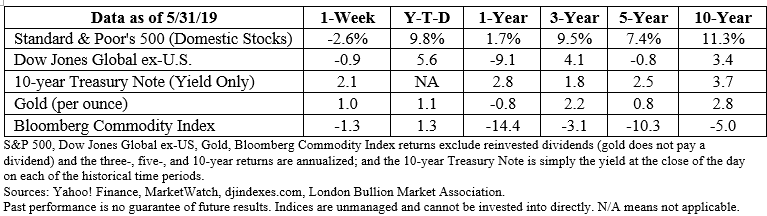
Major U.S. stock indices finished lower last week. Yields on U.S. Treasuries moved lower, too, suggesting investors may have been seeking safe havens.
LET’S HEAR IT FOR THE DOGS. Some people love cats. Some people love dogs. Some people believe your preference offers insight to your personality. You have probably heard variations on this idea. WebMD offered the example that cat owners are open, curious, creative thinkers, while dog owners are outgoing, enthusiastic, self-disciplined planners.

Recently, a bit of data emerged that may please dog owners in Britain. It seems canines in the United Kingdom are outstanding personal trainers. A University of Liverpool study, published in April in Scientific Reports, found:

“The odds of [dog owners] meeting current physical activity guidelines of 150 minutes per week were four times greater than for [people who don’t own dogs]. Children with dogs reported more minutes of walking and free-time (unstructured) activity. Dog ownership is associated with more recreational walking and considerably greater odds of meeting [physical activity] guidelines…It is recommended that adults undertake at least 150 minutes of moderate-to-vigorous intensity physical (MVPA) activity per week.”

British dogs are better at ensuring their owners get enough exercise than American and Australian dogs. In both the United States and Australia, a significant number of dog owners reported their dogs live outside and exercise on their own.

Few cats are willing be leashed and taken for walks, so cat ownership is less likely to help owners meet physical activity goals. Regardless, cat owners may realize some health benefits. A University of Minnesota study found cat owners were 30 percent less likely to die from heart attacks or strokes than non-cat owners. It remains unclear whether cats help lower stress and anxiety or cat owners tend to have low-stress personalities.

Weekly Focus – Think About It

“Owners of dogs will have noticed that, if you provide them with food and water and shelter and affection, they will think you are god. Whereas owners of cats are compelled to realize that, if you provide them with food and water and shelter and affection, they draw the conclusion that they are gods.”
--Christopher Hitchens, Author and columnist

* These views are those of Carson Coaching, and not the presenting Representative or the Representative’s Broker/Dealer, and should not be construed as investment advice.
* This newsletter was prepared by Carson Coaching. Carson Coaching is not affiliated with the named broker/dealer.
* Government bonds and Treasury Bills are guaranteed by the U.S. government as to the timely payment of principal and interest and, if held to maturity, offer a fixed rate of return and fixed principal value. However, the value of fund shares is not guaranteed and will fluctuate.
* Corporate bonds are considered higher risk than government bonds but normally offer a higher yield and are subject to market, interest rate and credit risk as well as additional risks based on the quality of issuer coupon rate, price, yield, maturity, and redemption features.
* The Standard & Poor's 500 (S&P 500) is an unmanaged group of securities considered to be representative of the stock market in general. You cannot invest directly in this index.
* All indexes referenced are unmanaged. Unmanaged index returns do not reflect fees, expenses, or sales charges. Index performance is not indicative of the performance of any investment.
* The Dow Jones Global ex-U.S. Index covers approximately 95% of the market capitalization of the 45 developed and emerging countries included in the Index.
* The 10-year Treasury Note represents debt owed by the United States Treasury to the public. Since the U.S. Government is seen as a risk-free borrower, investors use the 10-year Treasury Note as a benchmark for the long-term bond market.
* Gold represents the afternoon gold price as reported by the London Bullion Market Association. The gold price is set twice daily by the London Gold Fixing Company at 10:30 and 15:00 and is expressed in U.S. dollars per fine troy ounce.
* The Bloomberg Commodity Index is designed to be a highly liquid and diversified benchmark for the commodity futures market. The Index is composed of futures contracts on 19 physical commodities and was launched on July 14, 1998.
* The Dow Jones Industrial Average (DJIA), commonly known as “The Dow,” is an index representing 30 stock of companies maintained and reviewed by the editors of The Wall Street Journal.
* The NASDAQ Composite is an unmanaged index of securities traded on the NASDAQ system.
* International investing involves special risks such as currency fluctuation and political instability and may not be suitable for all investors. These risks are often heightened for investments in emerging markets.
* Yahoo! Finance is the source for any reference to the performance of an index between two specific periods.
* Opinions expressed are subject to change without notice and are not intended as investment advice or to predict future performance.
* Economic forecasts set forth may not develop as predicted and there can be no guarantee that strategies promoted will be successful.
* Past performance does not guarantee future results. Investing involves risk, including loss of principal.
* You cannot invest directly in an index.
* Stock investing involves risk including loss of principal.
* The foregoing information has been obtained from sources considered to be reliable, but we do not guarantee it is accurate or complete.
* There is no guarantee a diversified portfolio will enhance overall returns or outperform a non-diversified portfolio. Diversification does not protect against market risk.
* Asset allocation does not ensure a profit or protect against a loss.
* Consult your financial professional before making any investment decision.

 Sources:
https://www.npr.org/2019/05/17/724357441/u-s-to-lift-tariffs-on-canadas-and-mexico-s-steel-and-aluminum
https://twitter.com/realdonaldtrump/status/1134240653926232064
https://www.economist.com/finance-and-economics/2019/05/31/donald-trump-vows-to-use-tariffs-to-punish-mexico-for-migrants (or go to https://peakcontent.s3-us-west-2.amazonaws.com/+Peak+Commentary/06-03-19_TheEconomist-Donald_Trump_Vows_to_Use_Tariffs_to_Punish_Mexico_for+Migrants-Footnote_3.pdf)
https://ustr.gov/countries-regions/americas/mexico
https://libertystreeteconomics.newyorkfed.org/2019/05/new-china-tariffs-increase-costs-to-us-households.html
https://www.barrons.com/articles/dow-jones-industrial-average-drops-for-sixth-straight-week-on-tariff-tumult-51559351582?mod=hp_DAY_4 (or go to https://peakcontent.s3-us-west-2.amazonaws.com/+Peak+Commentary/06-03-19_Barrons-Dow_Drops_for_Sixth_Week_Because_Tariffs_Arent_Just_for_China_Anymore-Footnote_6.pdf)
https://www.marketwatch.com/story/2-year-treasury-yield-slumps-to-2-after-trump-wields-tariff-threat-against-mexico-2019-05-31
https://pets.webmd.com/ss/slideshow-truth-about-cat-people-and-dog-people
https://www.nature.com/articles/s41598-019-41254-6
https://www.medicalnewstoday.com/articles/98432.php
https://www.goodreads.com/quotes/tag/pets
May 28th Market Commentary

May 28, 2019
The Markets

U.S. stocks have had a great run.

During the past decade, the profitability of U.S. companies increased rapidly. Strong corporate earnings helped the U.S. stock market outperform markets in other nations by a significant margin. According to Capital Economics, “Since the start of this decade, the average annual return from the MSCI USA index of mid- and large-capitalization U.S. equities, which closely tracks the S&P 500, has been roughly 13 percent. This compares to only 7 percent from the MSCI World ex USA index of comparably-sized equities in 22 other developed economies.” Performance was measured in local currency.

Through the end of April, year-to-date returns for U.S. benchmark indices were soaring. T. Rowe Price reported, “Stocks recorded solid gains in April, continuing their strong start to the year. The S&P 500 and Nasdaq Composite Indexes hit new all‑time highs at the end of the month, while the other major benchmarks remained modestly below the peaks they established in the fall of 2018…Renewed confidence in the global economy seemed to be a primary factor boosting sentiment in April.”

Since early May, when trade discord resumed between the United States and China, major U.S. stock indices have lost value. Ben Levisohn of Barron’s reported the Dow Jones Industrial Average has fallen 3.5 percent since May 5, the Standard & Poor’s 500 Index is down 4.1 percent, and the Nasdaq Composite has surrendered 6.5 percent.

There are reasons to believe stock performance may not be as strong in the future. Last week, there were signs U.S. and global economies may be slowing. Randall Forsyth of Barron’s reviewed some indicators. “Long-term U.S. Treasury yields…fell on Thursday to their lowest levels since October 2017, before ticking up on Friday. At the same time, copper and crude-oil prices fell on the week. Those indicators of economic weakness were underscored by a drop in the flash IHS Markit Purchasing Managers Indexes to a shade above 50, the dividing line between expansion and contraction for the economy. Whatever the factors at work, the U.S. economy is slowing.”

The Federal Reserve Bank of Atlanta’s May 24 GDPNow forecast, which is a weekly estimate of potential economic growth for the year, projected the U.S. economy will grow 1.3 percent in 2019.

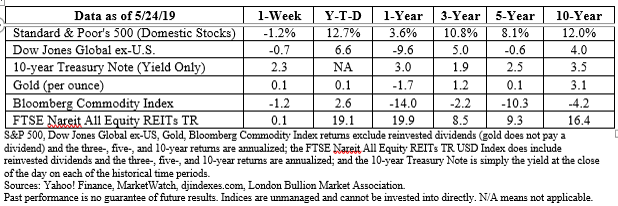
After a great decade and a stellar start to 2019, U.S. stock markets may be cooling off.


IT’S NOT CAPTURE THE FLAG. Like competitive gaming and Ultimate Frisbee, some may categorize pillow fighting as an activity rather than a sport. Jack Tarrant and Yoko Kono of Reuters described the last week’s All Japan Pillow Fighting Championship qualifier in Shizuoka Prefecture in this way:

“A mix between dodgeball and chess, the aim is to protect each team’s ‘King’ from being hit by pillows whilst trying to hit the opposition’s ‘King’ during two-minute sets. One player on each team can also use a duvet as a shield.”

Japan isn’t the only country to embrace pillow fighting. Since 2008, when International Pillow Fight Day was established, annual pillow fights have been launched in cities around the world, according to Awareness Days. Since the first World Pillow Fight Day in March 2008, the activity has gained popularity “…with pillow fighting flash mobs fighting it out in more and more cities every year…”

NOTE: Pillow fighting is not without risk. In 2015, West Point banned its annual pillow fight after 30 participants were injured.

Weekly Focus – Think About It

“The first colleges to make sports a major part of student life, in addition to the Ivies, were the military academies. They did so for some of the same reasons as the elite schools – athletics instilled character, etc. – but also because Army and Navy endorsed the old General Wellington idea that battles were won and lost on the playing fields of youth. The better the sports program, they reasoned, the better the soldier…”
--Steven Stark, Cultural commentator

* These views are those of Carson Coaching, and not the presenting Representative or the Representative’s Broker/Dealer, and should not be construed as investment advice.
* This newsletter was prepared by Carson Coaching. Carson Coaching is not affiliated with the named broker/dealer.
* Government bonds and Treasury Bills are guaranteed by the U.S. government as to the timely payment of principal and interest and, if held to maturity, offer a fixed rate of return and fixed principal value. However, the value of fund shares is not guaranteed and will fluctuate.
* Corporate bonds are considered higher risk than government bonds but normally offer a higher yield and are subject to market, interest rate and credit risk as well as additional risks based on the quality of issuer coupon rate, price, yield, maturity, and redemption features.
* The Standard & Poor's 500 (S&P 500) is an unmanaged group of securities considered to be representative of the stock market in general. You cannot invest directly in this index.
* All indexes referenced are unmanaged. Unmanaged index returns do not reflect fees, expenses, or sales charges. Index performance is not indicative of the performance of any investment.
* The Dow Jones Global ex-U.S. Index covers approximately 95% of the market capitalization of the 45 developed and emerging countries included in the Index.
* The 10-year Treasury Note represents debt owed by the United States Treasury to the public. Since the U.S. Government is seen as a risk-free borrower, investors use the 10-year Treasury Note as a benchmark for the long-term bond market.
* Gold represents the afternoon gold price as reported by the London Bullion Market Association. The gold price is set twice daily by the London Gold Fixing Company at 10:30 and 15:00 and is expressed in U.S. dollars per fine troy ounce.
* The Bloomberg Commodity Index is designed to be a highly liquid and diversified benchmark for the commodity futures market. The Index is composed of futures contracts on 19 physical commodities and was launched on July 14, 1998.
* The FTSE Nareit All Equity REITs Index tracks the performance of the U.S. Real Estate Investment Trust (REIT) industry at both an industry-wide level and on a sector-by-sector basis.
* The Dow Jones Industrial Average (DJIA), commonly known as “The Dow,” is an index representing 30 stock of companies maintained and reviewed by the editors of The Wall Street Journal.
* The NASDAQ Composite is an unmanaged index of securities traded on the NASDAQ system.
* International investing involves special risks such as currency fluctuation and political instability and may not be suitable for all investors. These risks are often heightened for investments in emerging markets.
* Yahoo! Finance is the source for any reference to the performance of an index between two specific periods.
* IHS Markit is a London-based global information provider that was formed in 2016 when Information Handling Services, Inc. and Markit Ltd. merged. It combines information and analytics to provide solutions for business, finance, and government.
* The Purchasing Managers’ Index (PMI) is a measure of the prevailing direction of economic trends in manufacturing and is based on a monthly survey of supply chain managers across 19 industries covering both upstream and downstream activity.
* Opinions expressed are subject to change without notice and are not intended as investment advice or to predict future performance.
* Economic forecasts set forth may not develop as predicted and there can be no guarantee that strategies promoted will be successful.
* Past performance does not guarantee future results. Investing involves risk, including loss of principal.
* You cannot invest directly in an index.
* Stock investing involves risk including loss of principal.
* The foregoing information has been obtained from sources considered to be reliable, but we do not guarantee it is accurate or complete.
* There is no guarantee a diversified portfolio will enhance overall returns or outperform a non-diversified portfolio. Diversification does not protect against market risk.
* Asset allocation does not ensure a profit or protect against a loss.
* Consult your financial professional before making any investment decision.

Sources:
https://research.cdn-1.capitaleconomics.com/faf89b/relentless-outperformance-of-us-equities-likely-to-end.pdf (or go to https://s3-us-west-2.amazonaws.com/peakcontent/+Peak+Commentary/05-28-19_Capital_Economic_Global_Markets_Update-Footnote_1.pdf)
https://www.troweprice.com/financial-intermediary/us/en/insights/articles/2019/q2/monthly-market-review.html
https://www.barrons.com/articles/dow-jones-industrial-average-drops-for-fifth-straight-week-51558749330?mod=hp_DAY_3 (or go to https://s3-us-west-2.amazonaws.com/peakcontent/+Peak+Commentary/05-28-19_Barrons-The_Dow_Celebrates_Five_Weeks_of_Futility-Footnote_3.pdf)
https://www.barrons.com/articles/trade-talks-take-an-ominous-new-turn-51558747006?mod=hp_DAY_1 (or go to https://s3-us-west-2.amazonaws.com/peakcontent/+Peak+Commentary/05-28-19_Barrons-The_Trade_War_Takes_an_Ominous_New_Turn-Footnote_4.pdf)
https://www.frbatlanta.org/cqer/research/gdpnow.aspx?mod=article_inline
https://www.reuters.com/article/us-pillowfighting-japan/duvets-discarded-cushions-thrown-at-japans-pillow-fighting-championship-idUSKCN1SV063
https://www.awarenessdays.com/awareness-days-calendar/international-pillow-fight-day-2019/
https://www.usatoday.com/story/news/nation/2015/11/25/west-point-bans-cadets-pillow-fight-after-30-injured-plebes/76382394/
https://www.theatlantic.com/entertainment/archive/2010/09/drill-and-kill-how-americans-link-war-and-sports/63832/

May 20th Market Commentary

May 20, 2019

The Markets

Trade war trade-off.

There was some good news on trade, last week. The United States took steps to reduce trade friction with the European Union, Canada, Mexico, and Japan.

“The United States on Friday reached an agreement with Canada and Mexico to remove steel and aluminum tariffs, which had been a persistent source of friction across North America over the past year. The deal on metals came as Mr. Trump decided not to press ahead immediately with levies on EU and Japanese automotive products – despite declaring that foreign car and vehicle imports represented a threat to U.S. national security,” reported James Politi, Jude Webber, and Jim Brunsden of Financial Times.

There was some bad news, too. Trade tensions escalated between the United States and China. The United States doubled tariffs on $200 billion of Chinese goods and threatened tariffs on an additional $325 billion of goods. The United States imports about $539 billion worth of goods from China each year, reported the BBC.

In addition, President Trump signed an executive order preventing U.S. companies from using telecommunications equipment made by firms believed to pose a risk to national security. The move is expected to affect the ability of a large Chinese telecoms firm to conduct business in the United States, reported David Lawder and Susan Heavey of Reuters.

China currently has tariffs on $110 billion of American goods and they announced plans to hike tariffs on $60 billion of these goods. In total, China imports $120 billion worth of goods overall from the United States each year.

While the relatively small amount of American goods imported by China would seem to give the United States an advantage in a trade war, China has other means of gaining leverage. The country holds about 7 percent of U.S. debt, which is more than any other nation, reported Jeff Cox of CNBC. If China were to slow purchases of Treasuries, yields on U.S. government bonds may move higher.

A source cited by Reshma Kapadia of Barron’s suggested it is unlikely the Chinese will stop buying Treasuries. “Where would they put the trillions of dollars? Ten-year German Bunds are below Japanese 10-year yields; there aren’t a lot of options…They also don’t want their currency to appreciate, so that handcuffs them…China tends to find things to hurt adversaries without hurting themselves.”

The Standard & Poor’s 500 Index finished the week lower.


WHICH CITIES OFFER THE BEST QUALITY OF LIFE? In March, Mercer published its 21st Quality of Living Survey. The goal is to help multinational corporations with data that can help them optimize their global operations. The survey considers factors like safety, housing, recreation, economics, public transport, consumer goods, and more. For 2019, the cities offering the highest quality of life were:

1. Vienna, Austria
2. Zurich, Switzerland
3. Vancouver, Canada
4. Munich, Germany
5. Auckland, New Zealand
6. Düsseldorf, Germany
7. Frankfurt, Germany
8. Copenhagen, Denmark
9. Geneva, Switzerland
10. Basel, Switzerland

Thirteen of the world’s top-20 cities were in Europe. The safest cities in Europe were Luxembourg, Basel, Bern, Helsinki, and Zurich. The least safe, as far as personal safety goes, were Moscow and St. Petersburg.

In North America, Canadian cities generally did better than U.S. cities. The highest ranked city in the United States was San Francisco, which came in at 34th. Boston ranked 36th and Honolulu 37th. The safest cities in North America were Vancouver, Toronto, Montreal, Ottawa, and Calgary.

Dubai offers the best quality of life in the Middle East. Dubai and Abu Dhabi were the safest cities, while Damascus was the least safe – in the Middle East and the world.

Singapore, Tokyo, and Kobe had the highest quality of life rankings among Asian cities. Cities in Australia and New Zealand also did quite well, overall.

Weekly Focus – Think About It

“You are all there, the people in the city. I can't believe I was ever among you. When you are away from a city it becomes a fantasy. Any town, New York, Chicago, with its people, becomes improbable with distance. Just as I am improbable here, in Illinois, in a small town by a quiet lake. All of us improbable to one another because we are not present to one another.”
--Ray Bradbury, American author

* These views are those of Carson Coaching, and not the presenting Representative or the Representative’s Broker/Dealer, and should not be construed as investment advice.
* This newsletter was prepared by Carson Coaching. Carson Coaching is not affiliated with the named broker/dealer.
* Government bonds and Treasury Bills are guaranteed by the U.S. government as to the timely payment of principal and interest and, if held to maturity, offer a fixed rate of return and fixed principal value. However, the value of fund shares is not guaranteed and will fluctuate.
* Corporate bonds are considered higher risk than government bonds but normally offer a higher yield and are subject to market, interest rate and credit risk as well as additional risks based on the quality of issuer coupon rate, price, yield, maturity, and redemption features.
* The Standard & Poor's 500 (S&P 500) is an unmanaged group of securities considered to be representative of the stock market in general. You cannot invest directly in this index.
* All indexes referenced are unmanaged. Unmanaged index returns do not reflect fees, expenses, or sales charges. Index performance is not indicative of the performance of any investment.
* The Dow Jones Global ex-U.S. Index covers approximately 95% of the market capitalization of the 45 developed and emerging countries included in the Index.
* The 10-year Treasury Note represents debt owed by the United States Treasury to the public. Since the U.S. Government is seen as a risk-free borrower, investors use the 10-year Treasury Note as a benchmark for the long-term bond market.
* Gold represents the afternoon gold price as reported by the London Bullion Market Association. The gold price is set twice daily by the London Gold Fixing Company at 10:30 and 15:00 and is expressed in U.S. dollars per fine troy ounce.
* The Bloomberg Commodity Index is designed to be a highly liquid and diversified benchmark for the commodity futures market. The Index is composed of futures contracts on 19 physical commodities and was launched on July 14, 1998.
* The DJ Equity All REIT Total Return Index measures the total return performance of the equity subcategory of the Real Estate Investment Trust (REIT) industry as calculated by Dow Jones.
* The Dow Jones Industrial Average (DJIA), commonly known as “The Dow,” is an index representing 30 stock of companies maintained and reviewed by the editors of The Wall Street Journal.
* The NASDAQ Composite is an unmanaged index of securities traded on the NASDAQ system.
* International investing involves special risks such as currency fluctuation and political instability and may not be suitable for all investors. These risks are often heightened for investments in emerging markets.
* Yahoo! Finance is the source for any reference to the performance of an index between two specific periods.
* Opinions expressed are subject to change without notice and are not intended as investment advice or to predict future performance.
* Economic forecasts set forth may not develop as predicted and there can be no guarantee that strategies promoted will be successful.
* Past performance does not guarantee future results. Investing involves risk, including loss of principal.
* You cannot invest directly in an index.
* Stock investing involves risk including loss of principal.
* The foregoing information has been obtained from sources considered to be reliable, but we do not guarantee it is accurate or complete.
* There is no guarantee a diversified portfolio will enhance overall returns or outperform a non-diversified portfolio. Diversification does not protect against market risk.
* Asset allocation does not ensure a profit or protect against a loss.
* Consult your financial professional before making any investment decision.

Sources:
https://www.ft.com/content/9aca49e0-78a3-11e9-be7d-6d846537acab (or go to https://s3-us-west-2.amazonaws.com/peakcontent/+Peak+Commentary/05-20-19_FinancialTimes-Donald_Trump_Eases_Tariffs_for_Allies_as_He_Focuses_on_China-Footnote_1.pdf)
https://www.bbc.com/news/business-45899310
https://www.reuters.com/article/us-usa-trade-china/us-blacklists-chinas-huawei-as-trade-dispute-clouds-global-outlook-idUSKCN1SL2DI
https://www.cnbc.com/2019/05/16/china-has-cut-its-holdings-of-us-debt-to-the-lowest-level-in-two-years.html
https://www.barrons.com/articles/trade-war-stock-market-outlook-51558120641 (or go to https://s3-us-west-2.amazonaws.com/peakcontent/+Peak+Commentary/05-20-19_Barrons-The_Trade_War_Will_Make_Stocks_Scary-5_Reasons_Not_to_Panic-Footnote_5.pdf)
https://mobilityexchange.mercer.com/Insights/quality-of-living-rankings (Click on 2019 City Ranking, Show/Hide full ranking)
https://www.mercer.com/newsroom/2019-quality-of-living-survey.html
https://www.goodreads.com/quotes/tag/cities?page=6