
January 8th Market Commentary

January 8, 2018

The Markets

Whoosh! Bang! Flash! Fizz! Whistle!

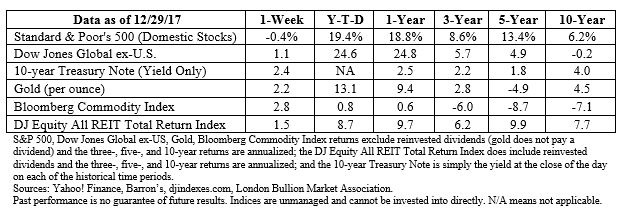
U.S. stock markets delivered their own version of fireworks to celebrate the New Year. During the first week of 2018, the Dow Jones Industrial Average hit a new all-time high, moving above 25,000 for the first time ever. The NASDAQ Composite and Standard & Poor’s 500 Indices also rose to new highs.

2018 is off to an impressive start, but let’s pause for a moment and take a look back at 2017. It was a memorable year for global markets, but there are other reasons it was interesting, too. Here are the highlights of a few of The Economist’s most popular articles during the year:

The world’s most valuable resource is no longer oil, but data (May 6). One-half of the most valuable companies in the world are American technology firms. Some, including The Economist, are concerned about tech companies’ market power and dominance of consumer data.

The world’s most dangerous cities (March 31). Despite a declining murder rate, San Salvador remained the world’s most dangerous city, as measured by homicides per 100,000 during 2016 (the latest figure available). Acapulco ranked second. Several cities in the United States made the list including St. Louis, Baltimore, Detroit, and New Orleans.

Governments may be big backers of the blockchain (June 1). Blockchain may seem complicated and difficult to understand, but it may become a part of everyday life. “…a blockchain expert at the Massachusetts Institute of Technology argues that governments will drive its adoption – an ironic twist for something that began as a libertarian counter model to centralized authority. Backers say it can be used for land registries, identity-management systems, health-care records, and even elections.”

The death of the internal combustion engine (August 12). Rapidly changing battery technology and electric motors, in tandem with self-driving systems and ride sharing, may mark the beginning of the end for the internal combustion engine. It’s a change that is likely to disrupt markets and industries. The silver lining may prove to be less traffic and improved air quality.

How to keep cool without costing the earth (February 11). Scientists at the University of Colorado in Boulder have “…invented a film that can cool buildings without the use of refrigerants and, remarkably, without drawing any power to do so. Better yet, this film can be made using standard roll-to-roll manufacturing methods at a cost of around 50 cents a square meter.”

There is a theme that appears to run through many of these articles. They explore new ways of doing things, such as cooling buildings and transporting people. The articles discuss the growing value of consumer data, which many people provide to companies for free, as well as technologies that may allow people to protect and monetize their data in the future (blockchain).

These new developments may be part of a process called creative destruction, which is a process of innovation that includes the introduction of new products and services that may eclipse existing ones. You don’t have to look far to find examples. Just think about the evolution of movie rentals, photography, or phones during the past couple decades.

Creative destruction was introduced in 1942 in Joseph Schumpeter’s book, Capitalism, Socialism and Democracy. He believed it was the essential fact about capitalism. More recently, MIT Professor Ricardo Caballero wrote, “Over the long run, the process of creative destruction accounts for over 50 percent of productivity growth.”

It seems, as Schumpeter suggested, we live in a gale of creative destruction.


CRYPTOCURRENCY MAY BE EXPENSIVE IN UNEXPECTED WAYS. If you’re like many investors, you have probably spent some time thinking about the latest innovation in money: cryptocurrency. Cryptocurrencies, or digital tokens, are ‘mined’ using computer networks to solve complex puzzles. The Economist provided an example:

“A huge aircraft hangar in Boden, in northern Sweden, big enough to hold a dozen helicopters, is now packed with computers – 45,000 of them, each with a whirring fan to stop it overheating. The machines work ceaselessly, trying to solve fiendishly difficult mathematical puzzles. The solutions are, in themselves, unimportant. Yet by solving the puzzles, the computers earn their owners a reward in bitcoin, a digital ‘crypto-currency.’”

A hangar of computers is a lot of overhead expense, and it’s not all that’s needed to mine digital tokens, either. Experts in the field told The Washington Post mining a popular cryptocurrency, “…probably uses as much as 1 to 4 gigawatts, or billion watts, of electricity, roughly the output of one to three nuclear reactors.”

Weekly Focus – Think About It 
“I offered a definition of bubble that I thought represents the term’s best use: A situation in which news of price increases spurs investor enthusiasm which spreads by psychological contagion from person to person, in the process amplifying stories that might justify the price increase and bringing in a larger and larger class of investors, who, despite doubts about the real value of the investment, are drawn to it partly through envy of others’ successes and partly through a gambler’s excitement.”
–Robert Shiller, American Nobel Laureate and Professor of Economics

* These views are those of Carson Group Coaching, and not the presenting Representative or the Representative’s Broker/Dealer, and should not be construed as investment advice.
* This newsletter was prepared by Carson Group Coaching. Carson Group Coaching is not affiliated with the named broker/dealer.
* Government bonds and Treasury Bills are guaranteed by the U.S. government as to the timely payment of principal and interest and, if held to maturity, offer a fixed rate of return and fixed principal value.  However, the value of fund shares is not guaranteed and will fluctuate.
* Corporate bonds are considered higher risk than government bonds but normally offer a higher yield and are subject to market, interest rate and credit risk as well as additional risks based on the quality of issuer coupon rate, price, yield, maturity, and redemption features.
* The Standard & Poor's 500 (S&P 500) is an unmanaged group of securities considered to be representative of the stock market in general. You cannot invest directly in this index.
* All indexes referenced are unmanaged. Unmanaged index returns do not reflect fees, expenses, or sales charges. Index performance is not indicative of the performance of any investment.
* The Dow Jones Global ex-U.S. Index covers approximately 95% of the market capitalization of the 45 developed and emerging countries included in the Index.
* The 10-year Treasury Note represents debt owed by the United States Treasury to the public. Since the U.S. Government is seen as a risk-free borrower, investors use the 10-year Treasury Note as a benchmark for the long-term bond market.
* Gold represents the afternoon gold price as reported by the London Bullion Market Association. The gold price is set twice daily by the London Gold Fixing Company at 10:30 and 15:00 and is expressed in U.S. dollars per fine troy ounce.
* The Bloomberg Commodity Index is designed to be a highly liquid and diversified benchmark for the commodity futures market. The Index is composed of futures contracts on 19 physical commodities and was launched on July 14, 1998.
* The DJ Equity All REIT Total Return Index measures the total return performance of the equity subcategory of the Real Estate Investment Trust (REIT) industry as calculated by Dow Jones.
* Yahoo! Finance is the source for any reference to the performance of an index between two specific periods.
* Opinions expressed are subject to change without notice and are not intended as investment advice or to predict future performance.
* Economic forecasts set forth may not develop as predicted and there can be no guarantee that strategies promoted will be successful.
* Past performance does not guarantee future results. Investing involves risk, including loss of principal.
* You cannot invest directly in an index.
* Stock investing involves risk including loss of principal.
* Consult your financial professional before making any investment decision.

Sources:
https://www.barrons.com/articles/dow-25-000-how-high-can-it-go-1515213968 (or go to https://s3-us-west-2.amazonaws.com/peakcontent/+Peak+Commentary/01-08-18_Barrons-Dow_25000-How_High_Can_It_Go-Footnote_1.pdf)
https://www.economist.com/news/top-ten-articles-2017 (or go to https://s3-us-west-2.amazonaws.com/peakcontent/+Peak+Commentary/01-08-18_TheEconomist-The_Economists_Ten_Most_Popular_Articles_of_2017-Footnote_2.pdf)
https://www.economist.com/news/business/21722869-anti-establishment-technology-faces-ironic-turn-fortune-governments-may-be-big-backers (or go to https://s3-us-west-2.amazonaws.com/peakcontent/+Peak+Commentary/01-08-18_TheEconomist-Governments_May_Be_Big_Backers_of_the_Blockchain-Footnote_3.pdf)
https://www.economist.com/news/science-and-technology/21716599-film-worth-watching-how-keep-cool-without-costing-earth (or go to https://s3-us-west-2.amazonaws.com/peakcontent/+Peak+Commentary/01-08-18_TheEconomist-How_to_Keep_Cool_Without_Costing_the_Earth-Footnote_4.pdf)
https://www.forbes.com/sites/joshlinkner/2012/11/16/palm-kodak-blockbuster-sears-rim-borders-circuit-city-compaq-and-the-only-thing-you-can-do-to-avoid-being-next/
https://books.google.com/books?id=ytrqJswoRCoC&printsec=frontcover&dq=schumpeter+creative+destruction&hl=en&sa=X&ved=0ahUKEwjI3vzTj8TYAhXn34MKHflSA6MQ6AEINjAD#v=onepage&q=essential%20fact&f=false (or go to https://s3-us-west-2.amazonaws.com/peakcontent/+Peak+Commentary/01-08-18_Schumpeter-Excerpt_from_Capitalism_Socialism_and_Democracy-Footnote_6.pdf)
https://economics.mit.edu/files/1785
https://books.google.com/books?id=ytrqJswoRCoC&printsec=frontcover&dq=schumpeter+creative+destruction&hl=en&sa=X&ved=0ahUKEwjI3vzTj8TYAhXn34MKHflSA6MQ6AEINjAD#v=onepage&q=gale&f=false (or go to https://s3-us-west-2.amazonaws.com/peakcontent/+Peak+Commentary/01-08-18_Schumpeter-Excerpt_from_Capitalism_Socialism_and_Democracy-Footnote_8.pdf)
https://www.economist.com/news/business/21638124-minting-digital-currency-has-become-big-ruthlessly-competitive-business-magic (or go to https://s3-us-west-2.amazonaws.com/peakcontent/+Peak+Commentary/01-08-18_TheEconomist-The_Magic_of_Mining-Footnote_9.pdf)
https://www.washingtonpost.com/news/energy-environment/wp/2017/12/19/why-the-bitcoin-craze-is-using-up-so-much-energy/?utm_term=.c9d35abe5a84
https://www.nobelprize.org/nobel_prizes/economic-sciences/laureates/2013/shiller-lecture.pdf (or go to https://s3-us-west-2.amazonaws.com/peakcontent/+Peak+Commentary/01-08-18_RobertShiller-Speculative_Asset_Prices-Footnote_11.pdf)
January 2nd Market Commentary

January 2, 2018

The Markets

How good was 2017?

It was so good, the Standard & Poor’s (S&P) 500 Index finished in positive territory every month for the first time ever (on a total return basis), reported Barron’s. All major U.S. indices finished the year with double-digit gains.

As we enter 2018, keep an eye on investor sentiment. “History has shown us that the crowd can be right during trends, but it also tends to be wrong at extremes. This is why sentiment can be an important contrarian indicator, because if everyone who might become bearish has already sold, only buyers are left. The reverse also applies,” reported ValueWalk.

Toward the end of 2017, sentiment shifted, but not everyone shared the same outlook. Surveys and indices that track market indicators and institutional advice became less bullish, while newsletter writers and investors became more bullish. 

• The CNN Fear & Greed Index dropped from Greedy territory into the Neutral range. The Index measures seven indicators including stock price strength and breadth, market momentum, high-yield bond demand, and market volatility to determine the emotion that may be driving markets.

• The TIM Group Market Sentiment fell from 47.3 percent to 43 percent, becoming more bearish. TIM tracks actionable ideas sent from the sell-side (e.g., investment and commercial banks; stock brokers; market makers) to buy-side clients (e.g., asset managers; institutional and retail investors). A score of zero is the most bearish and 100 is the most bullish.

• The AAII Investor Sentiment Survey indicated individual investors are becoming more bullish and less bearish. Some believe the survey is a contrarian indicator:

o Bullish sentiment was up 2.1 percent to 52.6 percent. The long-term average is 38.5 percent.
o Neutral sentiment was up 2.8 percent to 26.7 percent. The long-term average is 31.0 percent.
o Bearish sentiment was down 5 percent to 20.6 percent. The long-term average is 30.5 percent.

During 2017, U.S. markets appeared to be Teflon-coated. Geopolitical events, natural disasters, and other shocks had little impact on investor optimism or share prices, and expectations for volatility remained historically low. That may continue during 2018, or it may not. 


SOME OF THE BEST AND WORST OF 2017. It may have seemed longer but 2017 had 365 days, just like every other year. It was a year of firsts, worsts, and bests, although not everyone agrees about which were which. Here are a few memorable pop culture moments from 2017:

Making a mistake. “At February’s Oscars, some [person] hands presenters Warren Beatty and Faye Dunaway the wrong envelope, leading to an incorrect announcement of Best Picture. The actual winner turns out to be whatever other accounting companies are vying for the academy’s business,” reported New York Post.

Seeing and hearing the children. An interview with South Korea expert, Professor Robert Kelly, was interrupted by his toddlers and became a viral sensation. One Twitter post read, “Live your life like you just burst through the door of your dad’s super important live broadcast Skype call,” reported The Independent.

Empowering women. “Wonder Woman became the best-reviewed DC Universe film and a box-office hero when it hit theaters in May…[It] had the biggest opening ever for a movie directed by a woman with a $100.5 million debut and presented a turning point for female representation on the big screen,” wrote USA Today.

Selling stuff. Arguably the world’s most eligible royal bachelor, Prince Harry announced he’s engaged to Meghan Markle. Prepare for the glut of commemorative items. About £222 million was spent on memorabilia related to the 2011 royal wedding of the Duke and Duchess of Cambridge, reported The Telegraph.

Beknighting another Beatle. That’s right. The Beatles’ former drummer Ringo Starr is on the list to receive knighthood during Queen Elizabeth's annual New Year's Honours ceremony, announced Rolling Stone.

What were the best and worst moments of 2017 in your opinion?

Weekly Focus – Think About It 

“Your success and happiness lies in you. Resolve to keep happy, and your joy and you shall form an invincible host against difficulties.”
Helen Keller, American author, lecturer, and activist

* These views are those of Carson Group Coaching, and not the presenting Representative or the Representative’s Broker/Dealer, and should not be construed as investment advice.
* This newsletter was prepared by Carson Group Coaching. Carson Group Coaching is not affiliated with the named broker/dealer.
* Government bonds and Treasury Bills are guaranteed by the U.S. government as to the timely payment of principal and interest and, if held to maturity, offer a fixed rate of return and fixed principal value.  However, the value of fund shares is not guaranteed and will fluctuate.
* Corporate bonds are considered higher risk than government bonds but normally offer a higher yield and are subject to market, interest rate and credit risk as well as additional risks based on the quality of issuer coupon rate, price, yield, maturity, and redemption features.
* The Standard & Poor's 500 (S&P 500) is an unmanaged group of securities considered to be representative of the stock market in general. You cannot invest directly in this index.
* All indexes referenced are unmanaged. Unmanaged index returns do not reflect fees, expenses, or sales charges. Index performance is not indicative of the performance of any investment.
* The Dow Jones Global ex-U.S. Index covers approximately 95% of the market capitalization of the 45 developed and emerging countries included in the Index.
* The 10-year Treasury Note represents debt owed by the United States Treasury to the public. Since the U.S. Government is seen as a risk-free borrower, investors use the 10-year Treasury Note as a benchmark for the long-term bond market.
* Gold represents the afternoon gold price as reported by the London Bullion Market Association. The gold price is set twice daily by the London Gold Fixing Company at 10:30 and 15:00 and is expressed in U.S. dollars per fine troy ounce.
* The Bloomberg Commodity Index is designed to be a highly liquid and diversified benchmark for the commodity futures market. The Index is composed of futures contracts on 19 physical commodities and was launched on July 14, 1998.
* The DJ Equity All REIT Total Return Index measures the total return performance of the equity subcategory of the Real Estate Investment Trust (REIT) industry as calculated by Dow Jones.
* Yahoo! Finance is the source for any reference to the performance of an index between two specific periods.
* Opinions expressed are subject to change without notice and are not intended as investment advice or to predict future performance.
* Economic forecasts set forth may not develop as predicted and there can be no guarantee that strategies promoted will be successful.
* Past performance does not guarantee future results. Investing involves risk, including loss of principal.
* You cannot invest directly in an index.* Stock investing involves risk including loss of principal.
* Consult your financial professional before making any investment decision.

Sources:
https://www.barrons.com/articles/dow-industrials-end-solid-2017-on-a-sour-note-1514601649 (or go to https://s3-us-west-2.amazonaws.com/peakcontent/+Peak+Commentary/01-02-18_Barrons-Dow_Industrials_End_Solid_2017_on_a_Sour_Note-Footnote_1.pdf)
http://www.valuewalk.com/2017/12/when-overbought-is-bullish/
http://money.cnn.com/data/fear-and-greed/
https://www.wallstreetmojo.com/sell-side-vs-buy-side/
http://www.barrons.com/public/page/9_0210-investorsentimentreadings.html
http://www.aaii.com/sentimentsurvey
http://www.aaii.com/journal/article/is-the-aaii-sentiment-survey-a-contrarian-indicator
https://www.washingtonpost.com/business/economy/stock-markets-wrap-up-best-year-since-2013-as-investors-shrug-off-bad-newsthe-dow-jones-industrial-average-alone-surges-25-percent/2017/12/29/5bf67932-ecae-11e7-8a6a-80acf0774e64_story.html?utm_term=.2eea95db2906
https://www.cnbc.com/2017/12/26/could-2018-surprise-with-the-same-outsize-gains-as-2017.html
https://nypost.com/2017/12/28/the-highs-and-lows-of-pop-culture-in-2017/
https://www.usatoday.com/story/life/entertainthis/2017/12/06/15-biggest-pop-culture-moments-2017/910215001/
http://www.independent.co.uk/life-style/health-and-families/professor-robert-kelly-family-father-children-bbc-interview-south-korea-viral-a8127221.html 
http://www.telegraph.co.uk/news/2017/11/28/royal-wedding-souvenir-rush-prince-harry-meghan-markle-begins/
https://www.rollingstone.com/music/news/ringo-starr-bee-gees-barry-gibb-receive-knighthood-w514828
http://inspower.co/17-best-quotes-about-resolve/

December 26th Market Commentary

December 26, 2017

The Markets

It’s time to turn your mind to taxes.

Last week, President Trump signed tax reform, officially titled ‘An Act to provide for reconciliation pursuant to titles II and V of the concurrent resolution on the budget for fiscal year 2018,’ into law.

The legislation provides significant permanent tax cuts for businesses, including reducing the corporate tax rate from 35 percent to 21 percent. Most individual taxpayers will also receive tax benefits, including lower marginal tax rates. However, all of the individual tax breaks will expire before 2026.

In addition, “…the standard deduction has been raised from $6,350 for singles and $12,700 for couples filing jointly to $12,000 and $24,000…With the standard deduction raised to $24,000, many folks will take the standard deduction rather than itemize. Taxpayers itemize their deductions when total deductions exceed the standard deduction,” wrote Barron’s.

The new rules won’t go into effect until next year, and that gives you a small window of opportunity. If you act by the end of the year, you may be able to minimize the amount you pay Uncle Sam. For example, you may want to consider:

• Deferring income until 2018, if possible, when ordinary income tax rates may be lower
• Accelerating 2018 planned charitable giving into 2017
• Paying your January mortgage payment by December 31, 2017 as it includes interest for December
• Consider prepaying real estate taxes due in the first quarter and other state and local property taxes before December 31, 2017
• Harvesting capital losses in taxable investment accounts in 2017 and applying net capital losses against ordinary income in 2017 up to $3,000
• Waiting until January to send invoices for payments you typically receive in December, if you are self-employed

One problem with end-of-the-year tax reform is it leaves little time to act. Before making any decisions or taking any actions, please consult with a tax or legal advisor. This is not intended as legal or tax advice.

PERHAPS IT’S BEST TO USE OLD NEWSPAPER AND STRING. Here’s something to keep in mind next holiday season when you get ready to wrap gifts. If you have any doubts about whether your spouse will appreciate the workout gear, your daughters-in-law will love the bathroom rugs, or your adult son will value the hand-crocheted vest you made for his hunting dog, then you should not wrap your gifts in beautiful paper and ribbons. Perhaps, you shouldn’t wrap them at all!

Researchers from Yale and the University of Miami recently reviewed the work of economists and psychologists who have explored what produces lasting happiness and its implications for gift giving. They also conducted some field trials. The findings were unexpected, as The Economist explains:

“Americans spend $3.2bn a year on wrapping paper. Yet their work not only fails to enhance joy, it creates unrealistic expectations that lead to discontent. Gift wrappers may think they are transforming the mundane into the magnificent; recipients seem to experience the process in reverse, with disappointment the result.”

It brings to mind that old saying about putting lipstick on a pig. 

Of course, few people select an undesirable gift on purpose. The good news is that researchers can offer some insight into gift giving, too. In general, there are two gifting strategies: recipient-focused and giver-focused. If you rely on the former, you choose gifts based on what the person you’re buying for likes. If you prefer the latter, you give things you like.

It may seem counterintuitive but studies show that, “You and the recipient will likely feel closer to one another if you buy them a gift that says something about you, not them.”

Now, for the bad news: It’s not a definitive solution. Researchers caution that giving a gift you like “could signal self-obsession or narcissism.”

If you find the challenges of gift giving to be too much, consider giving a nice IRA or a college fund.

Weekly Focus – Think About It 

“We elves try to stick to the four main food groups: candy, candy canes, candy corns, and syrup.”
--Buddy, Main character in the movie Elf

* These views are those of Carson Group Coaching, and not the presenting Representative or the Representative’s Broker/Dealer, and should not be construed as investment advice.
* This newsletter was prepared by Carson Group Coaching. Carson Group Coaching is not affiliated with the named broker/dealer.
* Government bonds and Treasury Bills are guaranteed by the U.S. government as to the timely payment of principal and interest and, if held to maturity, offer a fixed rate of return and fixed principal value.  However, the value of fund shares is not guaranteed and will fluctuate.
* Corporate bonds are considered higher risk than government bonds but normally offer a higher yield and are subject to market, interest rate and credit risk as well as additional risks based on the quality of issuer coupon rate, price, yield, maturity, and redemption features.
* The Standard & Poor's 500 (S&P 500) is an unmanaged group of securities considered to be representative of the stock market in general. You cannot invest directly in this index.
* All indexes referenced are unmanaged. Unmanaged index returns do not reflect fees, expenses, or sales charges. Index performance is not indicative of the performance of any investment.
* The Dow Jones Global ex-U.S. Index covers approximately 95% of the market capitalization of the 45 developed and emerging countries included in the Index.
* The 10-year Treasury Note represents debt owed by the United States Treasury to the public. Since the U.S. Government is seen as a risk-free borrower, investors use the 10-year Treasury Note as a benchmark for the long-term bond market.
* Gold represents the afternoon gold price as reported by the London Bullion Market Association. The gold price is set twice daily by the London Gold Fixing Company at 10:30 and 15:00 and is expressed in U.S. dollars per fine troy ounce.
* The Bloomberg Commodity Index is designed to be a highly liquid and diversified benchmark for the commodity futures market. The Index is composed of futures contracts on 19 physical commodities and was launched on July 14, 1998.
* The DJ Equity All REIT Total Return Index measures the total return performance of the equity subcategory of the Real Estate Investment Trust (REIT) industry as calculated by Dow Jones.
* Yahoo! Finance is the source for any reference to the performance of an index between two specific periods.
* Opinions expressed are subject to change without notice and are not intended as investment advice or to predict future performance.
* Economic forecasts set forth may not develop as predicted and there can be no guarantee that strategies promoted will be successful.
* Past performance does not guarantee future results. Investing involves risk, including loss of principal.* You cannot invest directly in an index.* Stock investing involves risk including loss of principal.
* Consult your financial professional before making any investment decision.

Sources:
https://www.forbes.com/sites/beltway/2017/12/22/the-tax-vox-2017-lump-of-coal-award-tax-cuts-and-jobs-act-edition/#42f437fa21f7
http://www.carsonwealth.com/insights/blog/tax-cuts-jobs-act/
https://www.barrons.com/articles/its-official-what-the-new-tax-bill-means-for-you-1513795085?mod=hp_pop& (or go to https://s3-us-west-2.amazonaws.com/peakcontent/+Peak+Commentary/12-26-17_Barrons-Its_Official-What_the_New_Tax_Bill_Means_for_You-Footnote_3.pdf)
https://som.yale.edu/faculty-research/our-centers-initiatives/center-customer-insights/insights-review/perils-wrapping-paper-unwrapping-consumer-expectations
https://www.economist.com/news/business-and-finance/21732922-new-research-reveals-simmering-misunderstanding-under-tree-psychology-presents (or go to https://s3-us-west-2.amazonaws.com/peakcontent/+Peak+Commentary/12-26-17_TheEconomist-New_Research_Reveals_Simmering_Misunderstanding_Under_the_Tree-Footnote_5.pdf)
https://www.sciencedirect.com/science/article/pii/S0022103115000372
https://digest.bps.org.uk/2015/07/31/what-weve-been-getting-wrong-about-choosing-gifts/
http://www.imdb.com/title/tt0319343/quotes