
March 12, 2018
The Markets
It’s a bird…It’s a plane…It’s a labor shortage!
There is little doubt the Millennial generation has been reshaping our world. One of the most remarkable aspects of this demographic group is a preference for experiences over consumer goods. “Three out of four millennials would rather spend their money on an experience than buy something desirable. This “experience generation” is now a third of the U.S. population,” reported Eventbrite.
Well, a new experience has arrived – a labor shortage in the United States.
Last week, Barron’s reported, “Across the nation, in industries as varied as trucking, construction, retailing, fast food, oil drilling, technology, and manufacturing, it’s becoming increasingly difficult to find good help. And, with the economy in its ninth year of growth and another baby boomer retiring every nine seconds, the labor crunch is about to get much worse…This, of course, is how a labor market works: Production rises, workers get scarce, and employers raise wages to attract employees.”
Currently, the population of the United States is growing faster than the U.S. workforce, reported Barron’s. It’s a state of affairs that occurred twice during the last century (1948 through 1967 and 1991 through 1999) and was accompanied by labor shortages both times. This time, Baby Boomers’ retirements may exacerbate the situation. Some estimates suggest the current labor shortage could last through 2050.
Despite low unemployment and high demand for workers, wage growth slowed in February.
There is a wild card in play, however. Many Americans prefer to participate in the workforce through the Gig economy. Gig workers have temporary jobs or freelance rather than working for an employer. MBO Partners reported, “Independents are the nearly 41 million adult Americans of all ages, skill, and income levels – consultants, freelancers, contractors, temporary, or on-call workers – who work independently to build businesses, develop their careers, pursue passions, and/or to supplement their incomes.”
The government has yet to figure out how to measure the Gig economy. When it does, a clearer employment and wage picture may emerge.
IT’S NOT JUST FOR MILLENNIALS! While the emergence of the Gig economy often is attributed to Millennials, MBO Partners’ 2017 survey found the full-time Gig workforce is a generational mash-up. It includes:
• 38 percent Millennials (ages 21 to 37)
• 27 percent Gen Xers (ages 38 to 52)
• 35 percent Baby Boomers (ages 53 to 72) and Matures (ages 72 and older)
Full-time independents work at least 15 hours per week and average 35 hours per week.
While the term ‘Gig economy’ may conjure images of ride-sharing drivers and homeowners who rent to vacationers, it includes a much broader swath of careers and many people who earn six figures. So, what do Gig economy jobs look like? According to Entrepreneur.com and Forbes, some of the top gigs include:
• Deep learning professionals. Facilitating machines learning by developing neural networks similar to those of the human brain.
• Robotics designers and programmers. Responsible for building and designing mechanical elements and machinery to streamline operations.
• Ethical hackers. ‘White hats’ help companies evaluate systems for security vulnerabilities.
• Virtual reality freelancers. They develop algorithms and have 3D modeling and scanning skills.
• Social media marketers. Understand platform algorithms and create engaging content to help companies develop their brands and market their products on a platform.
• Multimedia artists. Employ technology to create designs and special effects for digital media.
• Broadcast and sound engineering technicians. Sound is a vital part of radio programs, television broadcasts, concerts, and movies.
• Carpenters. Demand for carpenters is expected to grow by 6 percent through 2024.
• Delivery truck drivers. This may change with the debut of self-driving delivery trucks.
If you’re a risk taker looking for a flexible career or a retiree looking to supplement your income, a job in the Gig economy may be just the ticket.
Weekly Focus – Think About It
“You don’t concentrate on risks. You concentrate on results. No risk is too great to prevent the necessary job from getting done.”
--Chuck Yeager, retired United States Air Force officer, flying ace, and test pilot
* These views are those of Carson Group Coaching, and not the presenting Representative or the Representative’s Broker/Dealer, and should not be construed as investment advice
.* This newsletter was prepared by Carson Group Coaching. Carson Group Coaching is not affiliated with the named broker/dealer.
* Government bonds and Treasury Bills are guaranteed by the U.S. government as to the timely payment of principal and interest and, if held to maturity, offer a fixed rate of return and fixed principal value. However, the value of fund shares is not guaranteed and will fluctuate.
* Corporate bonds are considered higher risk than government bonds but normally offer a higher yield and are subject to market, interest rate and credit risk as well as additional risks based on the quality of issuer coupon rate, price, yield, maturity, and redemption features.
* The Standard & Poor's 500 (S&P 500) is an unmanaged group of securities considered to be representative of the stock market in general. You cannot invest directly in this index.
* All indexes referenced are unmanaged. Unmanaged index returns do not reflect fees, expenses, or sales charges. Index performance is not indicative of the performance of any investment.
* The Dow Jones Global ex-U.S. Index covers approximately 95% of the market capitalization of the 45 developed and emerging countries included in the Index.
* The 10-year Treasury Note represents debt owed by the United States Treasury to the public. Since the U.S. Government is seen as a risk-free borrower, investors use the 10-year Treasury Note as a benchmark for the long-term bond market.
* Gold represents the afternoon gold price as reported by the London Bullion Market Association. The gold price is set twice daily by the London Gold Fixing Company at 10:30 and 15:00 and is expressed in U.S. dollars per fine troy ounce.
* The Bloomberg Commodity Index is designed to be a highly liquid and diversified benchmark for the commodity futures market. The Index is composed of futures contracts on 19 physical commodities and was launched on July 14, 1998.
* The DJ Equity All REIT Total Return Index measures the total return performance of the equity subcategory of the Real Estate Investment Trust (REIT) industry as calculated by Dow Jones.
* Yahoo! Finance is the source for any reference to the performance of an index between two specific periods.
* Opinions expressed are subject to change without notice and are not intended as investment advice or to predict future performance.
* Economic forecasts set forth may not develop as predicted and there can be no guarantee that strategies promoted will be successful.
* Past performance does not guarantee future results. Investing involves risk, including loss of principal.
* You cannot invest directly in an index.* Stock investing involves risk including loss of principal.
* Consult your financial professional before making any investment decision.
Sources:
https://www.eventbrite.com/blog/experience-economy-ds00/
https://www.barrons.com/articles/the-great-labor-crunch-1520655014 (or go to https://s3-us-west-2.amazonaws.com/peakcontent/+Peak+Commentary/03-12-18_Barrons-The_Great_Labor_Crunch-Footnote_2.pdf)
https://www.bls.gov/news.release/jec.nr0.htm
https://dictionary.cambridge.org/us/dictionary/english/gig-economy
https://www.mbopartners.com/uploads/files/state-of-independence-reports/StateofIndependence-2017-Final.pdf
https://www.bls.gov/careeroutlook/2016/article/what-is-the-gig-economy.htm
https://www.entrepreneur.com/slideshow/309958#1
https://www.forbes.com/pictures/58c0595f31358e1a35aca769/10-great-gig-economy-jobs/#45b1e497622e
https://study.com/articles/Multimedia_Artist_Job_Description_Duties_and_Requirements.html
http://money.cnn.com/2018/03/08/technology/starsky-self-driving-truck-florida/index.html
https://www.gobankingrates.com/making-money/side-gigs-can-make-rich/#1
https://www.riskology.co/99-risk-quotes/
March 5th Market Commentary
March 5, 2018
The Markets
As Yogi Berra once said: It’s déjà vu all over again.
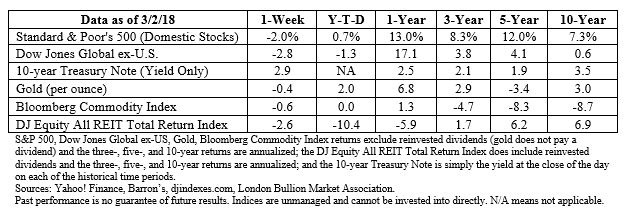
Last week, global stock markets took a bit of a dip after President Trump announced a 25 percent tariff on steel and a 10 percent tariff on aluminum. Tariffs are taxes on goods imported from other countries. In general, governments impose tariffs to enhance revenue and/or protect domestic industries from competition abroad.
Tariffs tend to spark fierce debate about protectionism and free trade. Proponents suggest tariffs may protect domestic companies and create jobs. Critics suggest tariffs may slow economic growth and drive prices higher.
Here’s the thing: tariffs don’t always produce the anticipated results. Let’s take a look at two examples while keeping in mind that World Trade Organization (WTO) rules do not allow countries to impose new tariffs unless they are ‘safeguards’ intended to protect a domestic industry.
In 2002, President George W. Bush imposed a tariff on steel. While the WTO was deliberating about the action, “…the European Union ended up hitting Bush where it hurt. The bloc planned tariffs on a wide range of products, including many produced in key swing states where job losses could hurt Bush’s chances of re-election,” reported Time. The WTO eventually decided the tariff was illegal. Eventually, in 2003, the tariff was removed.
In 2009, President Obama imposed a safeguard tariff on Chinese-made tires. China retaliated by restricting imports of American chicken feet (a culinary treat in China), reported The Economist. At the time, U.S. exports of chicken appendages were valued at about $278 million. Guess what happened?
Far fewer Chinese tires were exported to the United States. However, tire imports from South Korea, Thailand, and Indonesia doubled, more than offsetting the decline in Chinese-made tires, reported the Council on Foreign Affairs. On the other side of the tariff tiff, U.S. poultry exports to China fell, but U.S. poultry exports to Hong Kong rose. As they say, when one door closes, another door opens.
In the big picture, it’s unlikely U.S. tariffs on steel and aluminum will have significant impact on China, the reported target of the new steel tariffs. After all, China ranks eleventh on the list of nations sending steel to the United States, reported National Review. Most U.S. steel is imported from U.S. allies such as Canada, Mexico, and South Korea.
WHAT DOES YOUR STATE EXPORT? Every state has adopted official symbols that represent its culture and heritage. You can probably name your state’s official bird and flower. It’s likely you recognize your state’s flag and its seal. Can you name its highest value export?
The United States exported about $1.6 trillion worth of goods during 2017, according to The World Factbook. Here is a list of the states that export the most, along with their highest value exports:
1. Texas – fuel oil and light oil
2. California – civilian aircraft, engines, and parts
3. Washington – civilian aircraft, tanks, and armored vehicles
4. New York – diamonds and art
5. Illinois – light oil and soybeans
6. Michigan – trucks and passenger vehicles
7. Louisiana – fuel oil and soybeans
8. Florida – civilian aircraft and cellular phones
9. Ohio – civilian aircraft and soybeans
10. Pennsylvania – coal and medicine
11. Indiana – medicine and gear boxes
12. Georgia – civilian aircraft and gas turbines
13. New Jersey – fuel oil and jewelry
14. Tennessee – medical instruments and civilian aircraft
15. North Carolina – civilian aircraft and medicine
It’s interesting to note top-exporting states often are top-importing states. The top 10 states by import are: California, Texas, Michigan, Illinois, New York, New Jersey, Georgia, Pennsylvania, Tennessee, and Florida.
Weekly Focus – Think About It
“So, vision begins with the eyes, but it truly takes place in the brain.”
--Fei-Fei Li, Director of Stanford’s Artificial Intelligence Lab
* These views are those of Carson Group Coaching, and not the presenting Representative or the Representative’s Broker/Dealer, and should not be construed as investment advice.
* This newsletter was prepared by Carson Group Coaching. Carson Group Coaching is not affiliated with the named broker/dealer.
* Government bonds and Treasury Bills are guaranteed by the U.S. government as to the timely payment of principal and interest and, if held to maturity, offer a fixed rate of return and fixed principal value. However, the value of fund shares is not guaranteed and will fluctuate.
* Corporate bonds are considered higher risk than government bonds but normally offer a higher yield and are subject to market, interest rate and credit risk as well as additional risks based on the quality of issuer coupon rate, price, yield, maturity, and redemption features.
* The Standard & Poor's 500 (S&P 500) is an unmanaged group of securities considered to be representative of the stock market in general. You cannot invest directly in this index.
* All indexes referenced are unmanaged. Unmanaged index returns do not reflect fees, expenses, or sales charges. Index performance is not indicative of the performance of any investment.
* The Dow Jones Global ex-U.S. Index covers approximately 95% of the market capitalization of the 45 developed and emerging countries included in the Index.
* The 10-year Treasury Note represents debt owed by the United States Treasury to the public. Since the U.S. Government is seen as a risk-free borrower, investors use the 10-year Treasury Note as a benchmark for the long-term bond market.
* Gold represents the afternoon gold price as reported by the London Bullion Market Association. The gold price is set twice daily by the London Gold Fixing Company at 10:30 and 15:00 and is expressed in U.S. dollars per fine troy ounce.
* The Bloomberg Commodity Index is designed to be a highly liquid and diversified benchmark for the commodity futures market. The Index is composed of futures contracts on 19 physical commodities and was launched on July 14, 1998.
* The DJ Equity All REIT Total Return Index measures the total return performance of the equity subcategory of the Real Estate Investment Trust (REIT) industry as calculated by Dow Jones.
* Yahoo! Finance is the source for any reference to the performance of an index between two specific periods.
* Opinions expressed are subject to change without notice and are not intended as investment advice or to predict future performance.
* Economic forecasts set forth may not develop as predicted and there can be no guarantee that strategies promoted will be successful.
* Past performance does not guarantee future results. Investing involves risk, including loss of principal.
* You cannot invest directly in an index.
* Stock investing involves risk including loss of principal.
* Consult your financial professional before making any investment decision.
Sources:
https://yogiberramuseum.org/about-yogi/yogisms/
https://www.economist.com/news/business-and-finance/21737843-get-them-he-causing-chaos-president-donald-trump-wants-tariffs-steel-and (or go to https://s3-us-west-2.amazonaws.com/peakcontent/+Peak+Commentary/03-05-18_TheEconomist-President_Donald_Trump_Wants_Tariffs_on_Steel_and_Aluminium-Footnote_2.pdf)
https://www.investopedia.com/terms/t/tariff.asp
https://www.wto.org/english/tratop_e/safeg_e/safeg_e.htm
http://time.com/5180901/donald-trump-steel-aluminum-tariff/
https://www.washingtonpost.com/world/asia_pacific/us-china-embroiled-in-trade-spat-over-chicken-feet/2011/12/13/gIQASphjxO_print.html
https://www.cfr.org/blog/chicken-feet-and-china-back-future
https://www.nationalreview.com/2018/03/trump-steel-tariffs-bad-economics-bad-policy/
https://www.cia.gov/library/publications/the-world-factbook/rankorder/2078rank.html
http://tse.export.gov/tse/MapDisplay.aspx
https://www.census.gov/foreign-trade/statistics/state/data/index.html
http://tse.export.gov/stateimports/MapDisplay.aspx
https://www.ted.com/talks/fei_fei_li_how_we_re_teaching_computers_to_understand_pictures/transcript
February 26th Market Commentary
February 26, 2018
The Markets
U.S. Treasuries are offering a lesson in supply and demand.
Last week, the U.S. Treasury auctioned $258 billion in bonds. Treasury auctions are the way the United States government finances its debt. The Treasury sells short-, intermediate-, and long-term IOUs, known as bills, notes, and bonds. When investors and governments purchase bonds, they agree to lend money to the United States. In return, the United States agrees to pay an amount of interest over a certain period of time. At the end of that time, the government is expected to repay the money borrowed.
The price and interest paid on U.S. government debt is determined by supply and demand. When there are few bonds and a lot of demand, prices rise and interest rates fall. When there are a lot of bonds and little demand, prices fall and interest rates rise.
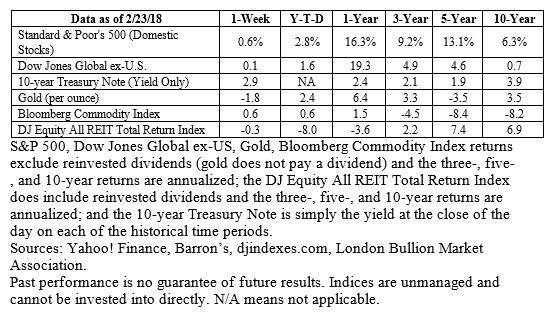
Last week, Barron’s reported, “The law of supply and demand meant that the glut of new Treasuries temporarily drove down prices and pushed up yields. The 10-year Treasury climbed during the week – brushing 2.95 percent – but ultimately lost half a basis point, ending at 2.87 percent. (A basis point is a hundredth of a percentage point.)”
The Treasury increased its debt issuance to fund tax reform and the two-year federal budget. Reuters reported, “…tax reform is expected to add as much as $1.5 trillion to the federal debt load, while the budget agreement would increase government spending by almost $300 billion over the next two years.”
A surplus of Treasury bonds, in tandem with decreased demand as the Federal Reserve reduces the holdings it accumulated during quantitative easing, could push Treasury rates higher. In addition, MarketWatch reported the Federal Reserve appears to be committed to gradually increasing the Fed funds rate to avoid an overheating economy and keep inflation down.
Higher interest rates may be coming.
OLYMPIC ATHLETES HAVE TO PAY THE BILLS, TOO. Not every American Olympian and Paralympian is a household name. Money.com reported, “These athletes don’t have the same kind of lucrative sponsorship deals as Olympic standouts like snowboarder Shaun White or alpine skiing star Lindsey Vonn – so they have to make ends meet, which can often mean squeezing in extra shifts during the off season, heading to the gym early in the morning before work and moving from a full-time position to a part-time one with no replacement for those lost wages.”
So, how do lesser-known athletes pay the bills while training?
• Sled hockey player Josh Pauls is a sales account executive. His teammate Steve Cash is a personal banker.
• Pairs figure skater Chris Knierim works as an auto mechanic and wants to have his own auto shop someday.
• Biathlon competitor Lowell Bailey is a singer and songwriter who plays in bluegrass bands.
• Curling team member Nina Roth is a registered nurse. Her teammate Tabitha Peterson is a pharmacist.
• Snowboarder Jonathan Cheever is a licensed plumber.
• Luger Emily Sweeney is a member of the National Guard, and so is bobsledder Nick Cunningham.
• Short track speed skater Jessica Kooreman has a real estate license.
• Luger Justin Krewson is a firefighter.
• Snowboarder Mike Schultz designs and engineers prosthetics.
• Nordic skier Kendall Gretsch works in tech support.
There is a lot to admire about Olympic and Paralympic athletes.
Weekly Focus – Think About It
“There are only three ways to meet the unpaid bills of a nation. The first is taxation. The second is repudiation. The third is inflation.”
--Herbert Hoover, 31st President of the United States
* These views are those of Carson Group Coaching, and not the presenting Representative or the Representative’s Broker/Dealer and should not be construed as investment advice.
* This newsletter was prepared by Carson Group Coaching. Carson Group Coaching is not affiliated with the named broker/dealer.
* Government bonds and Treasury Bills are guaranteed by the U.S. government as to the timely payment of principal and interest and, if held to maturity, offer a fixed rate of return and fixed principal value. However, the value of fund shares is not guaranteed and will fluctuate.
* Corporate bonds are considered higher risk than government bonds but normally offer a higher yield and are subject to market, interest rate and credit risk as well as additional risks based on the quality of issuer coupon rate, price, yield, maturity, and redemption features.
* The Standard & Poor's 500 (S&P 500) is an unmanaged group of securities considered to be representative of the stock market in general. You cannot invest directly in this index.
* All indexes referenced are unmanaged. Unmanaged index returns do not reflect fees, expenses, or sales charges. Index performance is not indicative of the performance of any investment.
* The Dow Jones Global ex-U.S. Index covers approximately 95% of the market capitalization of the 45 developed and emerging countries included in the Index.
* The 10-year Treasury Note represents debt owed by the United States Treasury to the public. Since the U.S. Government is seen as a risk-free borrower, investors use the 10-year Treasury Note as a benchmark for the long-term bond market.
* Gold represents the afternoon gold price as reported by the London Bullion Market Association. The gold price is set twice daily by the London Gold Fixing Company at 10:30 and 15:00 and is expressed in U.S. dollars per fine troy ounce.
* The Bloomberg Commodity Index is designed to be a highly liquid and diversified benchmark for the commodity futures market. The Index is composed of futures contracts on 19 physical commodities and was launched on July 14, 1998.
* The DJ Equity All REIT Total Return Index measures the total return performance of the equity subcategory of the Real Estate Investment Trust (REIT) industry as calculated by Dow Jones.
* Yahoo! Finance is the source for any reference to the performance of an index between two specific periods.
* Opinions expressed are subject to change without notice and are not intended as investment advice or to predict future performance.
* Economic forecasts set forth may not develop as predicted and there can be no guarantee that strategies promoted will be successful.
* Past performance does not guarantee future results. Investing involves risk, including loss of principal.
* You cannot invest directly in an index.
* Stock investing involves risk including loss of principal.
* Consult your financial professional before making any investment decision.
Sources:
https://www.barrons.com/articles/treasuries-undergo-a-glut-check-1519438243 (or go to https://s3-us-west-2.amazonaws.com/peakcontent/+Peak+Commentary/02-26-18_Barrons-Treasuries_Undergo_a_Glut_Check-Footnote_1.pdf)
https://www.treasurydirect.gov/instit/auctfund/work/work.htm
http://www.morningstar.com/cover/Classroom.html (Click on Bond Curriculum, Buying Bonds, Things to Consider When Buying Bonds) (or go to https://s3-us-west-2.amazonaws.com/peakcontent/+Peak+Commentary/02-26-18_Morningstar-Things_to_Consider_When_Buying_Bonds-Footnote_3.pdf)
https://www.investopedia.com/university/economics/economics3.asp
https://www.reuters.com/article/us-usa-auctions/jittery-u-s-bond-market-braces-for-supply-wave-idUSKCN1G20UH
https://www.marketwatch.com/story/fed-minutes-stronger-outlook-increases-the-chance-of-more-rate-hikes-2018-02-21
http://time.com/money/5116734/winter-olympic-athletes-with-jobs/
http://teamusa.usahockey.com/news_article/show/843629
https://www.aol.com/article/finance/2018/02/12/12-day-jobs-of-the-winter-olympics-athletes/23359714/#slide=7241016#fullscreen (or go to https://s3-us-west-2.amazonaws.com/peakcontent/+Peak+Commentary/02-26-18_AOL-Day_Jobs_of_the_Winter_Olympics_Athletes-Footnote_9.pdf)
https://www.engadget.com/2018/02/05/us-paralympian-designed-team-usa-snowboard-prosthetics/
https://www.teamusa.org/News/2018/January/19/Kendall-Gretsch-Is-On-Her-Way-To-Being-The-Next-Two-Sport-Paralympic-Star
https://www.brainyquote.com/quotes/herbert_hoover_753183