
April 2nd Market Commentary

April 2, 2018

The Markets

In like a lion…

Investors roared into 2018.

During the first week of the first quarter of the New Year, the Dow Jones Industrial Average rose above 25,000 for the first time ever. Less than two weeks later, it closed above 26,000. The Standard & Poor’s (S&P) 500 Index and NASDAQ Composite also reached new all-time highs.

Strong performance was supported by strong fundamentals. In December 2017, Mohamed A. El-Erian wrote in BloombergView economic and policy fundamentals, including synchronized global recovery, progress on U.S. tax reform, improved certainty around Brexit, and orderly acceptance of changing U.S. monetary policy, “…reinforce the prospects for better actual and future growth, thereby increasing the possibility of improved fundamentals validating notably elevated asset prices.”

During the first quarter, the global economy remained robust, reported Forbes. American companies were profitable (profitability is measured by earnings) and earnings per share for the S&P 500 Index are expected to increase during 2018. FactSet reported analysts currently estimate the S&P 500 Index will deliver double-digit earnings growth (18.5 percent overall) during 2018. Here’s what the analysts anticipate each quarter:

• Q1: Earnings growth of 17.3 percent 
• Q2: Earnings growth of 19.1 percent 
• Q3: Earnings growth of 20.9 percent 
• Q4: Earnings growth of 17.1 percent 

Improving expectations for American companies can be credited, in large part, to tax reform, which lowered corporate tax rates significantly. In addition, rising oil prices may help companies in the Energy sector, and rising interest rates may give a boost to companies in the Financials sector.

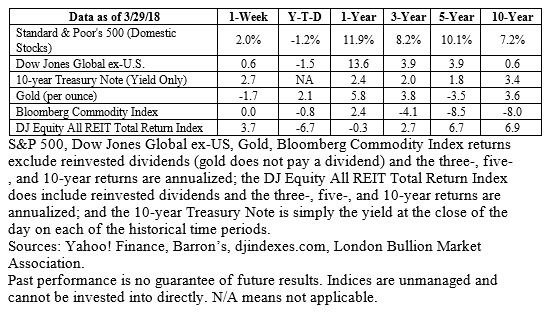
Despite a robust global economy, strong earnings, and improving earnings per share (EPS) expectations, the major U.S. stock indices delivered negative quarterly returns for the first time since 2015. On March 29, the last trading day of the quarter, the Dow closed at about 24,100.

If fundamentals are strong, why did major indices in the United States (and many indices around the world) finish the quarter lower? Financial Times suggested uncertainty might have something to do with the retreat:

“The tax cut has been achieved. We are no longer so sure that [President Trump’s] remaining ideas are so good, and most investors think his ideas about trade are downright terrible. And so the market has started reacting to presidential tweets… Most importantly, though, key assumptions have been stripped away. We can no longer rely on low volatility. And critically, the positive view of a low-inflation strong-growth future has been called into question – but only after the stock market had priced in that assumption as a done deal.”
Market declines may also reflect concern about valuations. One financial professional told Financial Times many asset classes have gone from being very expensive to being expensive. They haven’t yet gotten inexpensive.

Out like a lamb…

The last week of the quarter was a good one for U.S. stock markets, which pushed higher. However, the major indices were unable to overcome deficits accumulated earlier in the quarter. The Dow Jones Industrial Average gained 2.4 percent last week, finishing the quarter down 2.5 percent. The S&P 500 Index was up 2.0 percent last week, down 1.2 percent for the quarter. Likewise, the NASDAQ bounced 1.0 percent last week, but ended the quarter down 2.3 percent, reported Barron’s.
 

IF YOU ASKED ARTIFICIAL INTELLIGENCE (AI) TO BAKE, WHAT WOULD IT MAKE? Janelle Shane at PopSci.com wrote, “When computers try to imitate humans, they often get confused. But simulated brain cells in so-called neural networks can mimic our problem-solving skills. An AI will look at a dataset, figure out its governing rules, and use those instructions to make something new. We already employ these bots to recognize faces, drive cars, and caption images for the blind. But can a computer cook?”

Shane addressed the question by training a computer’s neural network to write a recipe. The computer reviewed a dataset of more than 24,000 online recipes (647 of them began with the word chocolate and 8 included blood as an ingredient). After two days of processing, the network delivered a remarkable recipe that includes a title, category, ingredients, and directions, although the nonsensical word choices are likely to leave bakers uncertain about how to proceed:

"CHOCOLATE BUTTERBROTH BLACK PUDDING

cheese/eggs

4 oz cocoa; finely ground
1 teaspoon butter
½ cup milk
¼ teaspoon pepper
¼ cup rice cream, chopped
1 lb cream
1 sesame peel

– DATE HOLY –

1 large egg
1 powdered sugar serving barme
¼ cup butter or margarine, melted

Brown sugar, chocolate; baking powder, beer, lemon juice and salt in chunk in greased 9x2 inch cake. Chill until golden brown and bubbly. Place serve garlic half by pieoun on top to make more use bay. Place in frying pan in preheated oven. Sprinkle with fresh parsley for cooking. Eating dish to hect in pot of the oil, pullover half-and half…Yield: 1 cake”

AI seems to have missed an important governing rule for recipes: Instructions should not include unlisted ingredients and all ingredients should be included in the instructions. DATE HOLY is particularly baffling. The author suggested the neural network might have been trying for frosting. It is a cake, after all. 

Weekly Focus – Think About It 

“We are surrounded by hysteria about the future of artificial intelligence and robotics – hysteria about how powerful they will become, how quickly, and what they will do to jobs…Mistaken predictions lead to fears of things that are not going to happen, whether it’s the wide-scale destruction of jobs, the Singularity, or the advent of AI that has values different from ours and might try to destroy us. We need to push back on these mistakes.” 
--Rodney Brooks, Australian robotics entrepreneur

* These views are those of Carson Group Coaching, and not the presenting Representative or the Representative’s Broker/Dealer, and should not be construed as investment advice.
* This newsletter was prepared by Carson Group Coaching. Carson Group Coaching is not affiliated with the named broker/dealer.
* Government bonds and Treasury Bills are guaranteed by the U.S. government as to the timely payment of principal and interest and, if held to maturity, offer a fixed rate of return and fixed principal value.  However, the value of fund shares is not guaranteed and will fluctuate.
* Corporate bonds are considered higher risk than government bonds but normally offer a higher yield and are subject to market, interest rate and credit risk as well as additional risks based on the quality of issuer coupon rate, price, yield, maturity, and redemption features.
* The Standard & Poor's 500 (S&P 500) is an unmanaged group of securities considered to be representative of the stock market in general. You cannot invest directly in this index.
* All indexes referenced are unmanaged. Unmanaged index returns do not reflect fees, expenses, or sales charges. Index performance is not indicative of the performance of any investment.
* The Dow Jones Global ex-U.S. Index covers approximately 95% of the market capitalization of the 45 developed and emerging countries included in the Index.
* The 10-year Treasury Note represents debt owed by the United States Treasury to the public. Since the U.S. Government is seen as a risk-free borrower, investors use the 10-year Treasury Note as a benchmark for the long-term bond market.
* Gold represents the afternoon gold price as reported by the London Bullion Market Association. The gold price is set twice daily by the London Gold Fixing Company at 10:30 and 15:00 and is expressed in U.S. dollars per fine troy ounce.
* The Bloomberg Commodity Index is designed to be a highly liquid and diversified benchmark for the commodity futures market. The Index is composed of futures contracts on 19 physical commodities and was launched on July 14, 1998.
* The DJ Equity All REIT Total Return Index measures the total return performance of the equity subcategory of the Real Estate Investment Trust (REIT) industry as calculated by Dow Jones.
* Yahoo! Finance is the source for any reference to the performance of an index between two specific periods.
* Opinions expressed are subject to change without notice and are not intended as investment advice or to predict future performance.
* Economic forecasts set forth may not develop as predicted and there can be no guarantee that strategies promoted will be successful.
* Past performance does not guarantee future results. Investing involves risk, including loss of principal.
* You cannot invest directly in an index.* Stock investing involves risk including loss of principal.
* Consult your financial professional before making any investment decision.

Sources:
https://www.barrons.com/articles/dow-25-000-how-high-can-it-go-1515213968 (or go to https://s3-us-west-2.amazonaws.com/peakcontent/+Peak+Commentary/04-02-18_Barrons-Dow_25000-How_High_Can_It_Go-Footnote_1.pdf)
https://www.bloomberg.com/view/articles/2017-12-11/4-developments-to-watch-in-global-economy
https://www.forbes.com/sites/kenrapoza/2018/03/27/sorry-bears-these-big-market-corrections-are-not-evidence-the-end-is-near/#307d2be9fa38
https://insight.factset.com/hubfs/Resources%20Section/Research%20Desk/Earnings%20Insight/EarningsInsight_032918.pdf
https://insight.factset.com/record-high-increase-in-sp-500-eps-estimates-for-q1-and-cy-2018
https://finance.yahoo.com/quote/%5EDJI/history?p=%5EDJI
https://www.ft.com/content/05a60e04-3357-11e8-ac48-10c6fdc22f03 (or go to https://s3-us-west-2.amazonaws.com/peakcontent/+Peak+Commentary/04-02-18_FinancialTimes-Four_Financial_Questions_for_Passover-Footnote_7.pdf)
https://www.ft.com/content/1e6c15e4-3359-11e8-ac48-10c6fdc22f03 (or go to https://s3-us-west-2.amazonaws.com/peakcontent/+Peak+Commentary/04-02-18_FinancialTimes-US_Stocks_Hit_by_First_Quarterly_Losses_Since_2015-Footnote_8.pdf)
https://www.barrons.com/articles/dow-gains-569-points-but-falls-for-the-quarter-1522454402 (or go to https://s3-us-west-2.amazonaws.com/peakcontent/+Peak+Commentary/04-02-18_Barrons-Dow_Gains_569_Points_but_Falls_for_the_Quarter-Footnote_9.pdf)
https://www.popsci.com/neural-network-bakes-a-cake (or go to https://s3-us-west-2.amazonaws.com/peakcontent/+Peak+Commentary/04-02-18_PopularScience-Recipe-Chocolate_Butterbroth_Black_Pudding-Footnote_10.pdf)
https://www.technologyreview.com/s/609048/the-seven-deadly-sins-of-ai-predictions/

March 26th Market Commentary

March 26, 2018

The Markets

Why am I saving and investing?

After a week like last week, it’s an important question. There are many reasons people save and invest, including to:

• Live the life they want today and in the future
• Accumulate resources so they’re prepared for any bumps in the road
• Provide an education for their children• Offer assistance to parents
• Support a young person with a disability
• Do good in the world
• Live comfortably in retirement without anxiety

However, none of these reasons have anything to do with short-term market fluctuations. 

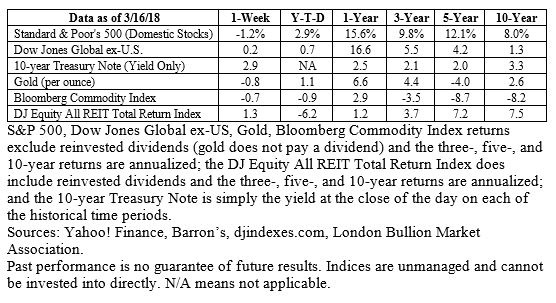
Last week, major U.S. stock indices experienced a selloff, and we saw a dramatic downturn in stock markets. The Dow Jones Industrial Average was down 5.7 percent, the Standard & Poor’s 500 index lost 6 percent, and the NASDAQ fell 6.5 percent, reported Barron’s.

Those are big moves for a single week. The kind of moves that light up the emotion centers of investors’ brains and make them want to sell.

It’s not a new phenomenon. In 2002, in an article for CNN Money, Jason Zweig explained the brain’s potentially negative influence on investment decisions, “But in the world of investing, a panicky response to a false alarm – dumping all your stocks just because the Dow is dropping – can be as costly as ignoring real danger. For one thing, it can cause you to flee the market at a low point and miss out when the market bounces back. A moment of panic can also disrupt your long-term investing strategy.”

So, what happened last week? In short:

The Fed raised rates, as expected. The Federal Reserve raised the Fed funds rate by a quarter of a percent, which may benefit savers and investors, but will make borrowing more expensive.
Tariffs triggered trade war worries. The Trump administration levied tariffs on China, raising concerns of a global trade war.
You’re fired! There was additional turnover among senior advisers to President Trump.
Can they do that? British news reported a data analytics firm has been influencing elections around the world in some unsavory ways.
Don’t share my data! There was news a social media firm had shared the personal data of thousands with a researcher who shared it with a third-party firm without permission.
Sigh. Another data breach. An online travel company experienced a data breach that may have exposed the personal information of 880,000 users.
The economy is chugging along. Last week’s U.S. economic releases were overshadowed by everything else, but many indicated a strengthening economy, reported Barron’s.

That’s a lot to take in over the span of five days. The critical thing is to recognize these short-term events are unlikely to change your long-term financial goals. Financial decisions, including buying and selling investments, are important and can be life shaping. They should be grounded by long-term financial goals and foundational principles of investing. They should not be based on the brain’s instinctive fear and flight response. 


LET’S TAKE A GOOD NEWS BREAK. After last week, we could all use some good news. Here are 10 intriguing headlines from the Good News Network:

1. Scientists Believe They Found a Way to Stop Future Hurricanes in Their Tracks
2. Strangers Rally Around 13-Year-old Whose Rock Museum was Robbed
3. Dog that Shoplifted a Book on ‘Abandonment’ is Given the Love It was Asking For
4. Stranger Becomes Honorary Grandma After She Opens Home to Stranded Father in Distress
5. We’re Not Spinning a Yarn Here: Knitting May Boost Health and Happiness
6. Robot Becomes Part of the Community After Easing Daily Burden of Water Collection in Remote Village
7. Instead of Using Trees, Scientists are Making Sustainable Paper Out of Manure
8. World’s First Mass-Produced, 3D-Printed Car is Electric and Costs Under $10K
9. This Pollution-Gobbling City Bench Can Absorb as Many Toxins as 275 Trees
10. Free Clothing Hung on Streets to Help the Homeless Stay Warm

There is a lot of good news in the world. Unfortunately, it doesn’t pack a wallop like bad news does, so we hear less about it. 

Weekly Focus – Think About It 

“When the weather changes, nobody believes the laws of physics have changed. Similarly, I don't believe that when the stock market goes into terrible gyrations its rules have changed.” 
--Benoit Mandelbrot, Mathematician and polymath

* These views are those of Carson Group Coaching, and not the presenting Representative or the Representative’s Broker/Dealer, and should not be construed as investment advice.
* This newsletter was prepared by Carson Group Coaching. Carson Group Coaching is not affiliated with the named broker/dealer.
* Government bonds and Treasury Bills are guaranteed by the U.S. government as to the timely payment of principal and interest and, if held to maturity, offer a fixed rate of return and fixed principal value.  However, the value of fund shares is not guaranteed and will fluctuate.
* Corporate bonds are considered higher risk than government bonds but normally offer a higher yield and are subject to market, interest rate and credit risk as well as additional risks based on the quality of issuer coupon rate, price, yield, maturity, and redemption features.
* The Standard & Poor's 500 (S&P 500) is an unmanaged group of securities considered to be representative of the stock market in general. You cannot invest directly in this index.
* All indexes referenced are unmanaged. Unmanaged index returns do not reflect fees, expenses, or sales charges. Index performance is not indicative of the performance of any investment.
* The Dow Jones Global ex-U.S. Index covers approximately 95% of the market capitalization of the 45 developed and emerging countries included in the Index.
* The 10-year Treasury Note represents debt owed by the United States Treasury to the public. Since the U.S. Government is seen as a risk-free borrower, investors use the 10-year Treasury Note as a benchmark for the long-term bond market.
* Gold represents the afternoon gold price as reported by the London Bullion Market Association. The gold price is set twice daily by the London Gold Fixing Company at 10:30 and 15:00 and is expressed in U.S. dollars per fine troy ounce.
* The Bloomberg Commodity Index is designed to be a highly liquid and diversified benchmark for the commodity futures market. The Index is composed of futures contracts on 19 physical commodities and was launched on July 14, 1998.
* The DJ Equity All REIT Total Return Index measures the total return performance of the equity subcategory of the Real Estate Investment Trust (REIT) industry as calculated by Dow Jones.
* Yahoo! Finance is the source for any reference to the performance of an index between two specific periods.
* Opinions expressed are subject to change without notice and are not intended as investment advice or to predict future performance.
* Economic forecasts set forth may not develop as predicted and there can be no guarantee that strategies promoted will be successful.
* Past performance does not guarantee future results. Investing involves risk, including loss of principal.
* You cannot invest directly in an index.
* Stock investing involves risk including loss of principal.
* Consult your financial professional before making any investment decision.

Sources:
https://www.barrons.com/articles/why-did-dow-drop-1-400-pick-your-poison-1521852744 (or go to https://s3-us-west-2.amazonaws.com/peakcontent/+Peak+Commentary/03-26-18_Barrons-Why_Did_Dow_Drop_1400-Pick_Your_Poison-Footnote_1.pdf)
https://www.scientificamerican.com/article/what-is-loss-aversion/
http://money.cnn.com/2002/09/25/pf/investing/agenda_brain_short/index.htm
https://www.consumerreports.org/interest-rate/fed-rate-hike-your-money/
https://www.cnn.com/2018/03/22/politics/donald-trump-china-tariffs-trade-war/index.html
https://www.brookings.edu/research/tracking-turnover-in-the-trump-administration/
https://www.ft.com/content/e4e95b6c-2dac-11e8-9b4b-bc4b9f08f381 (or go to https://s3-us-west-2.amazonaws.com/peakcontent/+Peak+Commentary/03-26-18_FinancialTimes-Chiefs_Hubris_Steered_Cambridge_Analytica_to_Data_Scandal-Footnote_7.pdf)
https://www.marketwatch.com/story/this-data-breach-affected-880000-people-and-it-has-nothing-to-do-with-facebook-2018-03-24
https://www.cnet.com/news/how-to-stop-sharing-facebook-data-after-cambridge-analytica-mess/
http://www.barrons.com/mdc/public/page/9_3063-economicCalendar.html?mod=BOL_Nav_MAR_other (Click on U.S. & Intl Recaps, then "Factory sector accelerates, housing prices climb") (or go to https://s3-us-west-2.amazonaws.com/peakcontent/+Peak+Commentary/03-26-18_Barrons-Factory_Sector_Accerlerates-Housing_Prices_Climb-Footnote_10.pdf)
https://www.goodnewsnetwork.org/scientists-believe-they-found-a-way-to-stop-future-hurricanes-in-their-tracks/
https://www.goodnewsnetwork.org/strangers-rally-around-13-year-old-whose-rock-museum-was-robbed/
https://www.goodnewsnetwork.org/dog-shoplifts-book-on-abandonment/
https://www.goodnewsnetwork.org/stranger-becomes-honorary-grandma-after-she-opens-home-to-stranded-father-in-distress/
https://www.goodnewsnetwork.org/were-not-spinning-a-yarn-here-knitting-may-boost-health-and-happiness/
https://www.goodnewsnetwork.org/robot-becomes-part-of-the-community-after-easing-daily-burden-of-water-collection-in-remote-village/
https://www.goodnewsnetwork.org/instead-of-using-trees-scientists-are-making-sustainable-paper-out-of-manure/
https://www.goodnewsnetwork.org/worlds-first-mass-produced-3d-printed-car-is-electric-and-costs-under-10k/
https://www.goodnewsnetwork.org/this-pollution-gobbling-city-bench-absorbs-as-much-co2-as-275-trees/
https://www.goodnewsnetwork.org/free-clothing-hung-on-streets-to-help-the-homeless/
https://www.brainyquote.com/quotes/benoit_mandelbrot_301439

March 19th Market Commentary

March 19, 2018

The Markets

It’s a good time for a gut check. 

Last week, after sliding lower for four days, the Standard & Poor’s 500 Index recouped some of its losses on Friday. The reasons behind the week’s poor showing were diverse. Barron’s reported:

“The market is so discombobulated right now that it can’t even decide what it’s afraid of. What do we mean? When the Standard & Poor’s 500 index suffered its first correction since the beginning of 2016 last month, the cause was easily identified – a good old-fashioned inflation scare caused by a larger-than-expected increase in wages and a rapidly rising 10-year Treasury yield, which almost hit 3 percent…Fast-forward more than a month and those fears seem almost quaint.” 

Those fears included:

• Special Counsel Robert Mueller’s subpoena of the Trump Organization.
• The effects of recent tariffs and the possibility of trade wars.
• The departure of Secretary of State Rex Tillerson.
• The Atlanta Fed revised its GDPNow Forecast downward for the first quarter of 2018. Weakness in consumer spending, net exports, and inventory investment offset gains in private fixed-investment growth.
• The Commerce Department reported weak retail sales for the third month in a row. Economists had expected sales to rise.

Here’s the thing: During 2017, volatility settled at historically low levels and stock markets charged ahead. As a result, it was relatively easy for investors to become sanguine about risk. You could say 2017 made investing seem as mundane as driving across the flatlands of the Plains states. It’s possible 2018 will be more like traveling icy switchbacks through the Rocky Mountains. 

No matter what happens in the months to come, it’s a good time to reassess your risk tolerance and make sure it aligns with your financial goals and asset allocation.

 
HOW MUCH DO YOU SPEND ON HEALTHCARE? Healthcare costs have been going up for a long time. The Centers for Medicare & Medicaid Services reported annual health spending – healthcare paid for through private health insurance, Medicare, Medicaid, or out-of-pocket spending by businesses, households and governments – in the United States averaged $3.3 trillion in 2016.

That’s about $10,348 per person. It’s a significant amount even before you consider the median income in the United States was about $57,600 that year.

Here’s another perspective: Healthcare spending was equal to almost one-fifth (17.9 percent of GDP) of everything the United States economy produced during 2016 (Gross Domestic Product – GDP – measures the value of all goods and services produced in a country). That’s more than U.S. manufacturing produced (11.7 percent of GDP) during 2016. Add in retail (5.9 percent of GDP) and the total is just shy of spending on healthcare.

The cost of healthcare is important not just because it’s high, but because it’s a critical aspect of retirement planning. A retirement plan is built around a horizon, which is the number of years you expect retirement to last. It’s a difficult number to think about because it’s a reflection of how long you expect to live. 

In general, the planning horizon for women should be longer than the planning horizon for men. Women tend to live longer, and that means their healthcare costs may be considerably higher. About $79,000 higher, according to one estimate that found a healthy 55-year-old woman could pay almost $523,000 in healthcare expenses (Medicare Parts A, B, D, a supplemental policy F, dental, and all out-of-pocket expenses) during retirement.

There are a variety of approaches that may help cover the expense – even if you’re closing in on retirement. A retirement planning strategy that factors in healthcare expenses with an appropriate planning horizon can help improve financial stability in your later years.

Weekly Focus – Think About It 

“We're optimistic about ourselves, we're optimistic about our kids, we're optimistic about our families, but we're not so optimistic about the guy sitting next to us, and we're somewhat pessimistic about the fate of our fellow citizens and the fate of our country. But private optimism about our own personal future remains persistent. And it doesn't mean that we think things will magically turn out okay, but rather that we have the unique ability to make it so."
 --Tali Sharot, Associate Professor of Cognitive Neuroscience, University College London

* These views are those of Carson Group Coaching, and not the presenting Representative or the Representative’s Broker/Dealer, and should not be construed as investment advice.
* This newsletter was prepared by Carson Group Coaching. Carson Group Coaching is not affiliated with the named broker/dealer.
* Government bonds and Treasury Bills are guaranteed by the U.S. government as to the timely payment of principal and interest and, if held to maturity, offer a fixed rate of return and fixed principal value.  However, the value of fund shares is not guaranteed and will fluctuate.
* Corporate bonds are considered higher risk than government bonds but normally offer a higher yield and are subject to market, interest rate and credit risk as well as additional risks based on the quality of issuer coupon rate, price, yield, maturity, and redemption features.
* The Standard & Poor's 500 (S&P 500) is an unmanaged group of securities considered to be representative of the stock market in general. You cannot invest directly in this index.
* All indexes referenced are unmanaged. Unmanaged index returns do not reflect fees, expenses, or sales charges. Index performance is not indicative of the performance of any investment.
* The Dow Jones Global ex-U.S. Index covers approximately 95% of the market capitalization of the 45 developed and emerging countries included in the Index.
* The 10-year Treasury Note represents debt owed by the United States Treasury to the public. Since the U.S. Government is seen as a risk-free borrower, investors use the 10-year Treasury Note as a benchmark for the long-term bond market.
* Gold represents the afternoon gold price as reported by the London Bullion Market Association. The gold price is set twice daily by the London Gold Fixing Company at 10:30 and 15:00 and is expressed in U.S. dollars per fine troy ounce.
* The Bloomberg Commodity Index is designed to be a highly liquid and diversified benchmark for the commodity futures market. The Index is composed of futures contracts on 19 physical commodities and was launched on July 14, 1998.
* The DJ Equity All REIT Total Return Index measures the total return performance of the equity subcategory of the Real Estate Investment Trust (REIT) industry as calculated by Dow Jones.
* Yahoo! Finance is the source for any reference to the performance of an index between two specific periods.
* Opinions expressed are subject to change without notice and are not intended as investment advice or to predict future performance.
* Economic forecasts set forth may not develop as predicted and there can be no guarantee that strategies promoted will be successful.
* Past performance does not guarantee future results. Investing involves risk, including loss of principal.
* You cannot invest directly in an index.* Stock investing involves risk including loss of principal.
* Consult your financial professional before making any investment decision.

Sources:
https://finance.yahoo.com/quote/%5EGSPC/history?p=%5EGSPC
https://www.barrons.com/articles/whipsawed-by-events-the-dow-drops-389-points-1521249865 (or go to https://s3-us-west-2.amazonaws.com/peakcontent/+Peak+Commentary/03-19-18_Barrons-Whipsawed_by_Events_the_Dow_Drops_389_Points-Footnote_2.pdf)
https://www.frbatlanta.org/cqer/research/gdpnow.aspx
https://www.cnbc.com/2018/03/14/retail-sales-decline-for-third-straight-month-in-february.html
https://finance.yahoo.com/news/markets-story-2017-fake-news-real-returns-162747489.html
https://www.cms.gov/Research-Statistics-Data-and-Systems/Statistics-Trends-and-Reports/NationalHealthExpendData/index.html
https://www.cms.gov/research-statistics-data-and-systems/statistics-trends-and-reports/nationalhealthexpenddata/nhe-fact-sheet.html
https://www.bea.gov/iTable/iTable.cfm?reqid=56&step=2&isuri=1#reqid=56&step=51&isuri=1&5602=5 (Click on Value Added By Industry, then select U. Value Added by Industry as Percentage of Gross Domestic Product) (or go to https://s3-us-west-2.amazonaws.com/peakcontent/+Peak+Commentary/03-19-18_BureauOfEconomics-U_Value_Added_by_Industry_as_a_Percentage_of+GDP-Footnote_8.pdf)
http://www.hvsfinancial.com/wp-content/uploads/2016/12/Women_Retirement_Health_Care.pdf 
https://www.ted.com/talks/tali_sharot_the_optimism_bias/transcript#t-141213