
April 23rd Market Commentary

April 23, 2018

The Markets

The world is in debt. 

The April 2018 International Monetary Fund (IMF) Fiscal Monitor reported global debt has reached a historically high level. In 2016, debt peaked at 225 percent of global gross domestic product (GDP) (the value of all goods and services produced across the world). Public debt is a significant component of global debt. The IMF wrote:

“For advanced economies, debt-to-GDP ratios have plateaued since 2012 above 105 percent of GDP – levels not seen since World War II – and are expected to fall only marginally over the medium term…In emerging market and middle-income economies, debt-to-GDP ratios in 2017 reached almost 50 percent – a level seen only during the 1980s’ debt crisis – and are expected to continue on an upward trend.”

There are numerous reasons high levels of government debt (the amount a government owes) and significant deficits (the difference between how much a government takes in from taxes and other sources and how much it spends) are a cause for concern: 

Higher interest payments. Governments typically finance debt by issuing government bonds. When bonds mature, the government issues new debt. If interest rates have risen, the cost of that debt increases. As a result, high debt levels can make tax hikes and spending cuts a necessity, explained the Committee for a Responsible Federal Budget.
Lower national savings and income. You may have heard the phrase, “Robbing Peter to pay Paul,” which means taking money from one source to pay another. When a country runs a deficit, a similar thing happens. In The Long-Run Effects of Federal Budget Deficits on National Saving and Private Domestic Investment, the Congressional Budget Office explained, “…a dollar’s increase in the federal deficit results in…a 33 cent decline in domestic investment.”
The tax lag. In his book, Do Deficits Matter?, Daniel Shaviro suggests sustained deficit spending creates a ‘tax lag’ by shifting responsibility for current spending onto future generations.

The IMF Fiscal Monitor wrote, “countries need to build fiscal buffers now by reducing government deficits and putting debt on a steady downward path.”

Last week, the interest rate on 10-year U.S. Treasuries rose above 2.9 percent, which raised concerns about inflation. Markets moved higher early in the week and tumbled later in the week. The major U.S. stock indices finished the week higher.


ARE YOU AN INSECT GOURMET? Throughout history, people have eaten bugs. According to National Geographic, hunter-gatherers probably learned which insects were edible by watching birds. People’s appetite for bugs didn’t disappear as they became more civilized. Pliny, a Roman scholar, wrote beetle larvae fed a diet of flour and wine were a favorite snack of aristocratic Romans.

The tradition of eating insects continues today.

According to National Geographic, “Gourmands in Japan savor aquatic fly larvae sautéed in sugar and soy sauce. De-winged dragonflies boiled in coconut milk with ginger and garlic are a delicacy in Bali. Grubs are savored in New Guinea and aboriginal Australia. In Latin America cicadas, fire-roasted tarantulas, and ants are prevalent in traditional dishes.”

Reuters said in Germany, Netherlands, and Belgium, shoppers can buy burgers made of buffalo worms (the larvae of buffalo beetles) at the local grocery. It’s a visually pleasing product, according to one of the burger company’s founders, because the insects don’t show.

In North Carolina, diners can order a tarantula burger, described as “…a hamburger topped with a crunchy full-grown, oven-roasted tarantula.” It comes with a side of fries – and possibly a drink to wash it down as fast as possible. Other restaurants across the United States offer fried silkworm larvae, red ant salad, cricket crab cakes and cricket pastry, and grasshopper rolls, according to Reuters and Spoon University.

Bon appetit! (Or should that be bug appetit?) 

Weekly Focus – Think About It 

“Then I say the earth belongs to each of these generations during its course, fully, and in their own right. The 2d. generation receives it clear of the debts and encumbrances of the 1st., the 3d. of the 2d. and so on. For if the 1st. could charge it with a debt, then the earth would belong to the dead and not the living generation. Then no generation can contract debts greater than may be paid during the course of its own existence.”
--Thomas Jefferson, Third President of the United States and principal author of the Declaration of Independence

* These views are those of Carson Group Coaching, and not the presenting Representative or the Representative’s Broker/Dealer, and should not be construed as investment advice.
* This newsletter was prepared by Carson Group Coaching. Carson Group Coaching is not affiliated with the named broker/dealer.
* Government bonds and Treasury Bills are guaranteed by the U.S. government as to the timely payment of principal and interest and, if held to maturity, offer a fixed rate of return and fixed principal value.  However, the value of fund shares is not guaranteed and will fluctuate.
* Corporate bonds are considered higher risk than government bonds but normally offer a higher yield and are subject to market, interest rate and credit risk as well as additional risks based on the quality of issuer coupon rate, price, yield, maturity, and redemption features.
* The Standard & Poor's 500 (S&P 500) is an unmanaged group of securities considered to be representative of the stock market in general. You cannot invest directly in this index.
* All indexes referenced are unmanaged. Unmanaged index returns do not reflect fees, expenses, or sales charges. Index performance is not indicative of the performance of any investment.
* The Dow Jones Global ex-U.S. Index covers approximately 95% of the market capitalization of the 45 developed and emerging countries included in the Index.
* The 10-year Treasury Note represents debt owed by the United States Treasury to the public. Since the U.S. Government is seen as a risk-free borrower, investors use the 10-year Treasury Note as a benchmark for the long-term bond market.
* Gold represents the afternoon gold price as reported by the London Bullion Market Association. The gold price is set twice daily by the London Gold Fixing Company at 10:30 and 15:00 and is expressed in U.S. dollars per fine troy ounce.
* The Bloomberg Commodity Index is designed to be a highly liquid and diversified benchmark for the commodity futures market. The Index is composed of futures contracts on 19 physical commodities and was launched on July 14, 1998.
* The DJ Equity All REIT Total Return Index measures the total return performance of the equity subcategory of the Real Estate Investment Trust (REIT) industry as calculated by Dow Jones.
* Yahoo! Finance is the source for any reference to the performance of an index between two specific periods.
* Opinions expressed are subject to change without notice and are not intended as investment advice or to predict future performance.
* Economic forecasts set forth may not develop as predicted and there can be no guarantee that strategies promoted will be successful.
* Past performance does not guarantee future results. Investing involves risk, including loss of principal.
* You cannot invest directly in an index.
* Stock investing involves risk including loss of principal.
* Consult your financial professional before making any investment decision.

Sources:
http://www.imf.org/en/Publications/FM/Issues/2018/04/06/fiscal-monitor-april-2018 (Click on Chapter 1, Full Text of Chapter 1, page 1)
https://www.investopedia.com/articles/personal-finance/081315/debt-vs-deficit-understanding-differences.asp
http://www.crfb.org/blogs/marc-goldwein-national-debt-yes-rising-annual-deficits-threaten-us-economy
http://www.cbo.gov/sites/default/files/cbofiles/attachments/45140-NSPDI_workingPaper.pdf (Page 6)
http://www.press.uchicago.edu/Misc/Chicago/751120.html
https://www.nasdaq.com/article/stock-market-news-for-apr-20-2018-cm950849
http://online.barrons.com/mdc/public/page/9_3063-economicCalendar.html (Click on “U.S. & Intl Recaps,” then "Geopolitical concerns ease")
https://news.nationalgeographic.com/news/2004/07/0715_040715_tvinsectfood.html
https://www.reuters.com/article/us-germany-food-insectburger/german-shoppers-sample-burgers-made-of-buffalo-worms-idUSKBN1HS0JF
https://www.reuters.com/article/us-north-carolina-tarantula-burger/you-want-tarantula-with-that-at-u-s-burger-joint-its-an-option-idUSKBN1HO29S
https://spoonuniversity.com/place/us-restaurants-that-serve-insect-dishes
http://library.intellectualtakeout.org/content/quotes-united-states-national-debt-budget-deficits
April 16th Market Commentary

April 16, 2018

The Markets

What do you think?

• Are you bullish, bearish, or neutral about the U.S. stock market? 
• Are U.S. stocks undervalued, overvalued, or fairly valued?
• What is the biggest threat the U.S. stock market faces this year?

During the first four months of 2018, U.S. stocks have experienced not one, but two, 10 percent declines. These short-term reversals are known as corrections. They occur relatively often, helping to wring out investor exuberance and, sometimes, to create buying opportunities as share prices drop.

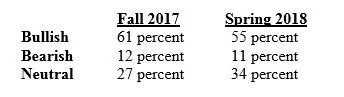
The current twinset of corrections appears to have created a fair amount of uncertainty, according to Barron’s bi-annual Big Money Poll of professional investors. The ranks of the bullish have diminished, and the bearish remain relatively unchanged, but the number of those who are ‘neutral’ has swelled:

April 16th Commentary pic 1.jpg


Professional investors say their clients are also unsure about stock markets. They indicated 60 percent of clients were neutral about stocks, while 23 percent were bullish and 17 percent were bearish.


When asked about market valuations, a majority thought U.S. stocks were fairly valued (57 percent) after the corrections. Thirty-five percent believe stocks remain overvalued, and 8 percent believe stocks have become undervalued.

If either ‘political/policy missteps’ or ‘rising interest rates’ was your answer to the biggest threat to U.S. stocks, then you’re thinking like a professional investor. Their list of worries included:

April 16th Commentary pic 2.jpg

Last week, the Dow Jones Industrial Average gained 1.8 percent, the Standard & Poor’s 500 Index was up 2.0 percent, and the NASDAQ Composite rose 2.8 percent.

April 16th Commentary pic 3.jpg


WHAT DOES YOUR PLAYLIST SAY ABOUT YOU? Your preference for pop, country, opera, classic rock, or some other type of music may provide clues to your personality, according to an article in Psychological Science entitled ‘Musical Preferences Predict Personality.’

Psychologists have been studying ‘personality’ for a long time. Their goal is to understand why people think, feel, and behave differently in the same situation. The prevailing personality model is called the ‘Big Five.’ It holds there are five factors that describe a broad range of personality traits and characteristics. No single factor describes personality by itself:

Extroversion includes people on two ends of a spectrum, introverts and extroverts. Extroverts thrive on interactions with others while introverts thrive on solitude. This factor reflects a person’s tendency to be sociable, assertive, talkative, and friendly. 
Agreeableness describes how well people get along well with others. This factor encompasses altruism, trust, tact, and loyalty.
Conscientiousness describes how well people control their impulses and act in socially acceptable ways. It encompasses persistence, ambition, energy, and resourcefulness.
Neuroticism describes how comfortable and confident people are with themselves. It encompasses awkwardness, pessimism, insecurity, and wariness.
Openness to experience describes willingness to try new experiences and think outside the box. This factor reflects perceptiveness, curiosity, insightfulness, and imagination.

As it turns out, musical preferences are pretty good predictors of some personality factors, especially openness, extroversion, and agreeableness. Openness is associated with a preference for ‘sophisticated’ music (classical, operatic, world, and jazz), extroversion is associated with ‘unpretentious’ music (country and folk), and, as you might expect, agreeableness is associated with liking all types of music. 
It’s notable that musical preferences fail to predict conscientiousness.

Weekly Focus – Think About It

“Sometimes they would take two ropes and turn them as a single rope together, but you could separate them and turn them in like an eggbeater on each other. The skipping rope was like a steady timeline – tick, tick, tick, tick – upon which you can add rhymes and rhythms and chants. Those ropes created a space where we were able to contribute to something that was far greater than the neighborhood.”
--Kyra Gaunt, Professor, Songwriter, Performer

* These views are those of Carson Group Coaching, and not the presenting Representative or the Representative’s Broker/Dealer, and should not be construed as investment advice.
* This newsletter was prepared by Carson Group Coaching. Carson Group Coaching is not affiliated with the named broker/dealer.
* Government bonds and Treasury Bills are guaranteed by the U.S. government as to the timely payment of principal and interest and, if held to maturity, offer a fixed rate of return and fixed principal value.  However, the value of fund shares is not guaranteed and will fluctuate.
* Corporate bonds are considered higher risk than government bonds but normally offer a higher yield and are subject to market, interest rate and credit risk as well as additional risks based on the quality of issuer coupon rate, price, yield, maturity, and redemption features.
* The Standard & Poor's 500 (S&P 500) is an unmanaged group of securities considered to be representative of the stock market in general. You cannot invest directly in this index.
* All indexes referenced are unmanaged. Unmanaged index returns do not reflect fees, expenses, or sales charges. Index performance is not indicative of the performance of any investment.
* The Dow Jones Global ex-U.S. Index covers approximately 95% of the market capitalization of the 45 developed and emerging countries included in the Index.
* The 10-year Treasury Note represents debt owed by the United States Treasury to the public. Since the U.S. Government is seen as a risk-free borrower, investors use the 10-year Treasury Note as a benchmark for the long-term bond market.
* Gold represents the afternoon gold price as reported by the London Bullion Market Association. The gold price is set twice daily by the London Gold Fixing Company at 10:30 and 15:00 and is expressed in U.S. dollars per fine troy ounce.
* The Bloomberg Commodity Index is designed to be a highly liquid and diversified benchmark for the commodity futures market. The Index is composed of futures contracts on 19 physical commodities and was launched on July 14, 1998.
* The DJ Equity All REIT Total Return Index measures the total return performance of the equity subcategory of the Real Estate Investment Trust (REIT) industry as calculated by Dow Jones.
* Yahoo! Finance is the source for any reference to the performance of an index between two specific periods.
* Opinions expressed are subject to change without notice and are not intended as investment advice or to predict future performance.
* Economic forecasts set forth may not develop as predicted and there can be no guarantee that strategies promoted will be successful.
* Past performance does not guarantee future results. Investing involves risk, including loss of principal.
* You cannot invest directly in an index.* Stock investing involves risk including loss of principal.
* Consult your financial professional before making any investment decision.

Sources:
https://www.investopedia.com/terms/c/correction.asp
https://www.barrons.com/articles/big-money-poll-more-good-news-for-stocks-1523665374 (or go to https://s3-us-west-2.amazonaws.com/peakcontent/+Peak+Commentary/04-16-18_Barrons-Big_Money_Poll-More_Good_News_for_Stocks-Footnote_2.pdf)
https://www.barrons.com/articles/dow-closes-the-week-up-427-pointsthe-hard-way-1523664000 (or go to https://s3-us-west-2.amazonaws.com/peakcontent/+Peak+Commentary/04-16-18_Barrons-Dow_Closes_the_Week_Up_427_Points-the_Hard_Way-Footnote_3.pdf)
https://www.researchgate.net/publication/322506461_Musical_Preferences_Predict_Personality_Evidence_from_Active_Listening_and_Facebook_Likes
https://positivepsychologyprogram.com/big-five-personality-theory/
https://www.ted.com/talks/kyra_gaunt_how_the_jump_rope_got_its_rhythm/transcript#t-84378

April 9th Market Commentary

April 9, 2018

The Markets

You could almost hear the spurs jingling.

Trade tensions ratcheted higher last week as the United States and China staked new positions on the not-so-dusty main street of trade. It was the latest round of posturing in what has the potential to become a trade war between the world’s largest economies. Barron’s explained:

“The trade battle has escalated since President Trump announced steel tariffs in March. China retaliated to those tariffs with its own duties, and the resulting back and forth resulted in announced tariffs on $50 billion worth of goods on both sides. Late on Thursday, Trump also directed the U.S. trade representative to identify $100 billion more in potential tariffs on Chinese goods.”

It was unwelcome news in financial markets where one-upmanship created uncertainty and unnerved investors. Distress in stock and bond markets may have been exacerbated by analysts’ warnings about worst-case scenarios, including the possibility of China reducing its $1.2 trillion position in U.S. Treasuries and diversifying its foreign exchange reserves into other nation’s currencies, according to Financial Times.

American manufacturing businesses have concerns about supply chain and other issues that may be created by tariffs, reported Forbes. In addition, farmers are bracing for the impact of a potential trade war. The New York Times wrote:

“China’s aggressive response to Mr. Trump’s tariffs is aimed squarely at products produced in the American heartland, a region that helped send him to the White House. A trade war with China could be particularly devastating to rural economies, especially for pig farmers and soybean and corn growers. Nearly two-thirds of United States soybean exports go to China.”

Major U.S. indices finished lower last week for the third time in four weeks. The Dow Jones Industrial Average was down 10.1 percent from its January closing high. Technically, that puts the Dow in correction territory.

April 9th Commentary.jpg


THE NOT-SO-SECRET MARCH MADNESS EFFECT. Have you ever wondered how students select colleges? Economic theory suggests, “Models of college choice typically assume that high school students are fully informed and choose to apply to and eventually attend a school that maximizes their expected, present discounted value of future wages less the costs associated with college attendance.”

It’s a good theory, if you’re an economist who believes people act in perfectly rational ways. Of course, there aren’t many high school students (or parents) who can explain the present discounted value of something, much less use it as a tool to choose a college.

The filters on college search tools include criteria that may be more relevant to the decision. College Board’s BigFuture online interactive guide asks students to consider their test scores – as well as a college or university’s geography, size, type, cost, diversity, and support services – among other factors.

Those other factors include college sports. As it turns out, the success of a school’s sports teams plays a significant role in the college selection process for some students. The Journal of Sports Economics published ‘Understanding College Application Decisions: Why College Sports Success Matters.’ It’s the work of economists at the University of Chicago (UC) who found:

“A school that is invited to the NCAA basketball tournament can on average expect an increase in sent SAT scores in the range of 2 percent to 11 percent the following year depending on how far the team advances in the tournament. The top 20 football teams also can expect increases of between 2 percent and 12 percent the following year.”

Having a sports team make it to the Final Four is roughly equivalent to a college adjusting tuition or financial aid by 6 percent to 32 percent or moving halfway up the list on the U.S. News College Rankings, according to UC researchers.

Weekly Focus – Think About It

“They say that nobody is perfect. Then they tell you practice makes perfect. I wish they'd make up their minds.”
--Wilt Chamberlain, American basketball player


* These views are those of Carson Group Coaching, and not the presenting Representative or the Representative’s Broker/Dealer, and should not be construed as investment advice.
* This newsletter was prepared by Carson Group Coaching. Carson Group Coaching is not affiliated with the named broker/dealer.
* Government bonds and Treasury Bills are guaranteed by the U.S. government as to the timely payment of principal and interest and, if held to maturity, offer a fixed rate of return and fixed principal value. However, the value of fund shares is not guaranteed and will fluctuate.
* Corporate bonds are considered higher risk than government bonds but normally offer a higher yield and are subject to market, interest rate and credit risk as well as additional risks based on the quality of issuer coupon rate, price, yield, maturity, and redemption features.
* The Standard & Poor's 500 (S&P 500) is an unmanaged group of securities considered to be representative of the stock market in general. You cannot invest directly in this index.
* All indexes referenced are unmanaged. Unmanaged index returns do not reflect fees, expenses, or sales charges. Index performance is not indicative of the performance of any investment.
* The Dow Jones Global ex-U.S. Index covers approximately 95% of the market capitalization of the 45 developed and emerging countries included in the Index.
* The 10-year Treasury Note represents debt owed by the United States Treasury to the public. Since the U.S. Government is seen as a risk-free borrower, investors use the 10-year Treasury Note as a benchmark for the long-term bond market.
* Gold represents the afternoon gold price as reported by the London Bullion Market Association. The gold price is set twice daily by the London Gold Fixing Company at 10:30 and 15:00 and is expressed in U.S. dollars per fine troy ounce.
* The Bloomberg Commodity Index is designed to be a highly liquid and diversified benchmark for the commodity futures market. The Index is composed of futures contracts on 19 physical commodities and was launched on July 14, 1998.
* The DJ Equity All REIT Total Return Index measures the total return performance of the equity subcategory of the Real Estate Investment Trust (REIT) industry as calculated by Dow Jones.
* Yahoo! Finance is the source for any reference to the performance of an index between two specific periods.
* Opinions expressed are subject to change without notice and are not intended as investment advice or to predict future performance.
* Economic forecasts set forth may not develop as predicted and there can be no guarantee that strategies promoted will be successful.
* Past performance does not guarantee future results. Investing involves risk, including loss of principal.
* You cannot invest directly in an index.
* Stock investing involves risk including loss of principal.
* Consult your financial professional before making any investment decision.

Sources:
https://www.theguardian.com/world/2018/apr/05/china-us-win-concessions-tariff-war-trade-donald-trump-xi-jinping
https://www.barrons.com/articles/the-brewing-u-s-china-trade-war-explained-in-charts-1523052689 (or go to https://s3-us-west-2.amazonaws.com/peakcontent/+Peak+Commentary/04-09-18_Barrons-The_Brewing_US-China_Trade_War_Explained_in_Charts-Footnote_2.pdf)
https://www.ft.com/content/df22be26-37fc-11e8-8eee-e06bde01c544 (or go to https://s3-us-west-2.amazonaws.com/peakcontent/+Peak+Commentary/04-09-18_FinancialTimes-Brewing_US-China_Trade_War_Spooks_Asset_Managers-Footnote_3.pdf)
https://www.forbes.com/sites/stevebanker/2018/03/02/trumps-tariffs-trade-wars-and-the-supply-chain/#67740190729a
https://www.nytimes.com/2018/04/07/us/politics/trump-trade-china-politics-heartland.html
https://www.barrons.com/articles/tariff-fears-and-a-jobs-report-send-stocks-lower-1523066354 (or go to https://s3-us-west-2.amazonaws.com/peakcontent/+Peak+Commentary/04-09-18_Barrons-Tariff_Fears_and_a_Jobs_Report_Send_Stocks_Lower-Footnote_6.pdf)
http://faculty.chicagobooth.edu/devin.pope/research/pdf/Website_Sports%20Econ%20Attention.pdf
https://bigfuture.collegeboard.org/college-search (Pages 107-108; 127; and 128)
http://bleacherreport.com/articles/57090