
August 13th Market Commentary

August 13, 2018

The Markets

Let’s talk Turkey!

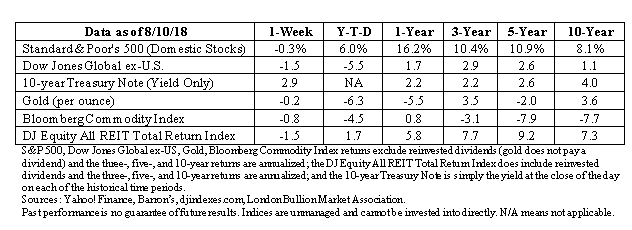
So, how did a country that represents just about 1.4 percent of the world’s economy spark a global selloff?

Turkey was once a rising star. The country’s Prime Minister Recep Tayyip Erdogan took office in 2003 and his “conservative, pro-business policies helped pull the country back from an economic crisis,” reported Financial Times.

As Turkey’s economy strengthened, investors saw opportunity. Investments from outside the country averaged about $13 billion a year, according to World Bank figures cited by Financial Times, although investment slowed after terror attacks in 2015.

Bloomberg reported Prime Minister Erdogan has become more authoritarian since being re-elected in 2018, giving himself power to name the head of Turkey’s central bank. Financial Times reported the Prime Minister’s “…unorthodox views on interest rates…has proved disruptive for monetary policy, leaving…Turkey’s central bank, struggling to contain inflation that is running at close to 16 percent.”

Lack of central bank autonomy concerned investors. The Turkish lira began to weaken against the U.S. dollar, making it costly for businesses to repay dollar-denominated debt.

Politics have factored into the situation, as well. During 2018, negotiations were underway to secure the release of an American pastor who was arrested on “farcical terrorism charges,” reported The Economist. However, talks collapsed early in August. Asset freezes and sanctions followed, along with promises of additional tariffs on Turkish goods imported by the United States.

The subsequent steep drop in the value of Turkish lira sparked concerns that rippled through global markets. Financial Times reported:

“Turkey’s deepening crisis punished emerging market currencies and sparked a global pullback from riskier assets on Friday…The S&P 500 fell 0.7 percent in New York on Friday. Treasury yields also moved lower, with the 10-year dipping below 2.9 percent for the first time this month, as investors sought safe assets…Investors’ shift from risky assets knocked equities across Europe, with Germany’s Dax, France’s CAC 40 and Spain’s Ibex all about 2 percent weaker.”

For quite some time, investors have appeared immune to geopolitical risks. Perhaps that is beginning to change.
 

3 THINGS TO CONSIDER BEFORE CLAIMING SOCIAL SECURITY BENEFITS: TIMING, SPOUSAL BENEFITS, AND WORK STATUS. Most Americans understand they can choose when to begin receiving Social Security benefits. The choices are fairly straightforward:

Early (age 62 to full retirement age). People who decide to collect benefits early typically receive a smaller monthly benefit than they would if they waited until full retirement age. The reduction in monthly income may be as large as 30 percent. However, they receive benefits for a longer period of time.

Normal (full retirement age). An American’s full retirement age is determined by his or her date of birth. For someone born in 1960 or later, full retirement age is 67 years. The amount of income a person receives at normal retirement age is determined by the amount earned during his or her working years.

Delayed (after full retirement age to age 70). By delaying the start of Social Security benefits, a person can increase his or her monthly benefit by accruing     delayed retirement credits. For Americans born in 1943 and after, credit accrues at a rate of 8 percent each year.

While it’s important to understand timing options for Social Security benefits, choosing when to take benefits may not be the most important decision you make, especially if you’re married.

There are several different claiming strategies that may help married couples optimize their benefits and the benefits available for children who are minors or have special needs. These options should be carefully considered before filing for benefits.

Your filing decision may also be affected by your work status and income. If you file early while still working, and your earnings exceed established limits, then a portion of your benefit may be withheld. In addition, your income will help determine whether your Social Security benefit is taxable.

If you would like to discuss your options for claiming Social Security benefits, give us a call.

Weekly Focus – Think About It

“Take time for all things: great haste makes great waste.”
--Benjamin Franklin, Founding Father

 * These views are those of Carson Group Coaching, and not the presenting Representative or the Representative’s Broker/Dealer, and should not be construed as investment advice.
* This newsletter was prepared by Carson Group Coaching. Carson Group Coaching is not affiliated with the named broker/dealer.
* Government bonds and Treasury Bills are guaranteed by the U.S. government as to the timely payment of principal and interest and, if held to maturity, offer a fixed rate of return and fixed principal value. However, the value of fund shares is not guaranteed and will fluctuate.
* Corporate bonds are considered higher risk than government bonds but normally offer a higher yield and are subject to market, interest rate and credit risk as well as additional risks based on the quality of issuer coupon rate, price, yield, maturity, and redemption features.
* Investing in foreign and emerging markets securities involves special additional risks. These risks include, but are not limited to, currency risk, geopolitical risk, and risk associated with varying accounting standards. Investing in emerging markets may accentuate these risks.
* The Standard & Poor's 500 (S&P 500) is an unmanaged group of securities considered to be representative of the stock market in general. You cannot invest directly in this index.
* All indexes referenced are unmanaged. Unmanaged index returns do not reflect fees, expenses, or sales charges. Index performance is not indicative of the performance of any investment.
* The Dow Jones Global ex-U.S. Index covers approximately 95% of the market capitalization of the 45 developed and emerging countries included in the Index.
* The 10-year Treasury Note represents debt owed by the United States Treasury to the public. Since the U.S. Government is seen as a risk-free borrower, investors use the 10-year Treasury Note as a benchmark for the long-term bond market.
* Gold represents the afternoon gold price as reported by the London Bullion Market Association. The gold price is set twice daily by the London Gold Fixing Company at 10:30 and 15:00 and is expressed in U.S. dollars per fine troy ounce.
* The Bloomberg Commodity Index is designed to be a highly liquid and diversified benchmark for the commodity futures market. The Index is composed of futures contracts on 19 physical commodities and was launched on July 14, 1998.
* The DJ Equity All REIT Total Return Index measures the total return performance of the equity subcategory of the Real Estate Investment Trust (REIT) industry as calculated by Dow Jones.
* Yahoo! Finance is the source for any reference to the performance of an index between two specific periods.
* Opinions expressed are subject to change without notice and are not intended as investment advice or to predict future performance.
* Economic forecasts set forth may not develop as predicted and there can be no guarantee that strategies promoted will be successful.
* Past performance does not guarantee future results. Investing involves risk, including loss of principal.
* You cannot invest directly in an index.
* Stock investing involves risk including loss of principal.
* Consult your financial professional before making any investment decision.

Sources:
https://tradingeconomics.com/turkey/gdp
https://www.ft.com/content/686f156c-9a36-11e8-9702-5946bae86e6d (or go to https://s3-us-west-2.amazonaws.com/peakcontent/+Peak+Commentary/08-13-18_FinancialTimes-Turkey-How_Investors_Turned_On_Erdogan-Footnote_2.pdf)
https://www.bloomberg.com/news/articles/2018-07-10/erdogan-gives-himself-power-to-appoint-central-bank-governor
https://www.economist.com/europe/2018/08/11/turkeys-diplomatic-crisis-is-hastening-an-economic-one (or go to https://s3-us-west-2.amazonaws.com/peakcontent/+Peak+Commentary/08-13-18_TheEconomist-Turkeys_Diplomatic_Crisis_is_Hastening_an_Economic_One-Footnote_4.pdf)
https://www.ft.com/content/7e1ddc8e-9c77-11e8-ab77-f854c65a4465 (or go to https://s3-us-west-2.amazonaws.com/peakcontent/+Peak+Commentary/08-13-18_FinancialTimes-Turkeys_Deepening_Crisis_Triggers_Retreat_from_Equities-Footnote_5.pdf)
https://www.marketwatch.com/story/commodities-are-beating-the-stock-market-as-geopolitical-risk-returns-2018-04-11
https://www.ssa.gov/oact/quickcalc/early_late.html
https://www.ssa.gov/oact/ProgData/nra.html
https://www.ssa.gov/oact/COLA/Benefits.html
https://www.ssa.gov/pubs/EN-05-10147.pdf
https://www.ssa.gov/planners/taxes.html
https://www.brainyquote.com/quotes/benjamin_franklin_122639?src=t_haste
 

August 6th Market Commentary

August 6, 2018

The Markets

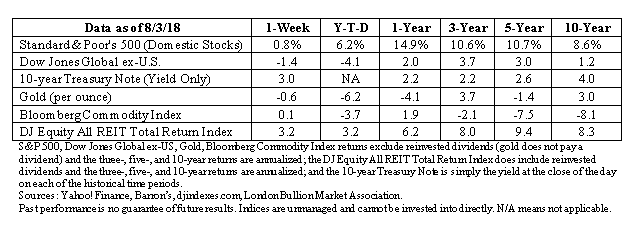
Capital gains tax reform comes with a big price tag: $100 billion over 10 years.

A capital gain is any increase in the value of an asset, such as an investment, a home, land, etc., between its purchase and its sale. The amount of a gain is determined by subtracting the purchase price from the sale price.

Last week, the White House proposed capital gains be adjusted or ‘indexed’ for inflation before they are taxed. Princeton Professor Alan Blinder explained the idea in The Wall Street Journal:

"Why index gains? Suppose you own a stock for many years, during which time overall prices have doubled because of inflation. Over the holding period, the value of your stock also has doubled. When you sell, the proceeds have precisely the same purchasing power as the original purchase. There’s no gain, no loss. But under current tax law, you owe taxes on the phantom ‘gain.’ Worse, if your stock went up by less than the cumulative inflation, you’ll still get taxed despite your loss. This is unfair and dysfunctional.”

While the suggestion is appealing to many investors, it’s not without controversy. For example, the White House suggested the Treasury Department change the tax code without Congressional approval by modifying enforcement regulations. However, the legislative branch – Congress – is constitutionally responsible for tax law.

In addition, adjusting capital gains for inflation without doing the same for interest expense and depreciation may allow some taxpayers to be able to generate significant losses on paper. Current tax law includes provisions that limit this kind of tax strategy, but indexing capital gains would reopen the door, reported the Tax Policy Center.

Another consideration is the impact of the change on the deficit and the national debt. The Congressional Budget Office estimates suggest 2017 tax reform will increase “…the total projected deficit over the 2018-2028 period by about $1.9 trillion.” Adjusting capital gains for inflation could increase the shortfall by about $100 billion over a decade, reported Naomi Jagoda for The Hill.

THE MILLENNIAL WAY. From social media to housing options to banking, every generation has had its own preferences. Today, millennials (individuals between the ages of 18 and 34) are having a profound influence on lifestyle and culture. Here are three trends to watch:

1. Millennials are moving to smaller cities. “Mid- or second-tier cities, loosely defined as those under a million people that aren’t regional powerhouses like Austin or Seattle, are increasingly seen as not just places to find a lower cost of living, easier commute, and closer connections with family, but also a more approachable, neighborhood-oriented version of the urban lifestyle that sent many to the larger cities in the first place,” reported Patrick Sisson for Curbed.com.

2. Millennials like point-of-sale loans. Point-of-sale loans are catching on. The Economist reported, “Consumers who might previously have financed big-ticket purchases such as furniture, electronics, or home-improvement projects with a credit card are now opting to borrow at the checkout, often with an initial 0 percent interest rate. These short-term credit products were once the domain of big banks…[and] store-branded credit cards. Now tech startups are entering the market with innovative techniques for underwriting and approving potential borrowers, often in seconds.”

3. Millennials tend to prefer healthier lifestyles. “For millennials, wellness is a daily, active pursuit. They’re exercising more, eating smarter, and smoking less than previous generations. They’re using apps to track training data and online information to find the healthiest foods. And, this is one space where they’re willing to spend money on compelling brands,” reported Goldman Sachs.

Weekly Focus – Think About It

“The changes in our life must come from the impossibility to live otherwise than according to the demands of our conscience, not from our mental resolution to try a new form of life.”
--Leo Tolstoy, Russian writer

* These views are those of Carson Group Coaching, and not the presenting Representative or the Representative’s Broker/Dealer, and should not be construed as investment advice.
* This newsletter was prepared by Carson Group Coaching. Carson Group Coaching is not affiliated with the named broker/dealer.
* Government bonds and Treasury Bills are guaranteed by the U.S. government as to the timely payment of principal and interest and, if held to maturity, offer a fixed rate of return and fixed principal value. However, the value of fund shares is not guaranteed and will fluctuate.
* Corporate bonds are considered higher risk than government bonds but normally offer a higher yield and are subject to market, interest rate and credit risk as well as additional risks based on the quality of issuer coupon rate, price, yield, maturity, and redemption features.
* The Standard & Poor's 500 (S&P 500) is an unmanaged group of securities considered to be representative of the stock market in general. You cannot invest directly in this index.
* All indexes referenced are unmanaged. Unmanaged index returns do not reflect fees, expenses, or sales charges. Index performance is not indicative of the performance of any investment.
* The Dow Jones Global ex-U.S. Index covers approximately 95% of the market capitalization of the 45 developed and emerging countries included in the Index.
* The 10-year Treasury Note represents debt owed by the United States Treasury to the public. Since the U.S. Government is seen as a risk-free borrower, investors use the 10-year Treasury Note as a benchmark for the long-term bond market.
* Gold represents the afternoon gold price as reported by the London Bullion Market Association. The gold price is set twice daily by the London Gold Fixing Company at 10:30 and 15:00 and is expressed in U.S. dollars per fine troy ounce.
* The Bloomberg Commodity Index is designed to be a highly liquid and diversified benchmark for the commodity futures market. The Index is composed of futures contracts on 19 physical commodities and was launched on July 14, 1998.
* The DJ Equity All REIT Total Return Index measures the total return performance of the equity subcategory of the Real Estate Investment Trust (REIT) industry as calculated by Dow Jones.
* Yahoo! Finance is the source for any reference to the performance of an index between two specific periods.
* Opinions expressed are subject to change without notice and are not intended as investment advice or to predict future performance.
* Economic forecasts set forth may not develop as predicted and there can be no guarantee that strategies promoted will be successful.
* Past performance does not guarantee future results. Investing involves risk, including loss of principal.
* You cannot invest directly in an index.
* Stock investing involves risk including loss of principal.
* Consult your financial professional before making any investment decision. 

Sources:
http://thehill.com/policy/finance/399953-trump-asked-treasury-to-look-into-capital-gains-tax-cut-sanders-says
https://www.merriam-webster.com/dictionary/capital%20gain
https://www.wsj.com/articles/index-capital-gains-but-not-without-congresss-consent-1533163465 (or go to https://s3-us-west-2.amazonaws.com/peakcontent/+Peak+Commentary/08-06-18_WSJ-Index_Capital_Gains_but_Not_Without_Congress_Consent-Footnote_3.pdf)
https://www.taxpolicycenter.org/taxvox/should-treasury-index-capital-gains
https://www.house.gov/the-house-explained/branches-of-government
https://www.cbo.gov/publication/53787
https://www.statista.com/topics/2705/millennials-in-the-us/
https://thoughtcatalog.com/jae-schaefer/2017/05/14-reasons-why-millennials-are-amazing-and-will-change-the-world/
https://www.curbed.com/2018/5/1/17306978/career-millennial-home-buying-second-city
https://www.economist.com/finance-and-economics/2018/08/04/tech-startups-are-reviving-point-of-sale-lending (or go to https://s3-us-west-2.amazonaws.com/peakcontent/+Peak+Commentary/08-06-18_TheEconomist-Tech-Startups_are_Reviving_Point-of-Sale_Lending-Footnote_10.pdf)
https://www.goldmansachs.com/our-thinking/pages/millennials/
https://www.brainyquote.com/quotes/leo_tolstoy_153949


July 31st Market Commentary

July 31, 2018

The Markets

Is it a sugar rush or something more sustainable?

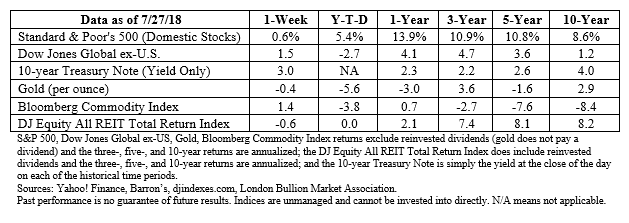
Economic growth in the United States was strong during the second quarter. Gross domestic product (GDP), which is the value of all goods and services produced in the United States, grew by 4.1 percent. That’s the fastest growth in four years, reported the BBC.

The news was received with varying levels of enthusiasm. President Trump said the gain is “an economic turnaround of historic importance” and thinks the economy should continue to grow rapidly, reported Shawn Donnan in Financial Times.

Economists were less certain. They think second quarter’s GDP gains were underpinned by one-time factors. These included high levels of profitability attributable to last year’s corporate tax cuts and an increase in exports as U.S. producers and their buyers abroad tried to avoid upcoming tariffs, reported Financial Times.

Another consideration is the business cycle. The business cycle tracks the rise and fall of a country’s productivity over time. The U.S. appears to be in the latter stages of the current cycle. John Authers of Financial Times explained:

“…President Donald Trump’s self-congratulation yesterday was fully merited. Things are going according to plan. This business cycle looks ever more like a normal one, which is a fantastic and welcome development after an epochal crisis and then a decade of doldrums…The advent of a normal cycle is itself a problem because a normal cycle terminates with high interest rates and declining growth. The president has voiced his disapproval of these things, but they are the logical and sensible consequence of the economic developments that are now unfolding.”

In the United States, the Dow Jones Industrial Average and the Standard & Poor’s 500 Index moved higher while the NASDAQ Composite gave up some ground.

IT’S CAMPING SEASON! In 1869, the first recreational camping guide, Adventures in Wilderness, was authored by minister William H.H. Murray and became a bestseller. The book’s success may have owed something to a new train route that made the Adirondacks more accessible. Time.com reported his practical guide offered advice on important topics:

“For sleeping, he describes how to make ‘a bed of balsam-boughs.’ On what to wear, he suggests bringing a ‘felt hat,’ ‘stout pantaloons,’ and a ‘rubber blanket or coat.’ For warding off woodchucks, ‘a stick, a piece of bark, or tin plate shied in the direction of the noise will scatter them like cats.’ As for wolves, his technique would likely not pass muster with fire wardens: ‘touch a match to an old stump and in two hours there will not be a wolf within ten miles of you.’”

His book inspired Kate Field to try camping, and she became an early advocate of land preservation. She wrote for the Adirondack Almanac in 1870. A more recent article in the publication reported:

“Field advised her readers to bring a tent rather than kill trees. ‘It is cruel to stab a tree to the heart merely to secure a small strip of bark,’ she said. ‘It is ungrateful to destroy the pine and balsam that have given us our beds of boughs, and fanned us with their vital breath. Let there be tents.’”

Additional advice can be found in Civil War veteran John M. Gould’s 1877 guide to backpacking, titled How To Camp Out. He warned against the allure of new gear:

“Do not be in a hurry to spend money on new inventions. Every year there is put upon the market some patent knapsack, folding stove, cooking-utensil, or camp trunk and cot combined; and there are always for sale patent knives, forks, and spoons all in one…Let them all alone: carry your pocket-knife…”

He might have been willing to make an exception for some of the gear available today!

Weekly Focus – Think About It

“Camping is nature's way of promoting the motel business.”
--Dave Barry, Humorist

* These views are those of Carson Group Coaching, and not the presenting Representative or the Representative’s Broker/Dealer, and should not be construed as investment advice.
* This newsletter was prepared by Carson Group Coaching. Carson Group Coaching is not affiliated with the named broker/dealer.
* Government bonds and Treasury Bills are guaranteed by the U.S. government as to the timely payment of principal and interest and, if held to maturity, offer a fixed rate of return and fixed principal value. However, the value of fund shares is not guaranteed and will fluctuate.
* Corporate bonds are considered higher risk than government bonds but normally offer a higher yield and are subject to market, interest rate and credit risk as well as additional risks based on the quality of issuer coupon rate, price, yield, maturity, and redemption features.
* The Standard & Poor's 500 (S&P 500) is an unmanaged group of securities considered to be representative of the stock market in general. You cannot invest directly in this index.
* All indexes referenced are unmanaged. Unmanaged index returns do not reflect fees, expenses, or sales charges. Index performance is not indicative of the performance of any investment.
* The Dow Jones Global ex-U.S. Index covers approximately 95% of the market capitalization of the 45 developed and emerging countries included in the Index.
* The 10-year Treasury Note represents debt owed by the United States Treasury to the public. Since the U.S. Government is seen as a risk-free borrower, investors use the 10-year Treasury Note as a benchmark for the long-term bond market.
* Gold represents the afternoon gold price as reported by the London Bullion Market Association. The gold price is set twice daily by the London Gold Fixing Company at 10:30 and 15:00 and is expressed in U.S. dollars per fine troy ounce.
* The Bloomberg Commodity Index is designed to be a highly liquid and diversified benchmark for the commodity futures market. The Index is composed of futures contracts on 19 physical commodities and was launched on July 14, 1998.
* The DJ Equity All REIT Total Return Index measures the total return performance of the equity subcategory of the Real Estate Investment Trust (REIT) industry as calculated by Dow Jones.
* Yahoo! Finance is the source for any reference to the performance of an index between two specific periods.
* Opinions expressed are subject to change without notice and are not intended as investment advice or to predict future performance.
* Economic forecasts set forth may not develop as predicted and there can be no guarantee that strategies promoted will be successful.
* Past performance does not guarantee future results. Investing involves risk, including loss of principal.
* You cannot invest directly in an index.
* Stock investing involves risk including loss of principal.
* The foregoing information has been obtained from sources considered to be reliable, but we do not guarantee it is accurate or complete.
* Consult your financial professional before making any investment decision.

Sources:
https://www.bbc.co.uk/news/business-44979607
https://www.ft.com/content/fe50168c-9197-11e8-b639-7680cedcc421 (or go to https://s3-us-west-2.amazonaws.com/peakcontent/+Peak+Commentary/07-30-18_FinancialTimes-Trump_Hails_Fastest_US_Growth_Rate_Since_2014-Footnote_2.pdf)
https://www.investopedia.com/terms/b/businesscycle.asp
https://www.ft.com/content/a3d6a03a-91a2-11e8-b639-7680cedcc421 (or go to https://s3-us-west-2.amazonaws.com/peakcontent/+Peak+Commentary/07-30-18_FinancialTimes-Sugar_Rush_from_Trumps_Tax_Cuts_Aids_Fast_Growth-Footnote_4.pdf)
http://www.barrons.com/mdc/public/page/9_3063-economicCalendar.html (Click on “U.S. & Intl Recaps”, then on “Geopolitical nerves”)
http://time.com/5343675/history-of-camping/
https://www.adirondackalmanack.com/2014/03/babe-woods-kate-field-adirondack-preservation.html
https://archive.org/stream/howtocampout17575gut/17575.txt
https://www.brainyquote.com/quotes/dave_barry_128131?src=t_camping