
September 4th Market Commentary

September 4, 2018

The Markets

Where is our country’s biggest export market?

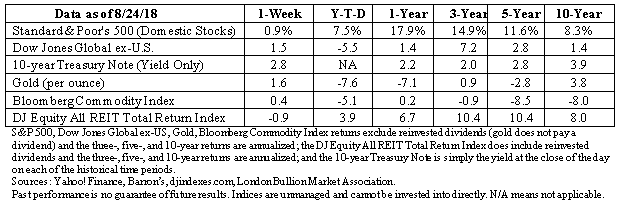
Markets were fired up last week after the United States and Mexico agreed on new trade rules. The Standard & Poor’s 500 (S&P 500) Index reached an all-time high and finished the month of August up about 3 percent, reported Michael Sheetz, Thomas Franck, and Alexandra Gibbs of CNBC.

During the latter half of last week, though, the S&P 500 gave back some gains. A hitch in the giddy-up of trade talks between the United States and Canada caused the index to stumble. Damian Paletta, Jeff Stein, and Heather Long of The Washington Post explained:

“High-stakes trade negotiations between the White House and Canadian leaders unraveled Friday, a major setback in President Trump’s effort to redraw the North American Free Trade Agreement…the United States and Canada have interwoven economies, with integrated supply chains and vast amounts of trade. The value of goods and services sold between the two countries last year reached $673.1 billion, making Canada the United States’ largest export market for goods.”

The United States exported about $341 billion of goods and services to Canada in 2017, according to The Office of the U.S. Trade Representative website. Our top exports to Canada during 2017 included:

• Services ($58 billion)
• Vehicles ($52 billion)
• Machinery ($43 billion)
• Electrical machinery ($25 billion)
• Agricultural products ($24 billion)
• Mineral fuels ($20 billion)
• Plastics ($13 billion)

Trade talks are expected to resume next week.
 

PREPARE FOR A SHAKE UP! From Reuters to Marketplace, economic and financial news shows like to ‘do the numbers.’ They often review economic indicators, Federal Reserve rate changes, or benchmark index performance.

In general, these statistics are intended to help people gauge how economies and markets are performing. For instance, when Gross Domestic Product (GDP) – the value of all goods and services produced by a nation during a certain period of time – moves higher, it means the economy grew during the period. When GDP moves lower, the economy contracted during the period.

Asset managers and investors rely on benchmark indices, like the S&P 500 Index, to measure the relative performance of investment portfolios. The S&P 500 is a benchmark for large U.S. company stocks. It includes companies from diverse sectors including:

• Information technology
• Healthcare
• Financials
• Consumer discretionary
• Industrials
• Consumer staples
• Energy
• Utilities
• Real estate
• Materials
• Telecommunications services

But, wait, change is coming!

Soon, benchmark indices will have a new sector. At the end of September 2018, Telecommunications Services will become Communication Services. The name is changing and so are the companies that will be included in the sector. Ben Levisohn at Barron’s reported:

“The biggest changes will be around some prominent companies that will migrate out of the information-technology and consumer-discretionary sectors and into a new communication-services sector…[The changes] certainly don’t herald any fundamental changes for the companies involved. But they do have the potential to create short-term noise…”

If you’d like to learn about the ways sector changes may affect benchmark indices, give us a call.

Weekly Focus – Think About It

“Progress is impossible without change, and those who cannot change their minds cannot change anything.”
--George Bernard Shaw, Irish playwright

* These views are those of Carson Group Coaching, and not the presenting Representative or the Representative’s Broker/Dealer, and should not be construed as investment advice.
* This newsletter was prepared by Carson Group Coaching. Carson Group Coaching is not affiliated with the named broker/dealer.
* Government bonds and Treasury Bills are guaranteed by the U.S. government as to the timely payment of principal and interest and, if held to maturity, offer a fixed rate of return and fixed principal value. However, the value of fund shares is not guaranteed and will fluctuate.
* Corporate bonds are considered higher risk than government bonds but normally offer a higher yield and are subject to market, interest rate and credit risk as well as additional risks based on the quality of issuer coupon rate, price, yield, maturity, and redemption features.
* The Standard & Poor's 500 (S&P 500) is an unmanaged group of securities considered to be representative of the stock market in general. You cannot invest directly in this index.
* All indexes referenced are unmanaged. Unmanaged index returns do not reflect fees, expenses, or sales charges. Index performance is not indicative of the performance of any investment.
* The Dow Jones Global ex-U.S. Index covers approximately 95% of the market capitalization of the 45 developed and emerging countries included in the Index.
* The 10-year Treasury Note represents debt owed by the United States Treasury to the public. Since the U.S. Government is seen as a risk-free borrower, investors use the 10-year Treasury Note as a benchmark for the long-term bond market.
* Gold represents the afternoon gold price as reported by the London Bullion Market Association. The gold price is set twice daily by the London Gold Fixing Company at 10:30 and 15:00 and is expressed in U.S. dollars per fine troy ounce.
* The Bloomberg Commodity Index is designed to be a highly liquid and diversified benchmark for the commodity futures market. The Index is composed of futures contracts on 19 physical commodities and was launched on July 14, 1998.
* The DJ Equity All REIT Total Return Index measures the total return performance of the equity subcategory of the Real Estate Investment Trust (REIT) industry as calculated by Dow Jones.
* Yahoo! Finance is the source for any reference to the performance of an index between two specific periods.
* Opinions expressed are subject to change without notice and are not intended as investment advice or to predict future performance.
* Economic forecasts set forth may not develop as predicted and there can be no guarantee that strategies promoted will be successful.
* Past performance does not guarantee future results. Investing involves risk, including loss of principal.
* You cannot invest directly in an index.
* Stock investing involves risk including loss of principal.
* Consult your financial professional before making any investment decision.


Sources:
https://www.cnbc.com/2018/08/31/us-markets-global-trade-tensions-ramp-up.html
https://www.washingtonpost.com/business/economy/nafta-talks-appear-to-sour-after-report-that-trump-disparaged-canada/2018/08/31/56ba2868-ad30-11e8-8a0c-70b618c98d3c_story.html?noredirect=on&utm_term=.15357d0708e8
https://ustr.gov/countries-regions/americas/canada
https://www.reuters.com/finance/markets
https://www.marketplace.org/shows/marketplace/07092018
https://www.investopedia.com/terms/c/contraction.asp
https://us.spindices.com/indices/equity/sp-500
https://www.barrons.com/articles/tech-stocks-could-be-winners-in-big-sector-shift-1535759312 (or go to https://s3-us-west-2.amazonaws.com/peakcontent/+Peak+Commentary/09-04-18_Barrons-Tech_Stocks_Could_be_Winners_in_Big_Section_Shift-Footnote_8.pdf)
https://www.brainyquote.com/quotes/george_bernard_shaw_386923?src=t_change
 

August 27th Market Commentary

August 27, 2018

The Markets

Tick, Tock.

Not everybody loves meetings and even fewer enjoy reading the minutes, but investors make an exception with the Federal Reserve. This week the Fed published the minutes from its August 1 meeting. While no changes were made to interest rates, the minutes did provide insight to how the Fed sees the U.S. economy.

Key Insights:

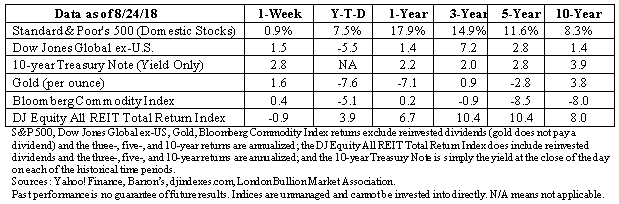
The economy is strong. The economy is poised for its best annual growth in a decade due to stimulation from tax cuts and federal spending. The current nine-year bull market is about to be the longest bull market in history and the stock market hit a new high last week. Inflation is back to the 2 percent range, after missing for several years, and the already tight labor market continues to tighten, reported The Wall Street Journal.

While the Fed remains concerned about the risks of inflation, it also is concerned about slowness in the housing market. Home building has declined due to a labor shortage and to higher cost in materials from tariffs, according to The New York Times.

• When will the Fed stop raising rates? The Fed is all but guaranteed to raise rates in September, with market odds at a 96 percent probability and a 60 percent probability for another hike in December. The Fed will continue its gradual interest rate increases for now as long as economic activity is consistently expanding at a sustainable rate. The minutes revealed the Fed governors will soon revise its policy stance from “accommodative to neutral,” reported MarketWatch.

• What does the Fed think about tariffs? The Fed is aware tariffs could derail their initial plan of steady rate hikes. Although concerned about President Trump’s tariffs, they are waiting for economic data to assess the damage. They did, however, say tariffs would have “adverse effects on business sentiment, investment spending, and employment. Moreover, wide-ranging tariff increases would also reduce the purchasing power of U.S. households,” reported The New York Times.

The Fed is content, for now, with their current policy stance of steady rate hikes, but are on edge as they wait to see how fiscal policy plays out in the data. The Fed is more likely to raise rates two more times this year given the strength of the economy.

HOW WOULD YOU ASK FOR A RAISE? When CNBC asked business author Suzy Welch how someone should ask for a raise she explained, “The key…is an approach that includes research and emphasizes your achievements.” She recommended three basic steps:

1. Time your request right. Ask after a big win, a positive performance review, or when being asked to accept more responsibility.
2. Prove your case. Be prepared to explain why you deserve a raise, including your achievements and results.
3. Establish a time frame for action. If your boss isn’t prepared to provide an answer immediately, end your meeting by asking when you can expect a response.

This is sound advice.

When Willy Appelman of Fast Company asked children at the Underhill Playground how they would ask a boss for a raise, the kids believed the keys to success were good manners, hard work, baked goods, and physical appearance. Here are some of their recommendations:

• “Ask them politely and say: Can I please have a raise because I’ve been really working hard this week.”
• “Go up to your boss and say: Is it okay if I have some more money?”
• “Be confident and try your best.”
• “I would give them desserts, like pastry and cookies.”
• “Make sure you look weaker than your employer so they have power and they might feel merciful...”

If you recently received a raise or a bonus (or expect to), you may want to give some serious thought to how you will to use the additional income – spend it, save it, or do some of both – and how your choices will affect your taxes. If you’d like to discuss your options, give us a call.

Weekly Focus – Think About It

“The tax advisor had just read the story of Cinderella to his four-year-old daughter for the first time. The little girl was fascinated by the story, especially the part where the pumpkin turns into a golden coach. Suddenly she piped up, ‘Daddy, when the pumpkin turned into a golden coach, would that be classed as income or a long-term capital gain?’”
--Unknown

* These views are those of Carson Group Coaching, and not the presenting Representative or the Representative’s Broker/Dealer, and should not be construed as investment advice.
* This newsletter was prepared by Carson Group Coaching. Carson Group Coaching is not affiliated with the named broker/dealer.
* Government bonds and Treasury Bills are guaranteed by the U.S. government as to the timely payment of principal and interest and, if held to maturity, offer a fixed rate of return and fixed principal value. However, the value of fund shares is not guaranteed and will fluctuate.
* Corporate bonds are considered higher risk than government bonds but normally offer a higher yield and are subject to market, interest rate and credit risk as well as additional risks based on the quality of issuer coupon rate, price, yield, maturity, and redemption features.
* The Standard & Poor's 500 (S&P 500) is an unmanaged group of securities considered to be representative of the stock market in general. You cannot invest directly in this index.
* All indexes referenced are unmanaged. Unmanaged index returns do not reflect fees, expenses, or sales charges. Index performance is not indicative of the performance of any investment.
* The Dow Jones Global ex-U.S. Index covers approximately 95% of the market capitalization of the 45 developed and emerging countries included in the Index.
* The 10-year Treasury Note represents debt owed by the United States Treasury to the public. Since the U.S. Government is seen as a risk-free borrower, investors use the 10-year Treasury Note as a benchmark for the long-term bond market.
* Gold represents the afternoon gold price as reported by the London Bullion Market Association. The gold price is set twice daily by the London Gold Fixing Company at 10:30 and 15:00 and is expressed in U.S. dollars per fine troy ounce.
* The Bloomberg Commodity Index is designed to be a highly liquid and diversified benchmark for the commodity futures market. The Index is composed of futures contracts on 19 physical commodities and was launched on July 14, 1998.
* The DJ Equity All REIT Total Return Index measures the total return performance of the equity subcategory of the Real Estate Investment Trust (REIT) industry as calculated by Dow Jones.
* Yahoo! Finance is the source for any reference to the performance of an index between two specific periods.
* Opinions expressed are subject to change without notice and are not intended as investment advice or to predict future performance.
* Economic forecasts set forth may not develop as predicted and there can be no guarantee that strategies promoted will be successful.
* Past performance does not guarantee future results. Investing involves risk, including loss of principal.
* You cannot invest directly in an index.
* Stock investing involves risk including loss of principal.
* Consult your financial professional before making any investment decision.
* Consult a qualified tax advisor for specific individualized tax advice.

Sources:
https://www.federalreserve.gov/newsevents/pressreleases/monetary20180822a.htm
https://www.wsj.com/articles/as-central-bankers-meet-economic-uncertainties-weigh-on-sunny-outlook-1535029200 (or go to https://s3-us-west-2.amazonaws.com/peakcontent/+Peak+Commentary/08-27-18_WSJ-As_Central_Bankers_Meet_Economic_Uncertainties_Weigh_on_Sunny_Outlook-Footnote_2.pdf)
https://www.nytimes.com/2018/08/22/business/federal-reserve-rate-hikes.html
https://www.marketwatch.com/story/fed-minutes-show-support-for-september-interest-rate-hike-combined-with-anxiety-about-a-trade-war-2018-08-22
https://www.cnbc.com/2017/12/11/suzy-welch-heres-the-exact-right-way-to-ask-for-a-raise.html
https://www.fastcompany.com (In the Video section, click on ‘Advice On How To Get A Raise... From Kids’; responses occurred at 29, 33, 44, 51, and 54 seconds from the start of the video)
https://www.taxconnections.com/best-tax-jokes-and-quotes-ebook


August 20th Market Commentary

August 20, 2018

The Markets

As Maxwell Smart used to say…

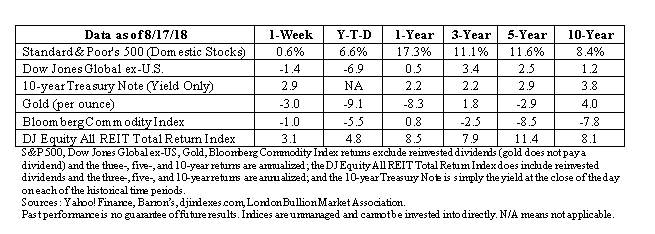
Missed it by THAT much! After a rocky start, the Standard & Poor’s 500 Index came within 1 percent of an all-time high last week, reported Ben Levisohn for Barron’s. It’s significant because the Standard & Poor’s 500 Index has been trading below its January record all year. The article suggested the lack of progress begs the question: Are we still in a bull market?

It’s the old ‘Shrink Global Markets with Corporate Buybacks’ trick. Last week, Robin Wigglesworth of Financial Times reported, “The global equity market is shrinking at the fastest pace in at least two decades, as a wave of corporate share buybacks swamps the overall volume of companies going public, issuing new stock or selling convertible debt.”

The value of the global equity market is increasing despite the reduction in volume. In part, this is because stock buybacks help push share prices higher.

There is a potential downside to buybacks, though. Nasdaq.com explained, “…rewarding current shareholders so liberally can lead to a systemic extraction of value from companies on a macroeconomic scale. Throw in dividends and little is left for growth and expansion.”

Would you believe…the President asked for it? “President Trump on Friday asked regulators to review a decades-old requirement that public companies release earnings quarterly, a change some executives support to promote longer-term planning but that some investors worry could reduce market transparency,” reported Dave Michaels, Michael Rapoport, and Jennifer Maloney of The Wall Street Journal.

While transparency is essential to investors, critics suggest quarterly reporting “distracts companies from focusing on longer-term financial and strategic goals and may deter companies from going public,” wrote Andrew Edgecliffe-Johnson and Mamta Badkar for Financial Times.

Stay tuned.

REMEMBER THAT SAYING ABOUT THE FOREST AND THE TREES? Some pretty good numbers have been posted for 2018. They’re the type of numbers that inspire confidence. For example:

4.1 percent. The United States experienced strong economic growth during the second quarter. The advance estimate for U.S. gross domestic product (the value of all goods and services produced by a nation) during the second quarter of 2018 was 4.1 percent. That was the highest rate of growth since the first quarter of 2014.

24.6 percent. 2017’s tax reform, which lowered corporate tax rates from an average of 35 percent to an average 21 percent, boosted corporate earnings, reported Nasdaq.com. With 91 percent of companies reporting in, the blended earnings growth rate for the S&P 500 was 24.6 percent during the second quarter of 2018.

$1 trillion. What are companies doing with their tax windfall? U.S. companies are rewarding shareholders by buying back stock, reported Nasdaq.com, which suggested buybacks could total $1 trillion in 2018.

3,453 days. Depending on how precisely you define the last bull market, August 22 may be the day that marks this one as the longest bull market in history.

While positive economic and market numbers are nice to see, they are trees in a forest and don’t necessarily provide a full or an accurate picture. For instance, the length of a bull market is interesting, but it has no predictive value, reported Barron’s. The length of the current economic expansion is far more important.

Barron’s cited Dr. Ed Yardeni, chief investment strategist at Yardeni Research, who said, “All I’m interested in is how long the expansion lasts…Because the longer it lasts, the longer the bull market lasts.”

It’s important to understand which numbers are important and how they relate to one another. If you would like to learn more, give us a call.

Weekly Focus – Think About It

“There is no truth. There is only perception.”
--Gustave Flaubert, French novelist


* These views are those of Carson Group Coaching, and not the presenting Representative or the Representative’s Broker/Dealer, and should not be construed as investment advice.
* This newsletter was prepared by Carson Group Coaching. Carson Group Coaching is not affiliated with the named broker/dealer.
* Government bonds and Treasury Bills are guaranteed by the U.S. government as to the timely payment of principal and interest and, if held to maturity, offer a fixed rate of return and fixed principal value. However, the value of fund shares is not guaranteed and will fluctuate.
* Corporate bonds are considered higher risk than government bonds but normally offer a higher yield and are subject to market, interest rate and credit risk as well as additional risks based on the quality of issuer coupon rate, price, yield, maturity, and redemption features.
* The Standard & Poor's 500 (S&P 500) is an unmanaged group of securities considered to be representative of the stock market in general. You cannot invest directly in this index.
* All indexes referenced are unmanaged. Unmanaged index returns do not reflect fees, expenses, or sales charges. Index performance is not indicative of the performance of any investment.
* The Dow Jones Global ex-U.S. Index covers approximately 95% of the market capitalization of the 45 developed and emerging countries included in the Index.
* The 10-year Treasury Note represents debt owed by the United States Treasury to the public. Since the U.S. Government is seen as a risk-free borrower, investors use the 10-year Treasury Note as a benchmark for the long-term bond market.
* Gold represents the afternoon gold price as reported by the London Bullion Market Association. The gold price is set twice daily by the London Gold Fixing Company at 10:30 and 15:00 and is expressed in U.S. dollars per fine troy ounce.
* The Bloomberg Commodity Index is designed to be a highly liquid and diversified benchmark for the commodity futures market. The Index is composed of futures contracts on 19 physical commodities and was launched on July 14, 1998.
* The DJ Equity All REIT Total Return Index measures the total return performance of the equity subcategory of the Real Estate Investment Trust (REIT) industry as calculated by Dow Jones.
* Yahoo! Finance is the source for any reference to the performance of an index between two specific periods.
* Opinions expressed are subject to change without notice and are not intended as investment advice or to predict future performance.
* Economic forecasts set forth may not develop as predicted and there can be no guarantee that strategies promoted will be successful.
* Past performance does not guarantee future results. Investing involves risk, including loss of principal.
* You cannot invest directly in an index.
* Stock investing involves risk including loss of principal.
* Consult your financial professional before making any investment decision.

Sources:
https://www.npr.org/templates/story/story.php?storyId=4865354
https://www.barrons.com/articles/will-jpmorgan-tank-when-jamie-dimon-leaves-1534433537 (or go to https://s3-us-west-2.amazonaws.com/peakcontent/+Peak+Commentary/08-20-18_Barrons-The_Bull_Market_Rumbles_On_Despite_Turkey_Turmoil-Footnote_2.pdf)
https://www.ft.com/content/5a359796-a18e-11e8-85da-eeb7a9ce36e4 (or go to https://s3-us-west-2.amazonaws.com/peakcontent/+Peak+Commentary/08-20-18_FinancialTimes-Global_Equity_Market_Shrinks_as_Buybacks_Surge-Footnote_3.pdf)
https://www.nasdaq.com/article/stock-buybacks-poised-to-eclipse-1-trillion-cm1006412
https://www.wsj.com/articles/trump-directs-sec-to-study-six-month-reporting-for-public-companies-1534507058 (or go to https://s3-us-west-2.amazonaws.com/peakcontent/+Peak+Commentary/08-20-18_WSJ-Trump_Asks_SEC_to_Study_Six-Month_Reporting_for_Public_Companies-Footnote_5.pdf)
https://www.ft.com/content/c1d133aa-a211-11e8-85da-eeb7a9ce36e4 (or go to https://s3-us-west-2.amazonaws.com/peakcontent/+Peak+Commentary/08-20-18_FinancialTimes-Trump_Asks_SEC_to_Study_Scrapping_Quarterly_Earnings_Reports-Footnote_6.pdf)
https://www.bea.gov/data/gdp/gross-domestic-product
https://www.factset.com/hubfs/Resources%20Section/Research%20Desk/Earnings%20Insight/EarningsInsight_081018.pdf
https://www.brainyquote.com/quotes/gustave_flaubert_161911?src=t_perception