
November 5th Market Commentary

November 5, 2018

The Markets

Stocks recovered some ground last week and then stumbled over unemployment.

Major U.S. stock indices faltered Friday after the Bureau of Labor Statistics (BLS) reported on a popular ‘lagging’ economic indicator – unemployment. (Remember, lagging indicators describe what has happened in the past.) The BLS reported:

“The unemployment rate remained at 3.7 percent in October, and the number of unemployed persons was little changed at 6.1 million. Over the year, the unemployment rate and the number of unemployed persons declined by 0.4 percentage point and 449,000, respectively.”

Reuters reported the number of Americans receiving unemployment benefits was at the lowest level in 45 years. That’s good news, but it’s old news. Again, unemployment is a lagging indicator and the report reflected what happened in October.

The stock market, on the other hand, is a ‘leading’ economic indicator. It moves in response to investors’ expectations for the future – and recent gyrations suggest investors aren’t certain what to think. Barron’s Daren Fonda wrote, “The market’s 6.9 percent slide in October and the stock averages’ wild swings are testing everyone’s mettle.”

Economists are uncertain about what’s to come, too. Kevin L. Kliesen, in an Economic Synopses on the St. Louis Federal Reserve website, wrote, “Historically, a trough in the unemployment rate also tends to be a reliable predictor of a business recession…an economic analyst is nonetheless never sure that a trough has occurred. Indeed, the unemployment rate can move up and down over the expansion.”

There is one thing many analysts think is likely. They expect the Federal Reserve to increase the Fed funds rate so the U.S. economy does not overheat. Paul Kiernan at The Wall Street Journal reported, “Robust hiring and wage gains last month leave the Federal Reserve all but certain to raise interest rates in December and on course to continue gradually lifting them next year.”

Higher interest rates are expected to keep inflation in check by slowing economic growth.

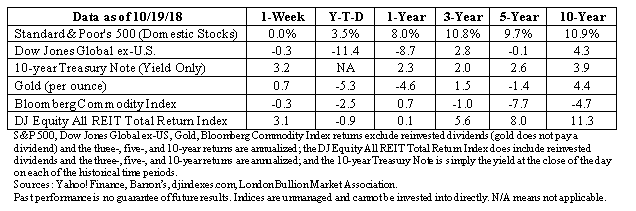
Despite Friday’s stumble, major U.S. stock indices finished the week higher.

HERE’S AN UNEXPECTED RETIREMENT SAVING TRICK. If you’re concerned your adult children are not saving enough for retirement, send them a photo of themselves that’s altered so they appear to be older, perhaps age 60 or 70. (You can do this for yourself, too.)

One reason Americans don’t begin saving early enough, or save as much as they should for retirement, is ‘present bias.’ When asked to choose between two possible rewards, research shows that people tend to choose the one that will be received sooner.

For instance, imagine you have chocolate and fruit salad. Which will you choose to eat today and which will you choose to eat next week? Researchers found that 83 percent of people chose chocolate today and fruit salad next week.

Try this one.

You can watch one movie today and another movie tomorrow. Your choices include ‘Anchorman,’ ‘Clear and Present Danger,’ ‘The Piano,’ and ‘Schindler’s List.’ What movie will you watch today? Which will you watch tomorrow?

Researchers found a higher percentage of participants chose to watch lighter films on the day they were asked and more intellectually taxing films later.

When presented with the choice to vacation today or save for retirement, it’s little surprise many people choose the former. The rewards associated with retirement are often far into the future. As a result, until a person is within a decade or so of retirement, it’s easy to rationalize spending on other things and not setting aside money for the future.

There is a way to overcome present bias. When people ‘get to know’ their older selves by spending time looking at altered photos, they tend to save more for the future.

Weekly Focus – Think About It

“If we now care little about ourselves in the further future, our future selves are like future generations. We can affect them for the worse, and, because they do not now exist, they cannot defend themselves. Like future generations, future selves have no vote, so their interests need to be specially protected. Reconsider a boy who starts to smoke, knowing and hardly caring that this may cause him to suffer greatly fifty years later. This boy does not identify with his future self.”
--Derek Parfit, British philosopher


* These views are those of Carson Group Coaching, and not the presenting Representative or the Representative’s Broker/Dealer, and should not be construed as investment advice.
* This newsletter was prepared by Carson Group Coaching. Carson Group Coaching is not affiliated with the named broker/dealer.
* Government bonds and Treasury Bills are guaranteed by the U.S. government as to the timely payment of principal and interest and, if held to maturity, offer a fixed rate of return and fixed principal value. However, the value of fund shares is not guaranteed and will fluctuate.
* Corporate bonds are considered higher risk than government bonds but normally offer a higher yield and are subject to market, interest rate and credit risk as well as additional risks based on the quality of issuer coupon rate, price, yield, maturity, and redemption features.
* The Standard & Poor's 500 (S&P 500) is an unmanaged group of securities considered to be representative of the stock market in general. You cannot invest directly in this index.
* All indexes referenced are unmanaged. Unmanaged index returns do not reflect fees, expenses, or sales charges. Index performance is not indicative of the performance of any investment.
* The Dow Jones Global ex-U.S. Index covers approximately 95% of the market capitalization of the 45 developed and emerging countries included in the Index.
* The 10-year Treasury Note represents debt owed by the United States Treasury to the public. Since the U.S. Government is seen as a risk-free borrower, investors use the 10-year Treasury Note as a benchmark for the long-term bond market.
* Gold represents the afternoon gold price as reported by the London Bullion Market Association. The gold price is set twice daily by the London Gold Fixing Company at 10:30 and 15:00 and is expressed in U.S. dollars per fine troy ounce.
* The Bloomberg Commodity Index is designed to be a highly liquid and diversified benchmark for the commodity futures market. The Index is composed of futures contracts on 19 physical commodities and was launched on July 14, 1998.
* The DJ Equity All REIT Total Return Index measures the total return performance of the equity subcategory of the Real Estate Investment Trust (REIT) industry as calculated by Dow Jones.
* International investing involves special risks such as currency fluctuation and political instability and may not be suitable for all investors. These risks are often heightened for investments in emerging markets.
* Yahoo! Finance is the source for any reference to the performance of an index between two specific periods.
* Opinions expressed are subject to change without notice and are not intended as investment advice or to predict future performance.
* Past performance does not guarantee future results. Investing involves risk, including loss of principal.
* You cannot invest directly in an index.
* Stock investing involves risk including loss of principal.
* Consult your financial professional before making any investment decision.

Sources:
https://www.barrons.com/articles/stock-rally-fizzles-in-wake-of-strong-payrolls-report-1541201581?mod=hp_DAY_8 (or go to https://s3-us-west-2.amazonaws.com/peakcontent/+Peak+Commentary/11-05-18_Barrons-Stock_Rally_Fizzles_in_Wake_of_Strong_Payrolls_Report-Footnote_1.pdf)
https://www.investopedia.com/ask/answers/what-are-leading-lagging-and-coincident-indicators/
https://www.bls.gov/news.release/empsit.nr0.htm
https://www.reuters.com/article/us-usa-economy-unemployment/u-s-labor-market-tightening-manufacturing-slowing-idUSKCN1N64XA
https://www.barrons.com/articles/stock-market-fear-1541091809?mod=hp_LEAD_3 (or go to https://s3-us-west-2.amazonaws.com/peakcontent/+Peak+Commentary/11-05-18_Barrons-How_to_Take_Fear_Out_of_Your_Investing_Decisions-Footnote_5.pdf)
https://research.stlouisfed.org/publications/economic-synopses/2018/06/01/recession-signals-the-yield-curve-vs-unemployment-rate-troughs
https://www.wsj.com/articles/fed-will-likely-raise-rates-after-strong-jobs-report-1541176431 (or go to https://s3-us-west-2.amazonaws.com/peakcontent/+Peak+Commentary/11-05-18_WSJ-Fed-Will_Likely_Raise_Rates_After_Strong_Jobs_Report-Footnote_7.pdf)
https://www.reuters.com/article/us-usa-economy/u-s-job-growth-soars-annual-wage-gain-largest-since-2009-idUSKCN1N70AJ
https://www.ncbi.nlm.nih.gov/pmc/articles/PMC3949005/
https://www.behavioraleconomics.com/resources/mini-encyclopedia-of-be/present-bias/
https://canvas.harvard.edu/files/2761311/download?download_frd=1 (Pages 10, 14-16; Course taught by Brigitte C. Madrian, https://scholar.harvard.edu/bmadrian/classes/api-304-behavioral-economics-and-public-policy)
https://pdfs.semanticscholar.org/2b03/cdc6119a5578cd284d8fe9de99e1f169a8fb.pdf (Pages 262-263, 265)
https://books.google.com/books?id=ulhHdvbDRUkC&pg=PA319&lpg=PA319&dq=If+we+now+care+little+about+ourselves+in+the+further+future,+our+future+selves+are+like+future+generations.+We+can+affect+them+for+the+worse,+and,+because+they+do+not+now+exist,+they+cannot+defend+themselves.+Like+future+generations,+future+selves+have+no+vote,+so+their+interests+need+to+be+specially+protected.&source=bl&ots=lVFartNzpF&sig=LgqLWOkCgwMIpj5ixgDFIqNMJuw&hl=en&sa=X&ved=2ahUKEwil5t3plbbeAhVRmeAKHbX1AhYQ6AEwAHoECAAQAQ#v=onepage&q=319&f=false (pages 319-320) (or go to https://s3-us-west-2.amazonaws.com/peakcontent/+Peak+Commentary/11-05-18_Book_Excerpt-Reasons_and_Persons-Footnote_13.pdf)

 

October 29th Market Commentary

October 29, 2018

The Markets

Why did the stock market fall when the economy is doing well?

The answer is that one reflects the past and the other anticipates the future.

Last Friday’s advance estimate from the Bureau of Economic Analysis showed the U.S. economy grew 3.5 percent during the third quarter of 2018. Harriet Torry of The Wall Street Journal reported:

“The economy powered ahead in the third quarter, driven by robust consumer and government spending, though Friday’s report included warning signs that the business sector faces turbulence that could hold back the expansion in the months ahead.”

Third quarter’s economic growth was slower than economic growth during the second quarter and stronger than economic growth during the first quarter of 2018.

Economists refer to economic growth as a ‘lagging indicator.’ It is a measure that may help confirm longer-term trends, but offers little information about the future.

In contrast, the stock market is a ‘leading indicator.’ It reflects what investors think may happen over the next few weeks or months. The volatility we’ve seen during the past two weeks suggests investors are uncertain about what may be ahead. Many factors are contributing to uncertainty. For instance, investors are concerned:

• The U.S. economy may grow more slowly. Economic growth slowed during the third quarter and investors are uncertain whether the trend will continue through the remainder of 2018 and into 2019.

• Negative earnings guidance from companies. Corporate earnings growth was robust during the third quarter. Through Friday, almost one-half of companies in the Standard and Poor’s 500 Index had reported earnings and their blended earnings growth rate was 22.5 percent, according to FactSet. However, despite strong earnings growth, many companies’ shares lost value. One reason is a fair number of companies have issued negative guidance indicating earnings may be weaker in the future.

• Trade tensions could slow global growth. While trade disputes with Mexico and Canada have been resolved, trade issues between the United States and China remain. Al Root of Barron’s reported:

"Now, on third-quarter calls, companies have begun to spell out tariff impacts in greater detail. Calculating the ultimate impact of tariffs isn’t easy or precise. A fair calculation would include not only costs but also changes in demand and the possibility of supply-chain disruptions. The result could be significant. The International Monetary Fund lowered its global growth expectations when it released its recent outlook because of, in part, ‘escalating trade tensions.’

• Federal Reserve rate hikes could slow economic growth too quickly. The Fed has begun raising the Fed funds rates, encouraging interest rates higher, in an effort to keep inflation in check. Some are concerned the Fed may raise rates too quickly or too high and choke economic growth.

You have probably heard the saying, “Markets hate uncertainty.” Recent volatility seems to be the result of uncertainty and it is possible uncertainty will cause stock markets to bounce around for some time.

When stock markets are volatile and headlines describe the action with words like ‘plunge’ and ‘erase,’ it’s easy to let emotion get the better of you. Before making changes to your portfolio, please give us a call. We can discuss your concerns and any changes you would like to make to your long-term financial plan.

IS THAT A FACT? A recent Pew Research Center survey found younger people (ages 18 to 49) were better able to distinguish facts from opinions than older people.

Jeffrey Gottfried at Pew reported, “About a third of 18- to 49-year-olds (32 percent) correctly identified all five of the factual statements as factual, compared with two-in-ten among those ages 50 and older. A similar pattern emerges for the opinion statements. Among 18- to 49-year-olds, 44 percent correctly identified all five opinion statements as opinions, compared with 26 percent among those ages 50 and older.”

Pew concluded younger Americans, especially millennials, were better able to distinguish fact from opinion than older Americans because young people tend to be more digitally savvy and also tend not to have a strong affiliation to either political party.

If you’re ready to test your acumen, visit the Pew Research Center website and search for ‘Quiz: How well can you tell factual from opinion statements?’

Weekly Focus – Think About It

“I never considered a difference of opinion in politics, in religion, in philosophy, as cause for withdrawing from a friend.”
--Thomas Jefferson, 3rd American President


* These views are those of Carson Group Coaching, and not the presenting Representative or the Representative’s Broker/Dealer, and should not be construed as investment advice.
* This newsletter was prepared by Carson Group Coaching. Carson Group Coaching is not affiliated with the named broker/dealer.
* Government bonds and Treasury Bills are guaranteed by the U.S. government as to the timely payment of principal and interest and, if held to maturity, offer a fixed rate of return and fixed principal value. However, the value of fund shares is not guaranteed and will fluctuate.
* Corporate bonds are considered higher risk than government bonds but normally offer a higher yield and are subject to market, interest rate and credit risk as well as additional risks based on the quality of issuer coupon rate, price, yield, maturity, and redemption features.
* The Standard & Poor's 500 (S&P 500) is an unmanaged group of securities considered to be representative of the stock market in general. You cannot invest directly in this index.
* All indexes referenced are unmanaged. Unmanaged index returns do not reflect fees, expenses, or sales charges. Index performance is not indicative of the performance of any investment.
* The Dow Jones Global ex-U.S. Index covers approximately 95% of the market capitalization of the 45 developed and emerging countries included in the Index.
* The 10-year Treasury Note represents debt owed by the United States Treasury to the public. Since the U.S. Government is seen as a risk-free borrower, investors use the 10-year Treasury Note as a benchmark for the long-term bond market.
* Gold represents the afternoon gold price as reported by the London Bullion Market Association. The gold price is set twice daily by the London Gold Fixing Company at 10:30 and 15:00 and is expressed in U.S. dollars per fine troy ounce.
* The Bloomberg Commodity Index is designed to be a highly liquid and diversified benchmark for the commodity futures market. The Index is composed of futures contracts on 19 physical commodities and was launched on July 14, 1998.
* The DJ Equity All REIT Total Return Index measures the total return performance of the equity subcategory of the Real Estate Investment Trust (REIT) industry as calculated by Dow Jones.
* International investing involves special risks such as currency fluctuation and political instability and may not be suitable for all investors. These risks are often heightened for investments in emerging markets.
* Yahoo! Finance is the source for any reference to the performance of an index between two specific periods.
* Opinions expressed are subject to change without notice and are not intended as investment advice or to predict future performance.
* Past performance does not guarantee future results. Investing involves risk, including loss of principal.
* You cannot invest directly in an index.
* Stock investing involves risk including loss of principal.
* Consult your financial professional before making any investment decision.

Sources:
https://www.bea.gov/data/gdp/gross-domestic-product
https://www.wsj.com/articles/u-s-economy-grew-at-3-5-rate-in-third-quarter-1540557378 (or go to https://s3-us-west-2.amazonaws.com/peakcontent/+Peak+Commentary/10-29-18_WSJ-US_Economy_Grew_at_3.5_Percent_Rate_in_Third_Quarter-Footnote_2.pdf)
https://www.investopedia.com/terms/l/laggingindicator.asp
https://www.investopedia.com/articles/economics/08/leading-economic-indicators.asp
https://www.factset.com/hubfs/Resources%20Section/Research%20Desk/Earnings%20Insight/EarningsInsight_102618.pdf
https://www.barrons.com/articles/trade-war-hits-stock-market-1540493330?mod=hp_DAY_9 (or go to https://s3-us-west-2.amazonaws.com/peakcontent/+Peak+Commentary/10-29-18_Barrons-Trumps_Trade_War_with_China_is_Starting_to_Hit_Home_for_More_Companies-Footnote_6.pdf)
https://www.brookings.edu/blog/up-front/2018/10/12/wessels-economic-update-are-the-feds-interest-rate-hikes-a-mistake/
http://www.pewresearch.org/fact-tank/2018/10/23/younger-americans-are-better-than-older-americans-at-telling-factual-news-statements-from-opinions/
http://www.pewresearch.org/quiz/news-statements-quiz/
https://www.brainyquote.com/quotes/thomas_jefferson_389008


October 22nd Market Commentary

October 22, 2018

The Markets

The world remains full of opportunities and challenges.

Although we’ve seen global markets moving in tandem in recent years, Sara Potter of FactSet pointed out, “…we’re starting to see the end of the synchronized global growth that has prevailed over the last two years. While the U.S. economy remains strong, growth in Europe and Japan is moderating, and emerging markets are under increasing economic and financial market pressure.”

Strong economic growth and robust earnings helped U.S. stocks significantly outperform other regions of the world during the third quarter of 2018. In addition, the resolution of some trade tensions, namely the signing of a United States-Korea trade deal and the renegotiation of NAFTA (North American Free Trade Agreement), helped soothe investor concerns, reported Jeffrey Kleintop of Schwab.

The trade relationship between the United States and China, however, remains an itchy rash marring the outlook for economic growth in both countries. The Economist Intelligence Unit reported:

“Since the start of 2018 trade policy has become the biggest risk to The Economist Intelligence Unit's central forecast for global economic growth. We now expect this risk to materialize in the form of a bilateral trade war between the United States and China, with negative consequences for global growth…The trade war comes at a challenging time for the Chinese economy…The trade war will also affect the U.S. economy…the escalating trade dispute with China will start to weigh on growth later in 2018 and into 2019 – we now expect growth to slow in 2019 to 2.2 percent (2.5 percent previously). The U.S. manufacturing and agricultural sectors, in particular, will be hit by the trade dispute, and rising interest rates will cause private consumption to slow.”

China’s economic growth slowed during the third quarter. The nation experienced its slowest growth since 2009, reported Reuters.

Chinese stock markets generally lost value. However, some Chinese indices performed better than others, depending on the type of stocks included in the index. For example, the MSCI China Index, which measures large- and mid-cap stocks of various share types that trade on the mainland and in Hong Kong, was down 8.45 percent during the quarter.

In contrast, the MSCI Red Chip Index, which is comprised of stocks that are incorporated outside of China, trade on the Hong Kong exchange, and are usually controlled by the state or a province or municipality, was up 3.25 percent for the quarter and flat year-to-date.

Emerging markets were weak performers overall during the third quarter, but there were bright spots. Schroders explained, “Turkey was the weakest index market amid a sharp sell-off in the lira…By contrast, Thailand recorded a strong gain and was the best performing index, with energy stocks among the strongest names. Mexico outperformed as the market rallied following general elections and an agreement with the United States on NAFTA renegotiation. Taiwan, where semiconductor stocks supported performance, also outperformed. Despite ongoing risk of new U.S. sanctions, Russian equities also finished ahead of the benchmark, benefiting from crude oil price strength.”

Political strife continued to hamper the European Union and the United Kingdom during the third quarter. Overall company profits weren’t particularly impressive in the region and neither was economic growth, reported BlackRock.

As the third quarter came to a close, Barron’s conducted its Fall Big Money Poll. Vito Racanelli reported almost two-thirds of professional money managers from across the country said the U.S. stock market was fairly valued – and that was before the market slid lower early in the fourth quarter. While the money managers’ assessment doesn’t mean all U.S. stocks are fairly valued, there may be opportunities to invest in sound companies at attractive prices.

Trade tensions, inflation trends, and central bank monetary policy are likely to affect the performance of markets during the remainder of 2018 and into next year.


NEW TREND: PETS AND FINANCIAL PLANNING. Animals have played important roles in human lives for centuries. They provide companionship, comic relief, work assistance, transportation, reassurance, protection, and food.

Today, emotional-support and service animals may be found in workplaces, beauty salons, cafes, theatres, airplanes, and many other places where our parents or grandparents would have been surprised to find them. Landlords charge pet rent, and some service animals qualify as a medical expense under Internal Revenue Service rules.

It is also becoming more and more common for pet owners to include pets in their financial planning goals. While you cannot leave your pet property, you can make arrangements to have your pet cared for after you are gone.

Last week, The Economist reported, “Two-thirds of all horse owners in America have made some provision in their wills for their pets, according to a survey by the American Pet Products Association. Over a third of American pet owners say they would pay for animal-related expenses by putting less into their retirement accounts. And, three-quarters of those buying a home said they would turn down an otherwise ideal property if it did not meet their animal’s needs.” In addition, pets can become beneficiaries of trusts.

Whether you think the idea of providing financial support for pets is silly or you wholeheartedly embrace it, the role of animals in the lives of many Americans is changing.

Weekly Focus – Think About It

“Animals are such agreeable friends - they ask no questions; they pass no criticisms.”
--George Eliot (a.k.a. Mary Anne Evans), English Novelist

* These views are those of Carson Group Coaching, and not the presenting Representative or the Representative’s Broker/Dealer, and should not be construed as investment advice.
* This newsletter was prepared by Carson Group Coaching. Carson Group Coaching is not affiliated with the named broker/dealer.
* Government bonds and Treasury Bills are guaranteed by the U.S. government as to the timely payment of principal and interest and, if held to maturity, offer a fixed rate of return and fixed principal value. However, the value of fund shares is not guaranteed and will fluctuate.
* Corporate bonds are considered higher risk than government bonds but normally offer a higher yield and are subject to market, interest rate and credit risk as well as additional risks based on the quality of issuer coupon rate, price, yield, maturity, and redemption features.
* The Standard & Poor's 500 (S&P 500) is an unmanaged group of securities considered to be representative of the stock market in general. You cannot invest directly in this index.
* All indexes referenced are unmanaged. Unmanaged index returns do not reflect fees, expenses, or sales charges. Index performance is not indicative of the performance of any investment.
* The Dow Jones Global ex-U.S. Index covers approximately 95% of the market capitalization of the 45 developed and emerging countries included in the Index.
* The 10-year Treasury Note represents debt owed by the United States Treasury to the public. Since the U.S. Government is seen as a risk-free borrower, investors use the 10-year Treasury Note as a benchmark for the long-term bond market.
* Gold represents the afternoon gold price as reported by the London Bullion Market Association. The gold price is set twice daily by the London Gold Fixing Company at 10:30 and 15:00 and is expressed in U.S. dollars per fine troy ounce.
* The Bloomberg Commodity Index is designed to be a highly liquid and diversified benchmark for the commodity futures market. The Index is composed of futures contracts on 19 physical commodities and was launched on July 14, 1998.
* The DJ Equity All REIT Total Return Index measures the total return performance of the equity subcategory of the Real Estate Investment Trust (REIT) industry as calculated by Dow Jones.
* International investing involves special risks such as currency fluctuation and political instability and may not be suitable for all investors. These risks are often heightened for investments in emerging markets.
* Yahoo! Finance is the source for any reference to the performance of an index between two specific periods.
* Opinions expressed are subject to change without notice and are not intended as investment advice or to predict future performance.
* Economic forecasts set forth may not develop as predicted and there can be no guarantee that strategies promoted will be successful.
* Past performance does not guarantee future results. Investing involves risk, including loss of principal.
* You cannot invest directly in an index.
* Stock investing involves risk including loss of principal.
* Consult your financial professional before making any investment decision.

Sources:
https://insight.factset.com/global-growth-will-remain-strong-in-2018-but-risks-are-looming
https://www.schwab.com/resource-center/insights/content/whats-store-global-stocks-q4
https://finance.yahoo.com/news/apos-expect-next-trump-apos-174706046.html
http://country.eiu.com/article.aspx?articleid=987167082&Country=Nigeria&topic=Economy&subtopic=Current+policy&oid=247162408&flid=1907256774 (or go to https://s3-us-west-2.amazonaws.com/peakcontent/+Peak+Commentary/10-22-18_TheEconomist-EIU_Global_Forecast-US-China_Trade_Ware_will_Damage_Growth-Footnote_4.pdf)
https://www.reuters.com/article/china-economy-gdp/china-q3-gdp-growth-slows-to-65-pct-y-y-missing-fcast-idUSB9N1WQ013
https://www.msci.com/end-of-day-data-search (Click on Country tab; select China Markets; As of September 28, 2018) (or go to https://s3-us-west-2.amazonaws.com/peakcontent/+Peak+Commentary/10-22-18_MSCI-China_Markets_Index_as_of_09-28-18-Footnote_6.pdf)
https://www.msci.com/documents/10199/aa99c3a4-d48b-44ac-8caa-49522caa9021 (Page 1)
https://www.msci.com/documents/10199/47be4803-fcea-4f25-bda4-93adac816847 (Page 1)
https://www.schroders.com/en/insights/economics/quarterly-markets-review---q3-2018/
https://www.blackrock.com/investing/insights/blackrock-investment-institute/outlook
https://www.barrons.com/articles/stocks-will-rally-more-than-10-in-2019-barrons-big-money-poll-finds-1539979367?mod=hp_LEAD_3 (or go to https://s3-us-west-2.amazonaws.com/peakcontent/+Peak+Commentary/10-22-18_Barrons-Stocks_will_Rally_More_than_10%25_in_2019-Big_Money_Poll_Predicts-Footnote_11.pdf)
https://www.newyorker.com/magazine/2014/10/20/pets-allowed
https://www.usatoday.com/story/money/personalfinance/2014/10/25/pet-rent-apartments/17793493/
https://www.nolo.com/legal-encyclopedia/estate-planning-pets.html
https://www.economist.com/finance-and-economics/2018/10/13/people-are-including-pets-in-their-financial-plans (or go to https://s3-us-west-2.amazonaws.com/peakcontent/+Peak+Commentary/10-22-18_TheEconomist-People_are_Including_Pets_in_their_Financial_Plans-Footnote_15.pdf)
https://www.brainyquote.com/quotes/george_eliot_104038